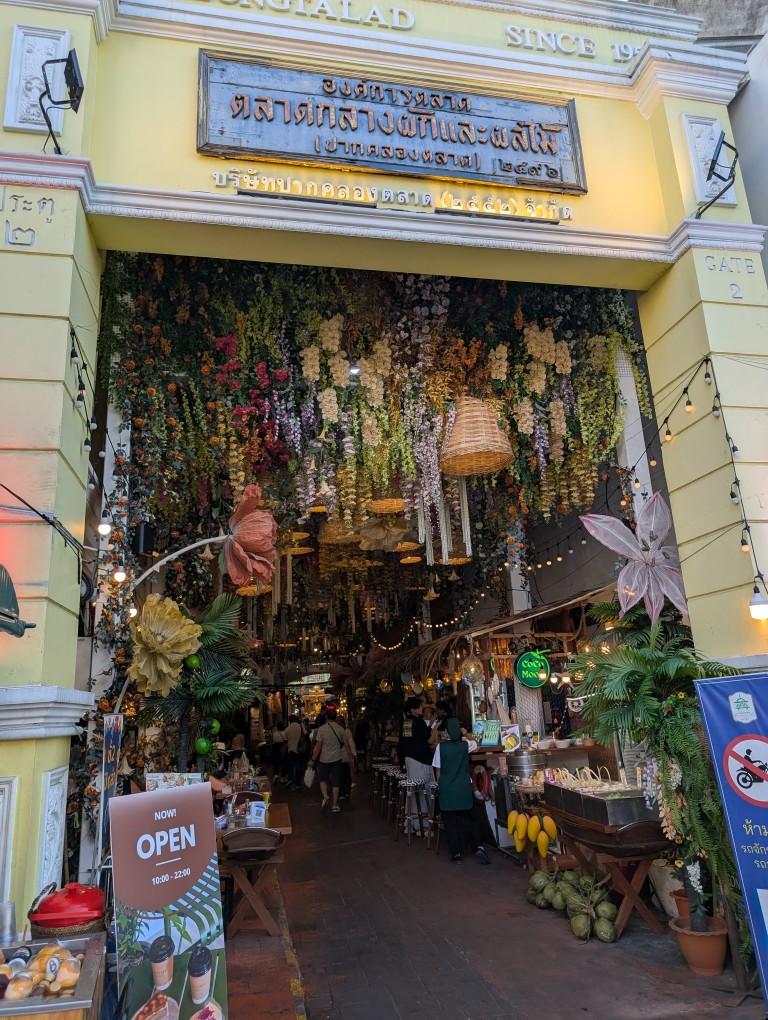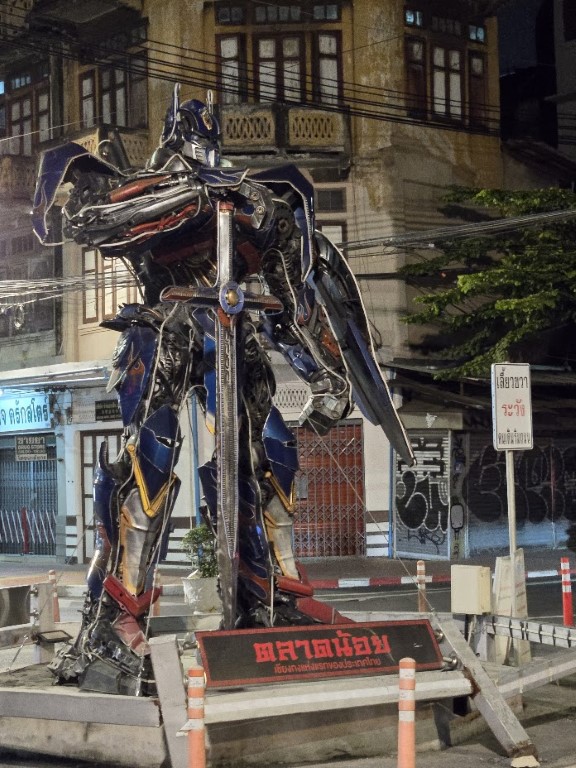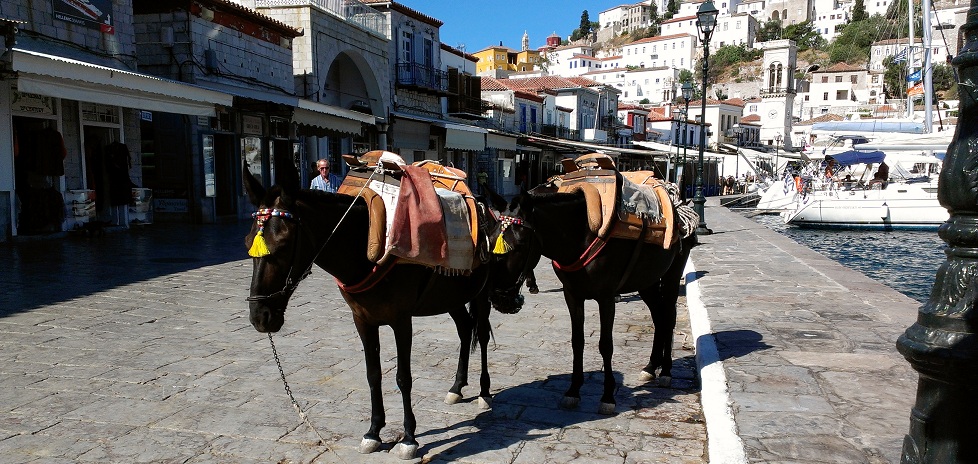
Thailand, Day 4: Koh Kret

In preparation for this trip, we watched a whole lot of videos.  In addition to the aforementioned Cal, we also watched videos from someone named “Bangkok Jack,” an Austrian-Thai dual citizen living in Chiang Mai, Mark Wiens, and whatever else we could filter out of the influencer drivel and AI slop.

One of our favorites, recommended to us by the folks at Chinese Cooking Demystified (great channel, check it out) is a channel called OTR Food and History, which is based in Bangkok, and does long-form videos about… well, guess.

One of the most intriguing videos from them that we watched was on Koh Kret, a small island about 30 km up the river from Bangkok. It was settled by Mon refugees from Myanmar and then cut off from the mainland for a long time, leading to a fascinating hybrid culture that has some dishes not readily available anywhere else in Thailand.

We planned to visit the island’s markets to try local street food, look at pottery shops, maybe walk a circuit of the island, and then in the evening we had reservations at a restaurant on the far side that is only reachable by boat, even from elsewhere on Koh Kret.

Spoiler: We only did some of that.

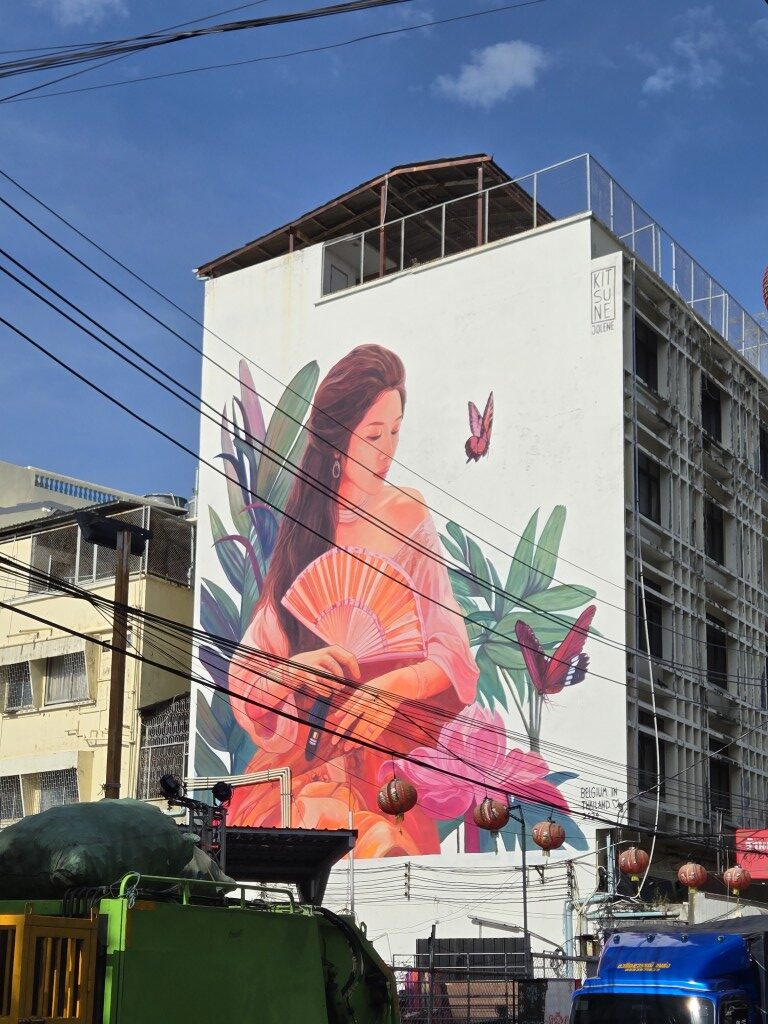
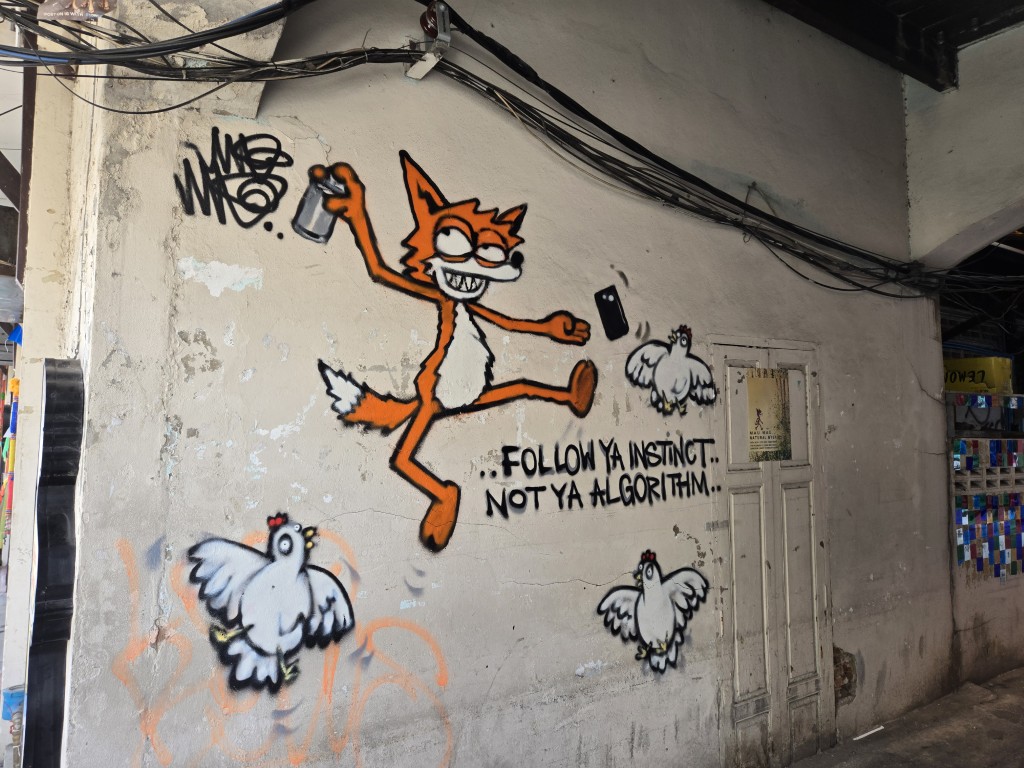
The route up there from our hotel in Chinatown is a bit convoluted.  First we walked down to the ferry, and snapped a few pictures of amazing street art on the way.


These were all on Song Wat Road, a funky little street by the river in Chinatown that we really liked.

From there, we boarded a ferry to take us as far up the river as we could go by boat.
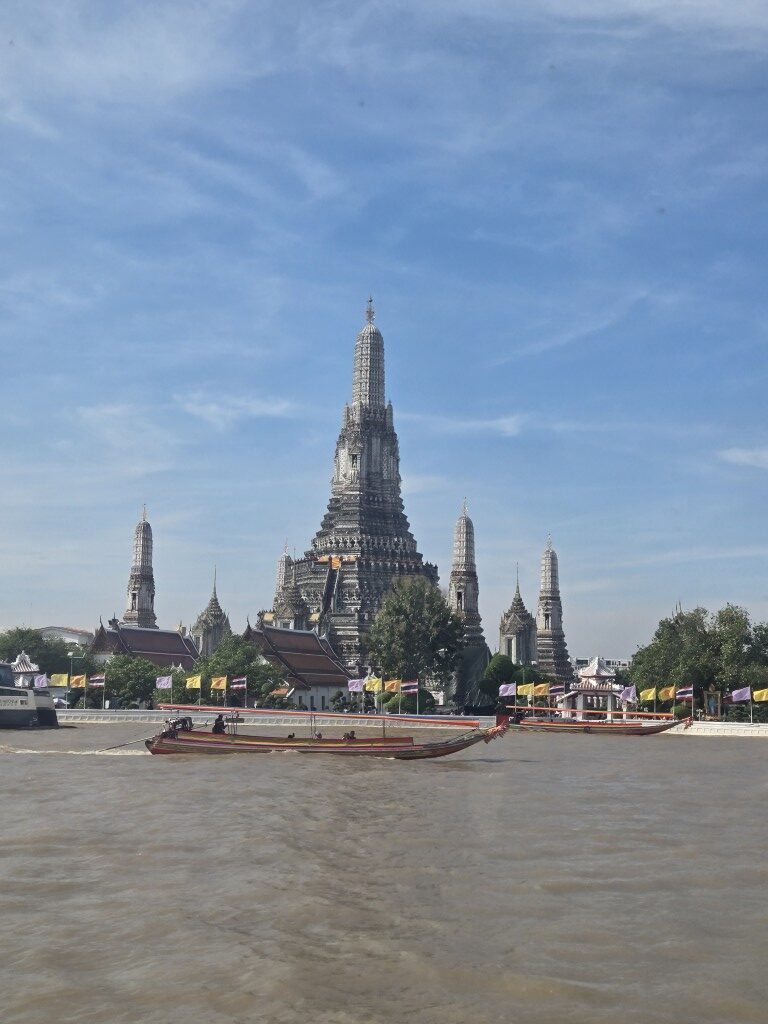

We noticed that the river seemed to be very high – the ferry was slowing down dramatically as it came up to bridges, and was very carefully passing under the very center of the arches, with inches to spare.  This turned out to be an unfortunate foreshadowing of what we would find on Koh Kret.

But first we had to GET to Koh Kret.  After forty minutes or so on the ferry, we reached the northern terminus of the line, which turned out to be right next to the prison where foreign detainees are usually kept.  The things you learn from geocache descriptions.

However, not wanting to change our accommodation plans, we opted instead to take a Grab (the Thai equivalent of Lyft) another ten minutes north to the point on the riverbank opposite Koh Kret, where you could catch a ferry to the island.
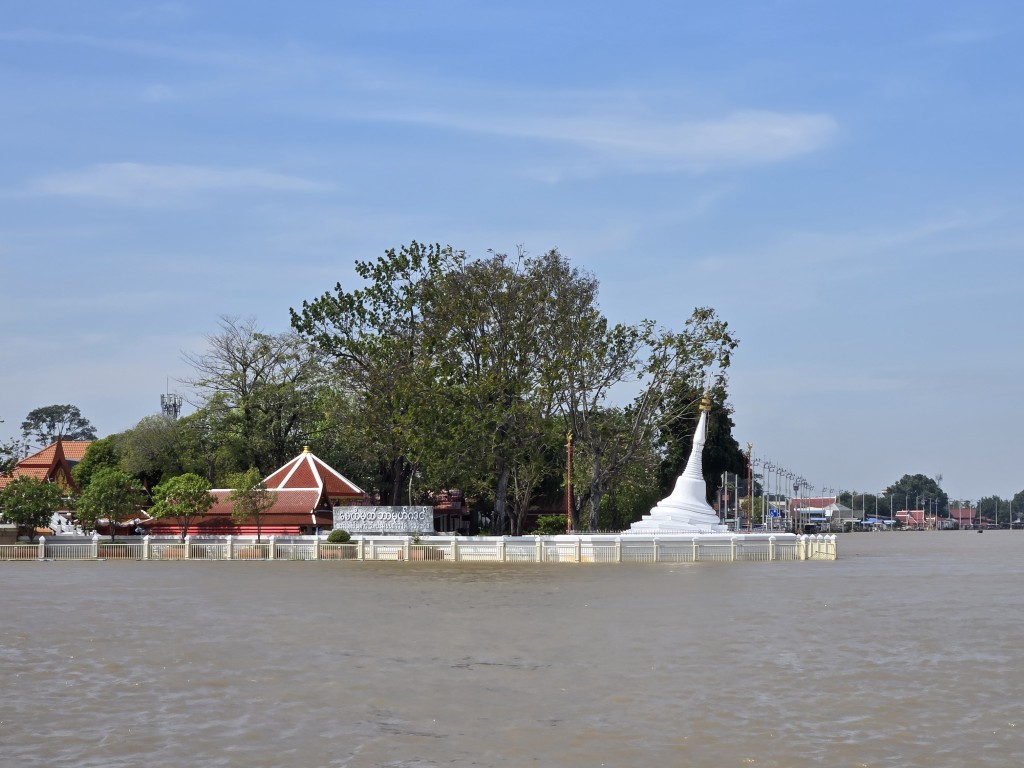
That small tower, or stupa, isn’t supposed to be leaning like that, but it’s been doing it since 1891, so that’s not particularly new.  However, notice the water level – that WAS new, and as it turns out, quite bad.

When we got across the river we found that major parts of the island were flooded.  We didn’t take many pictures, because that would feel exploitative, but the waterside markets which mark the route away from the dock in both directions were knee-deep.

We were able to wander about the temple grounds, which were just high enough to be OK.
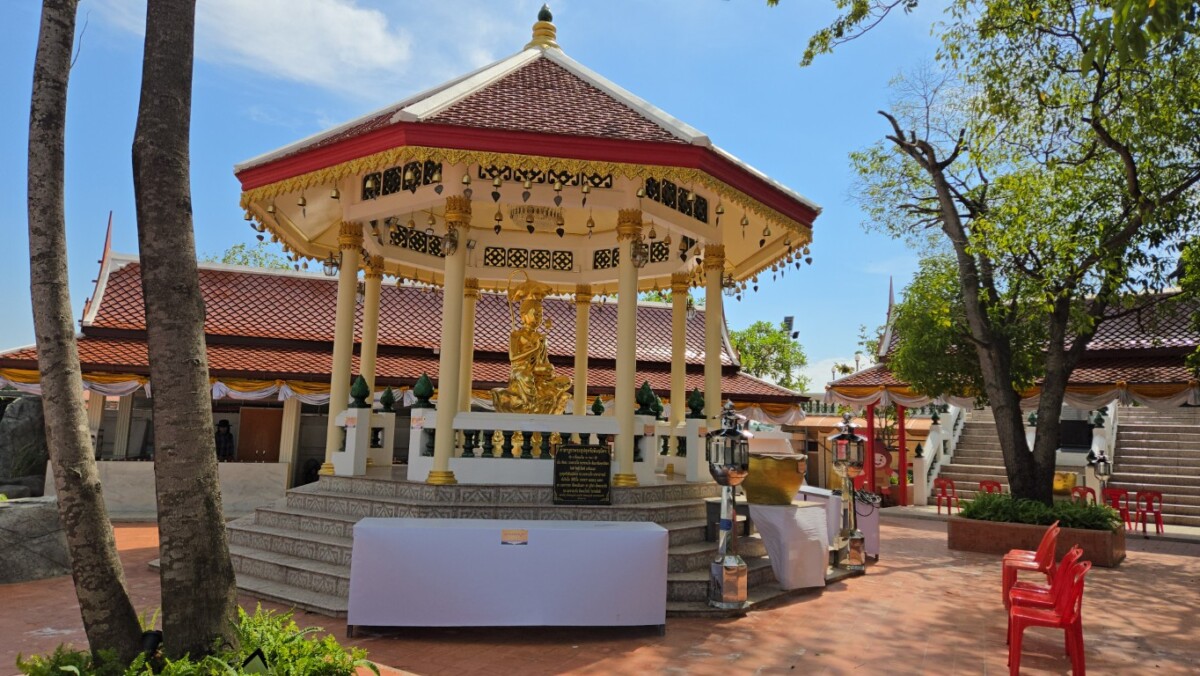
There was a dry elevated walking path into the interior of the island, but we only walked down it a little ways – clearly no one on the island was going to be happy to see us gawping at their unfortunate situation.

So instead we walked back to the ferry dock, where there were still a few enterprising vendors set up to sell food. (And weirdly, the coffee shop in the temple was still open.)
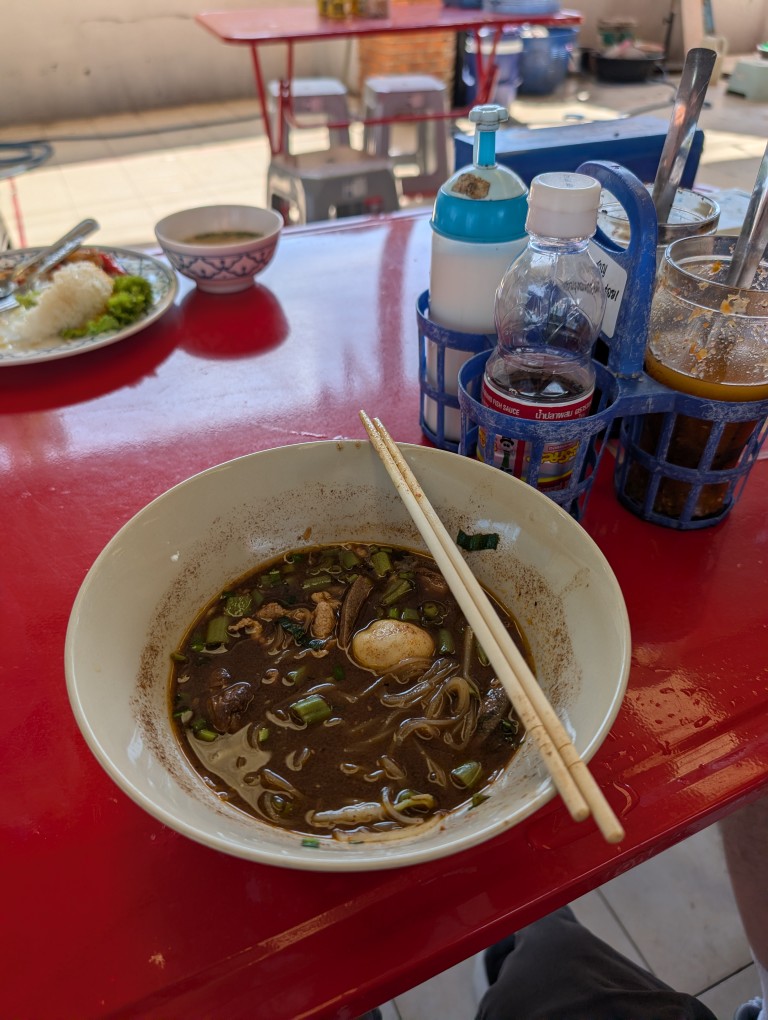

This was an absolutely delicious boat noodle, which we forgot to actually photograph before we had eaten most of it.  This will be a running theme going forward.

As mentioned, our dinner reservations were on Koh Kret as well.  The restaurant we had booked is ONLY accessible by boat, even from on the island, and we had a water taxi coming at five to take us around.  However, there didn’t seem to be much point in hanging out.  So we cancelled our taxi (we’d pick up the local ferry by the restaurant instead), returned to the mainland, and went looking for something to do.

The Thai board game store was interesting, but since they didn’t have any demo games to play, that didn’t kill much time.

Which is how we ended up at the cat cafe.
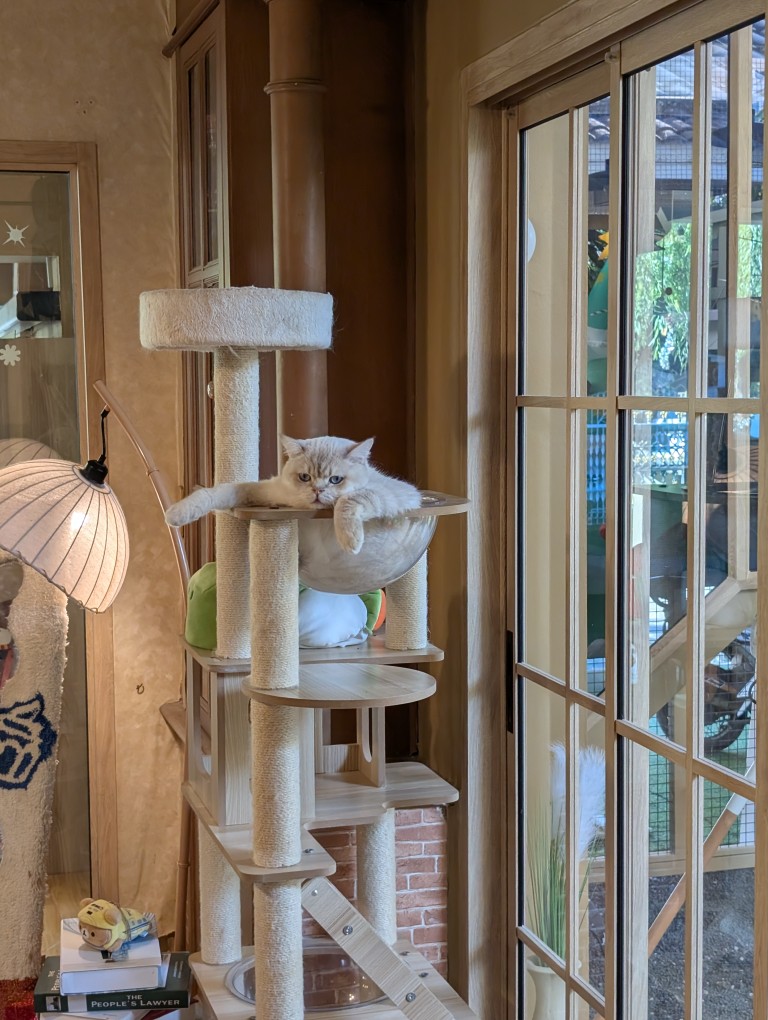
The board game store and the 30 degree weather gave us the idea that it might be nice to find a cafe with board games we COULD play and maybe just cool off for a while.  Google Maps came up with “KuppuGamu.” Pretty sure that’s not Thai.  Maybe it’s what Thai people think Japanese sounds like in English?

At any rate, the Grab took us down several different secondary roads to a gated housing community.  Then INSIDE the community, where the driver had to tell the guard where we were going.  Then down several more suburban streets to what gave every appearance of being just an actual house on a suburban cul de sac.

I can’t show you a street view shot, of course, because I guarantee that car has never made it back here.

Which meant the folks in this cafe were QUITE surprised by a pair of random Canadian tourists on their doorstep. This place is NOT generally on the tuktuk tours.

But they were super nice, and after we purchased some yuzu sodas to meet the cover charge, we had a lovely time hanging out with the cats and playing Marvel Splendor. (Which, surprisingly, does actually seem to be a slight improvement on the original.)
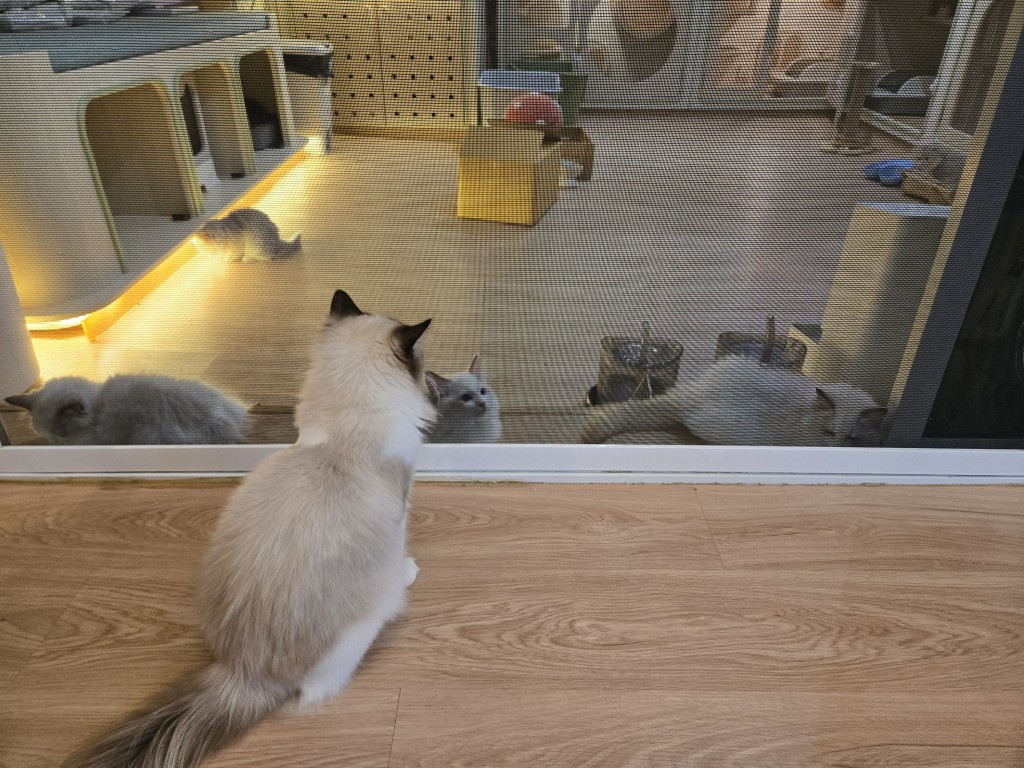
After an hour or so, it was time to call another Grab and catch our ferry over to Rorsor127, the fine dining restaurant featured in the OTR video at the start of the post.
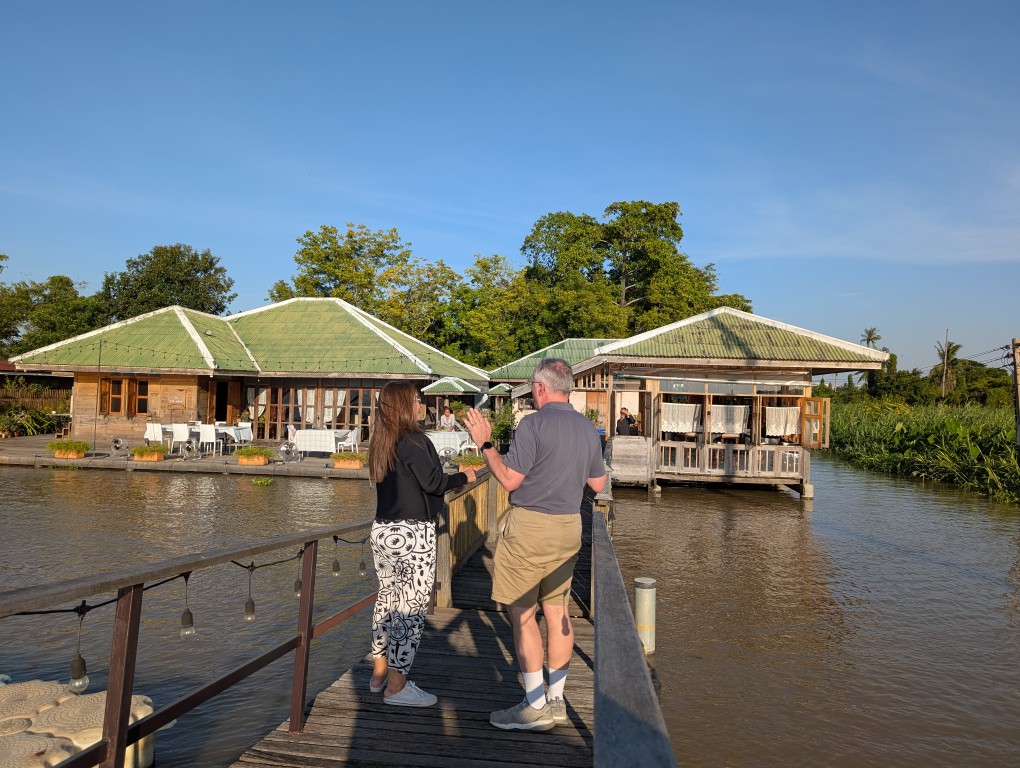
I have no idea what I’m doing in this picture.  I probably didn’t have any idea what I was doing at the time, either.

Rorsor127 is an amazing restaurant.  A former vacation home for a prince, it features Royal Thai cuisine, which is a quite distinct category from the street food we’d been stuffing ourselves with.  We had a prix fixe meal consisting of 4 appetizers, 5 shared mains, and a dessert.

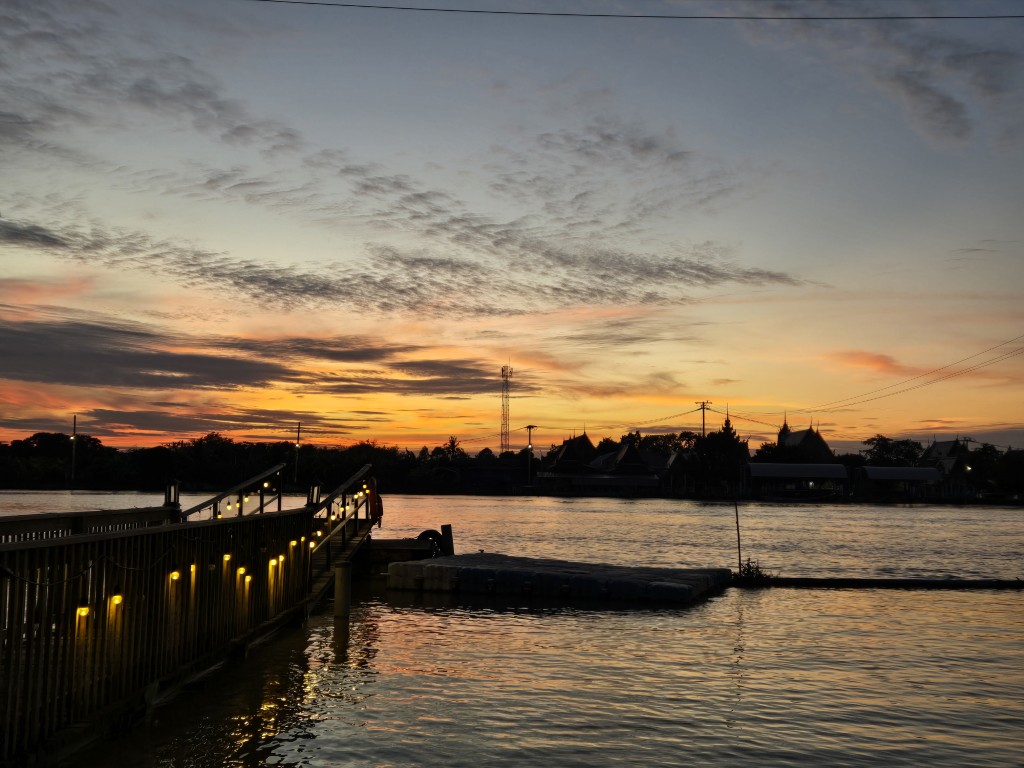
But not before enjoying drinks and a sunset.
And now on to the food. First up, an amuse-bouche.  Sadly, we don’t actually remember what it was, but it was definitely delicious.  We’ll just take as read that everything was amazing from this point.
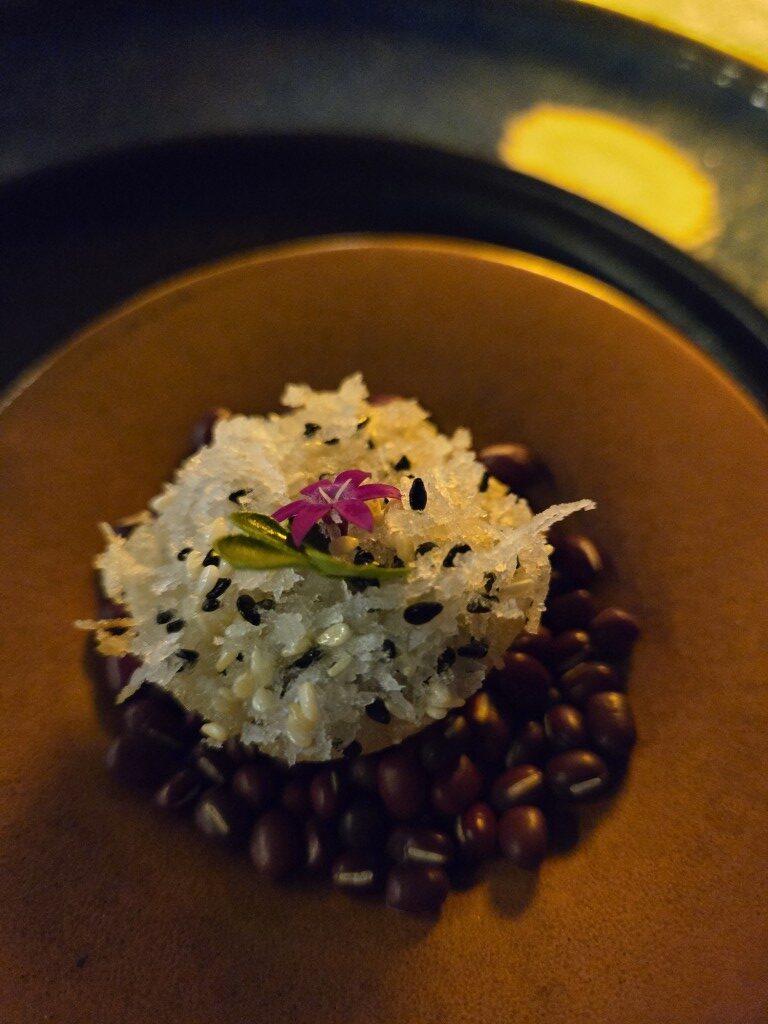

Eggplant Thai salad on crispy rice sheet with fried red ant eggs:

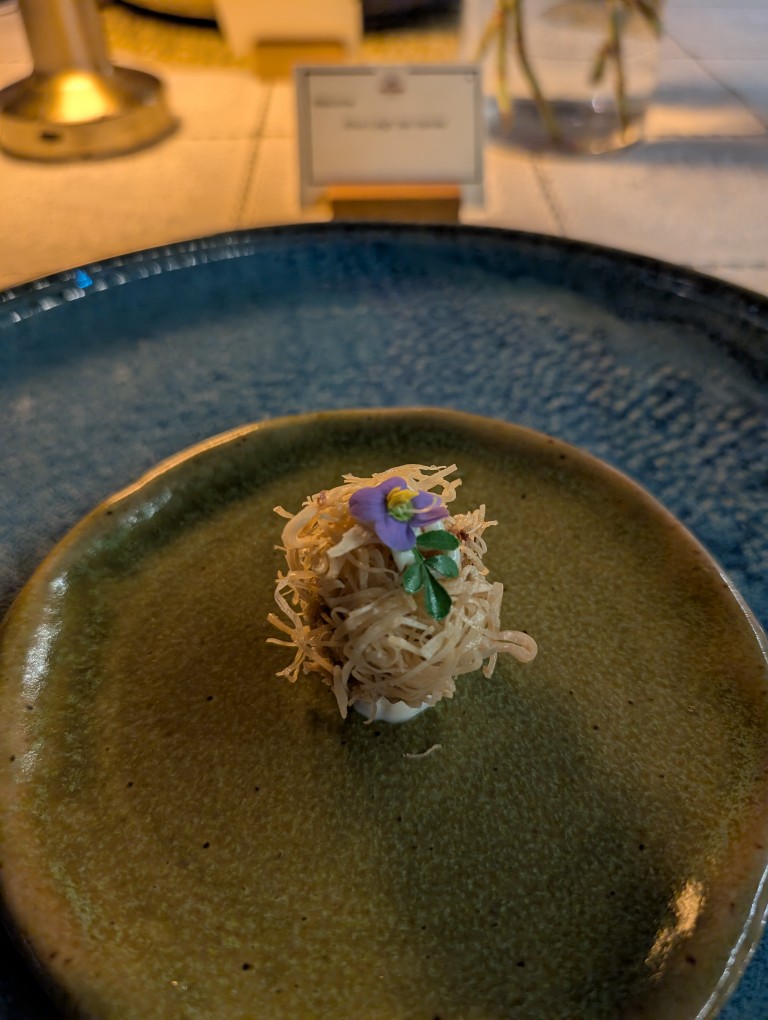
Western-style fried truffle and crab meat croquette.  This one came under a bell jar full of smoke, which was neat.
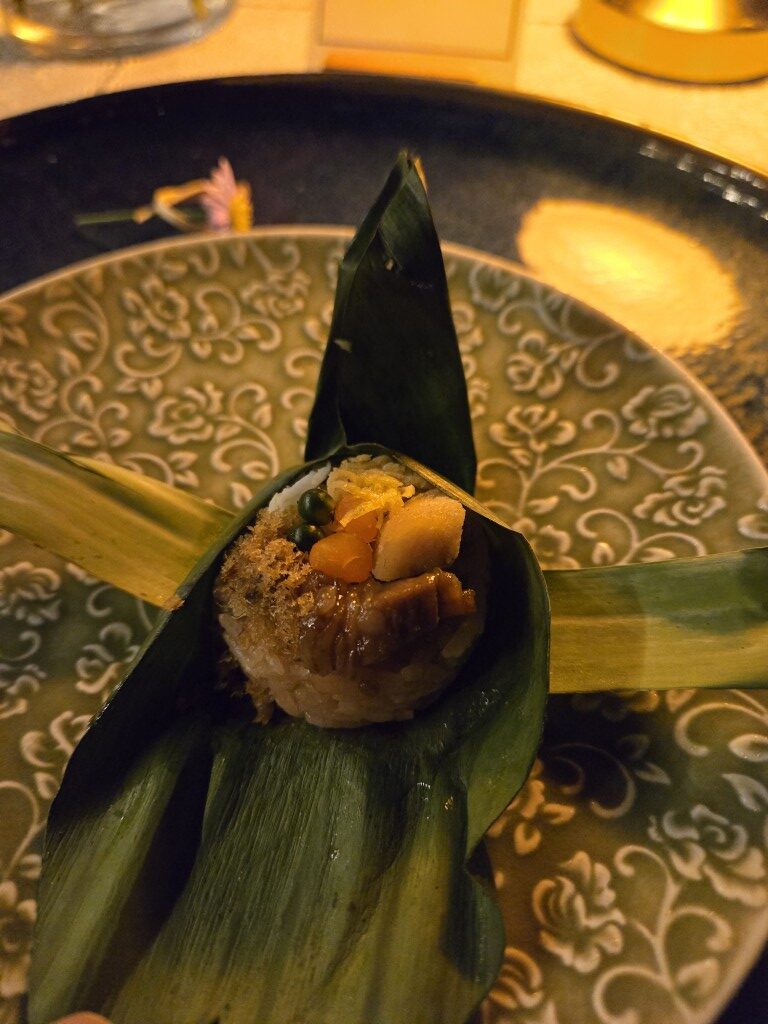
Steamed rice mixed with chili paste served with Thai garnishes:
Thai rice noodles with sweet and sour curry.  (Mom’s secret recipe!) (The chef’s mom, not MY mom.)
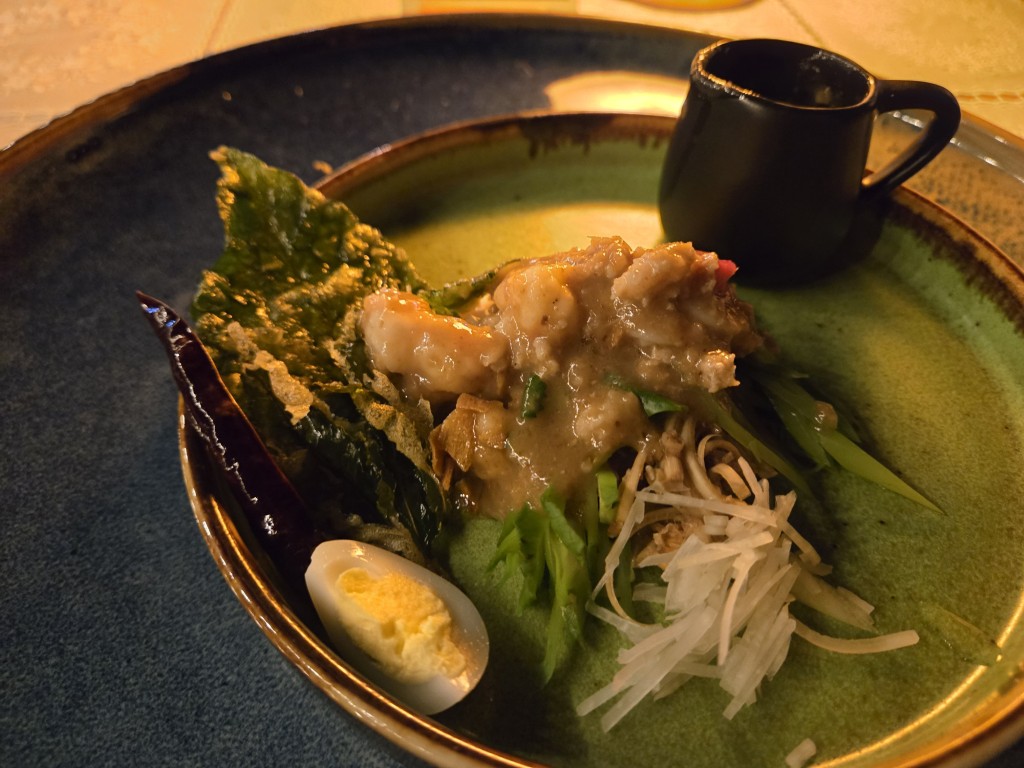
And for the shared dishes – tamarind chili pork paste served with Thai omlet, ku-lao fish, and vegetables, garden cassia curry with pork, gang run juan spicy shrimp paste soup (beef for Leigh, pork for me), stir fried green curry paste with Chai Nat featherback fish balls, stuffed with Chaiya salted egg yolks, and stir-fried shrimp with seasonal vegetables topped with crispy pork cracklings and fried garlic.

Envy us.  This meal was un-fing-believable.

Oh, and candle-smoked coconut milk over Thai jelly for dessert.
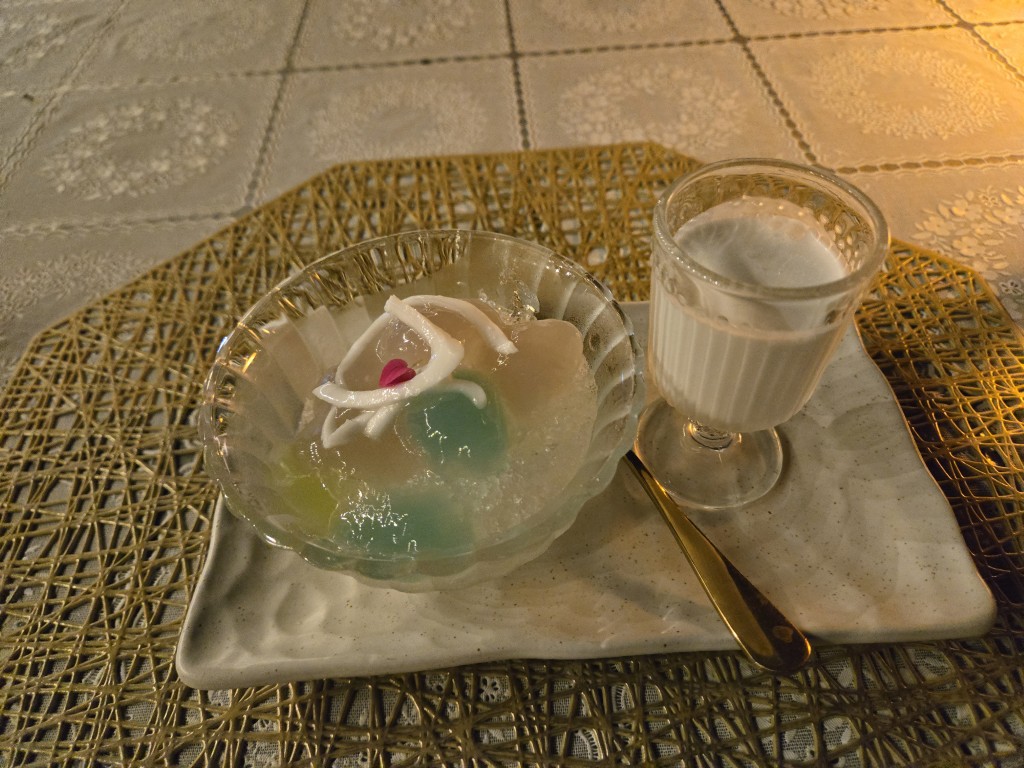
Throughout this absolutely stunning meal (which, to be clear, was being served to a total of ten guests, that being close to max capacity for this restaurant) we were chatted with by both the owners and the chef, who kept coming out to tell us about the food and generally make us feel welcomed.

This is an experience we will definitely keep with us for a long time.

And from there, boat to Grab back to the hotel, and time to pack up to move on to our next stop in Thailand!
Thailand, Day 3: Bangkok – Food Tour!

OK, right up front, if you are planning a trip to Bangkok, do not pass Go, do not collect 200 Baht, do not EVER play Monopoly (it’s a TERRIBLE game, seriously. In this dissertation, I shall…). Just immediately go to Chili Paste tours and book their “Old Bangkok Food and Culture Walk.”

I would say just trust me, but we can do better than that.  Buckle up. But not literally, because tuktuks don’t have seatbelts.

Chin, our guide, picked us up from our hotel promptly at 9 AM. We had a tuktuk driver with us for the entire day, who would go off and park when we set out on foot, and then rejoin us when it was time to shuttle to another part of the city.  For the record, Bangkok traffic is terrifying, especially in a tiny vehicle with no doors or windows. But also kinda thrilling.

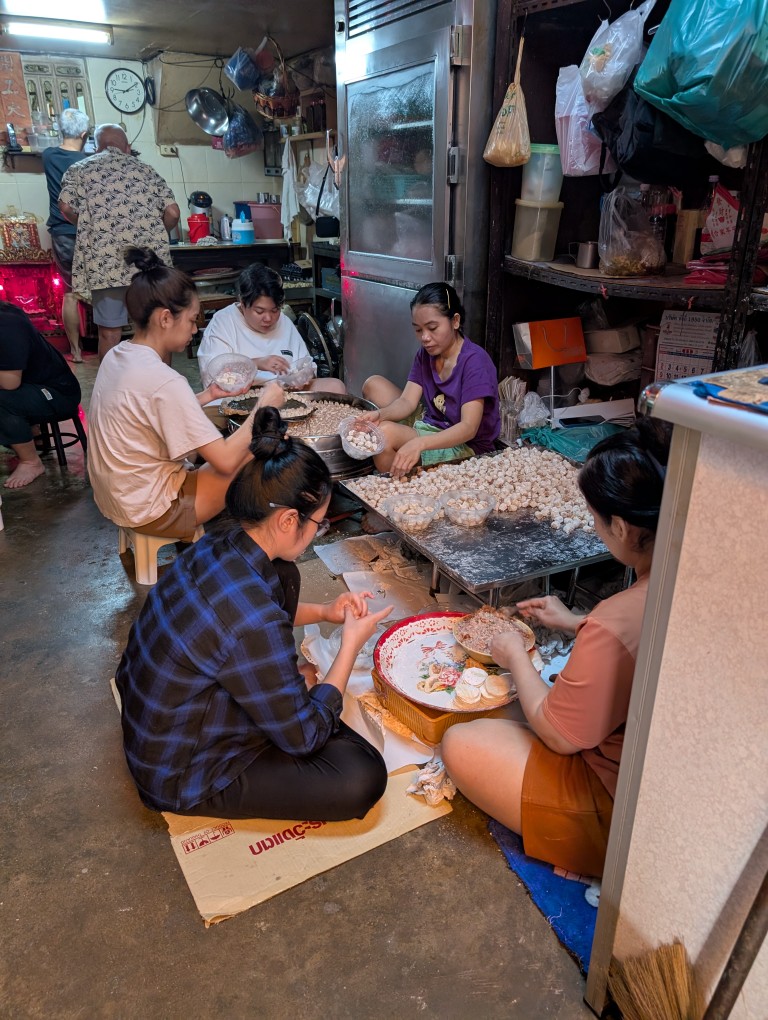
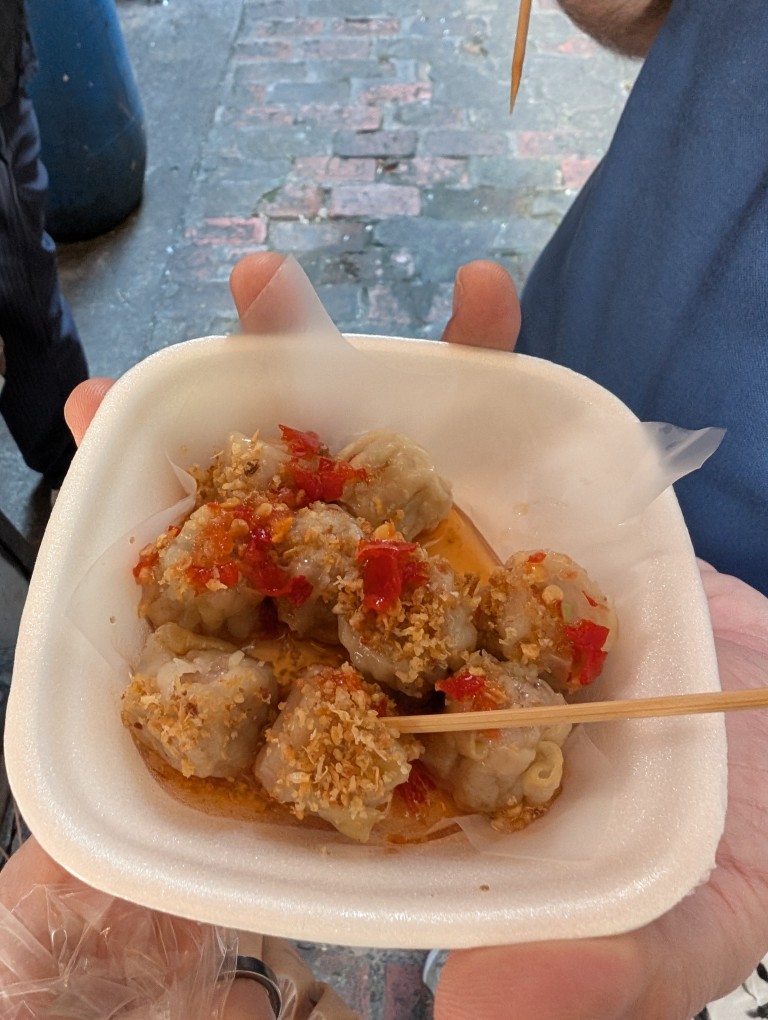
We started the day by walking down a narrow alley to get to a different, narrower alley to discover a home with a small cart outside the door and about six people gathered around inside making dim sum. Or rather just one kind of dim sum – pork shu mai.  Apparently, they make thousands of these things every day, and then granddad goes out and sells them until they are gone.  Which doesn’t take long, because they are amazing.

This was off to a hell of a start.  What next? Coffee?  Sure, I love coffee.  Leigh, on the other hand, opted for an iced tea, which turned out to be a Thai iced tea that came in a bag.

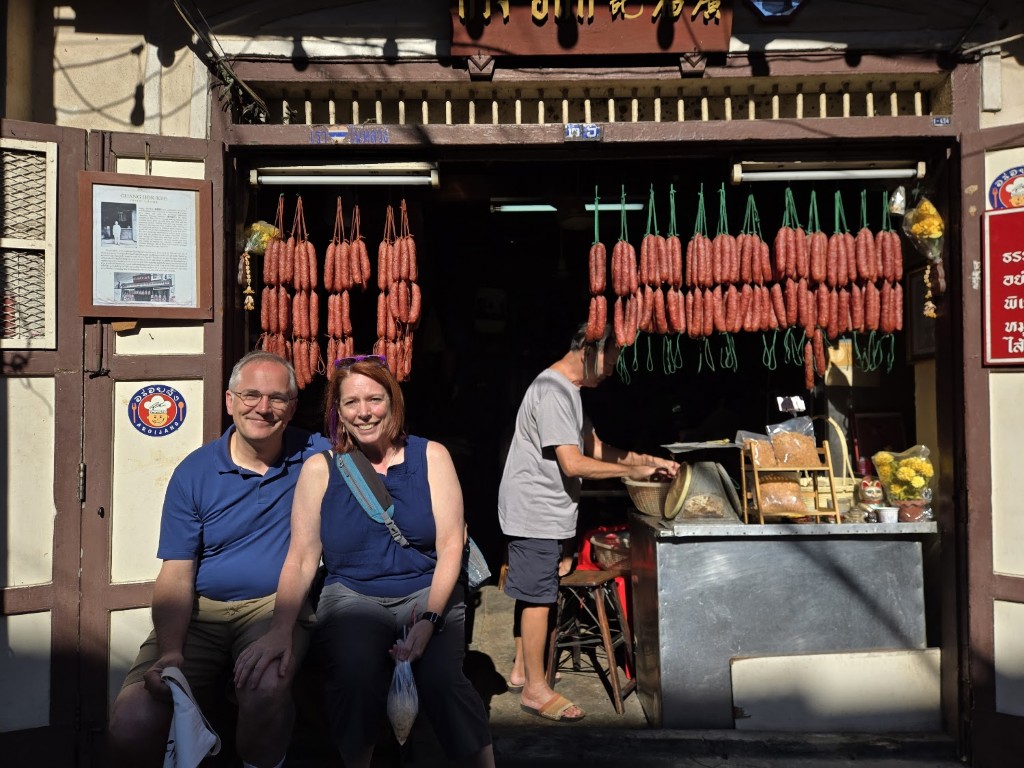
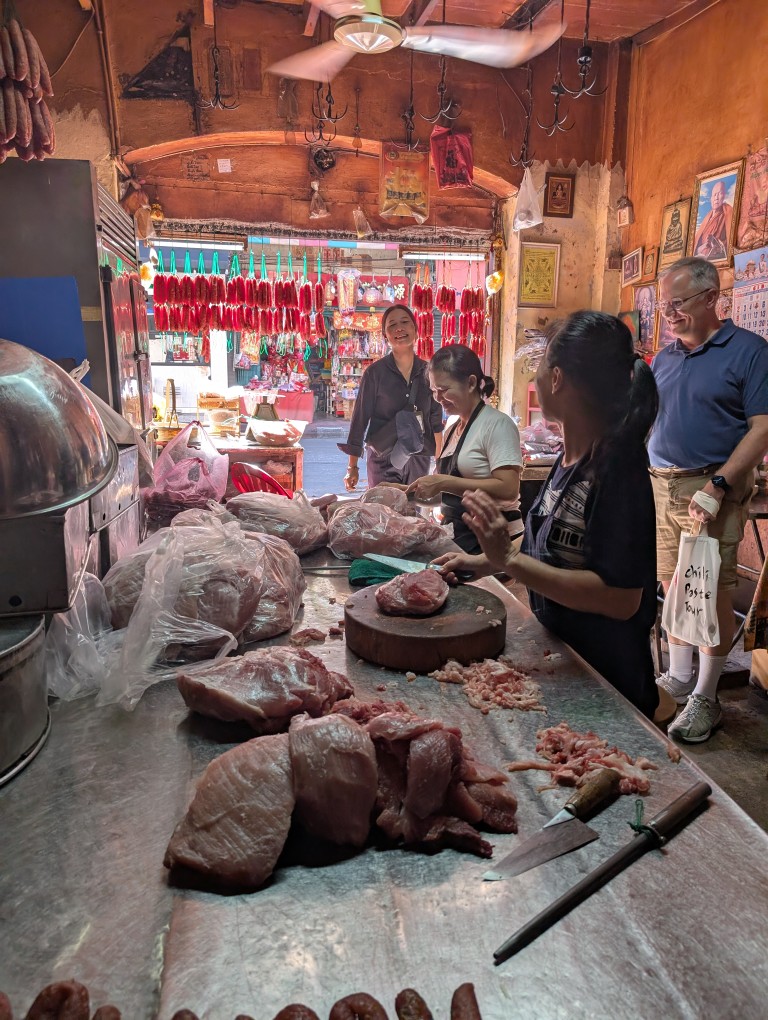
How about visiting a shop where they make Chinese sausage?


We got to taste the sausage, as well as go inside and watch some of the sausage being made, too.  I don’t know what everyone complains about – it was fine.

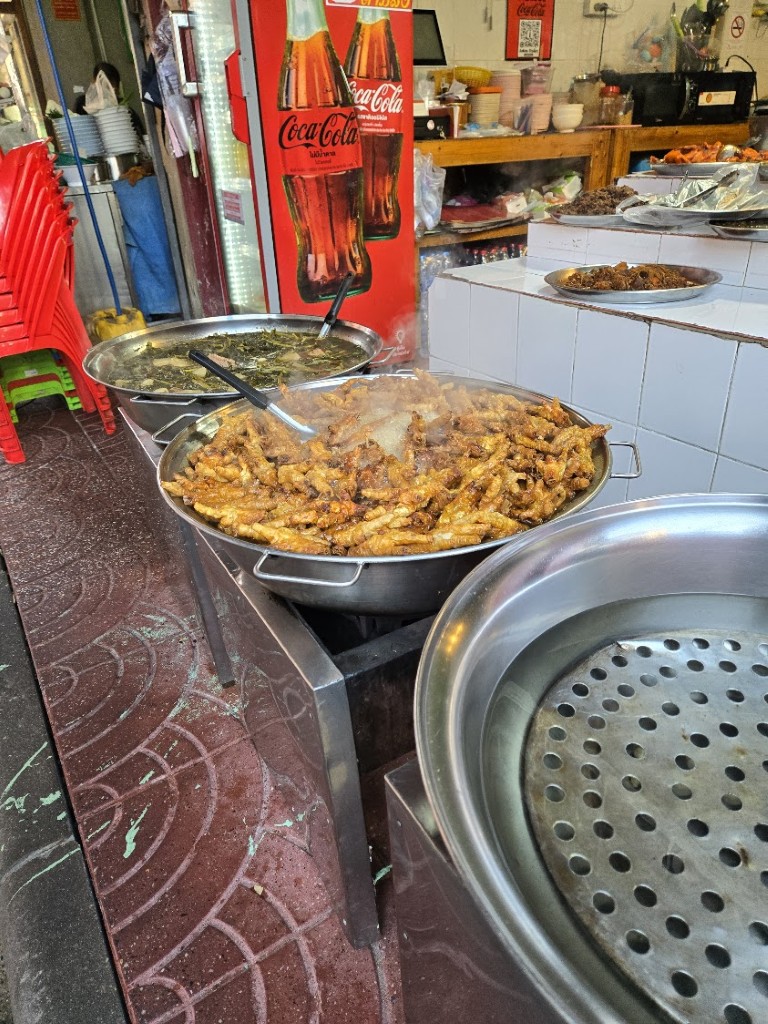
Oh look – a big vat of chicken feet!

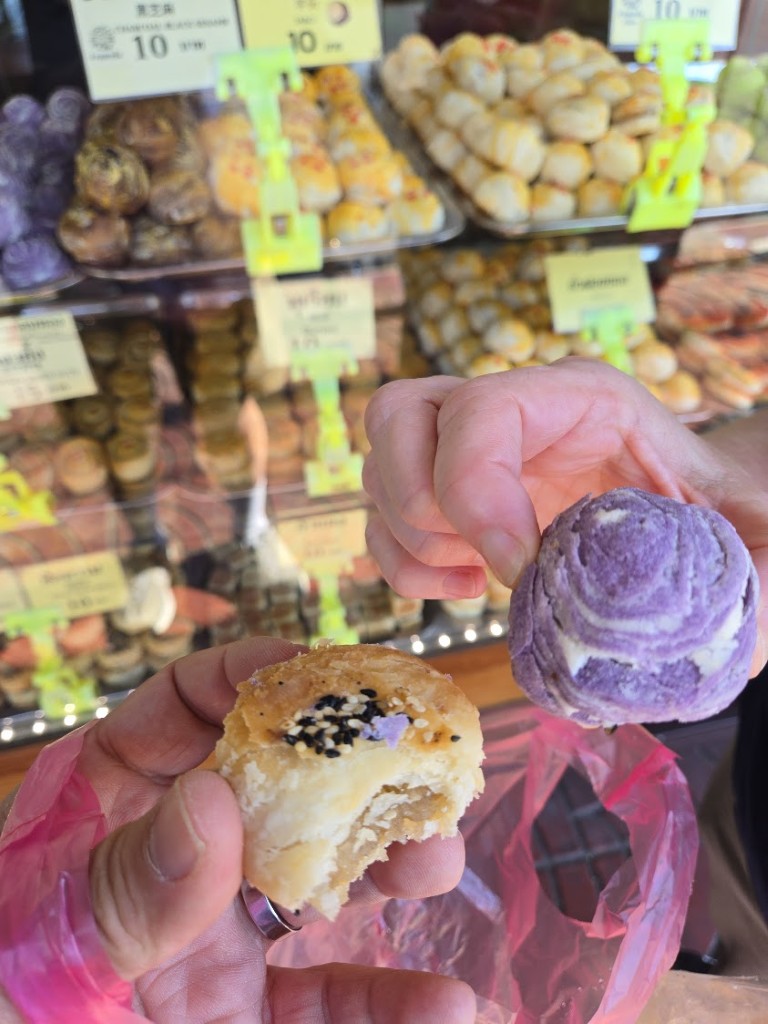
Time for some flaky pastries?  Sure!

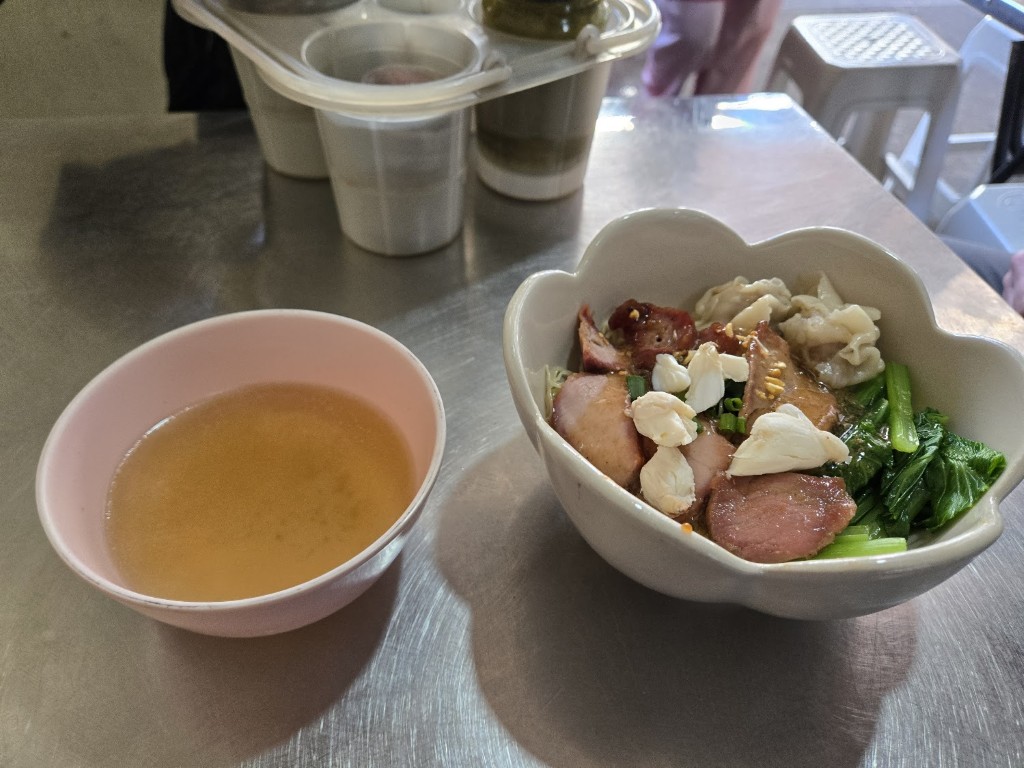
Or perhaps some noodle wonton soup, with sausage and crabmeat!

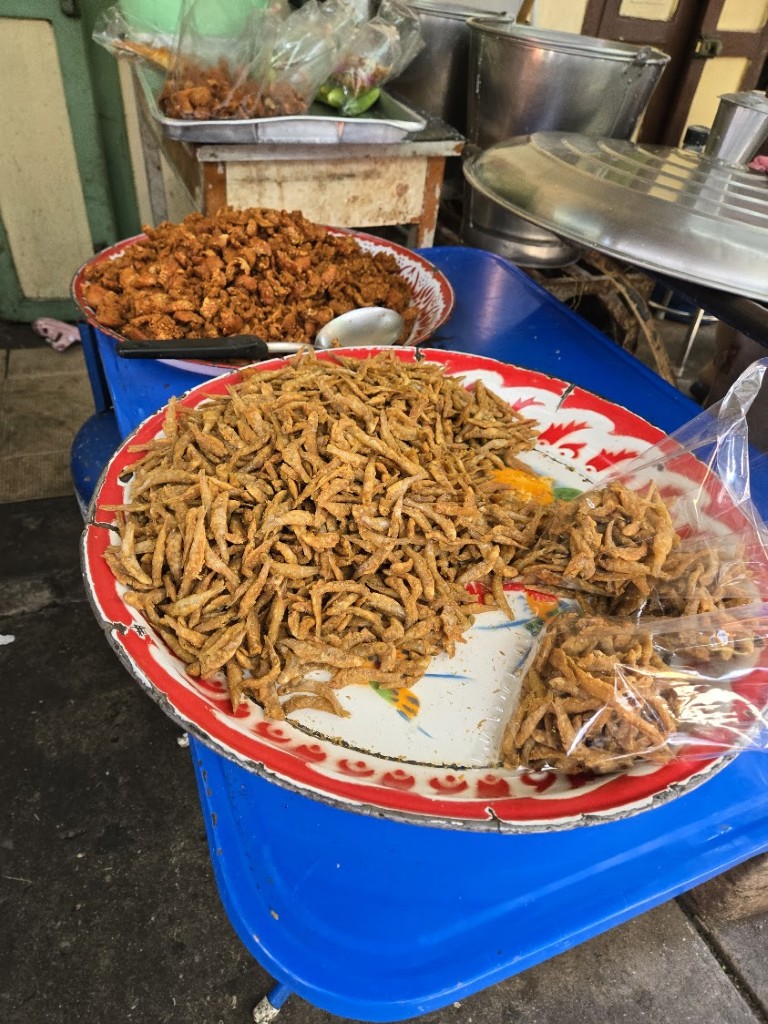
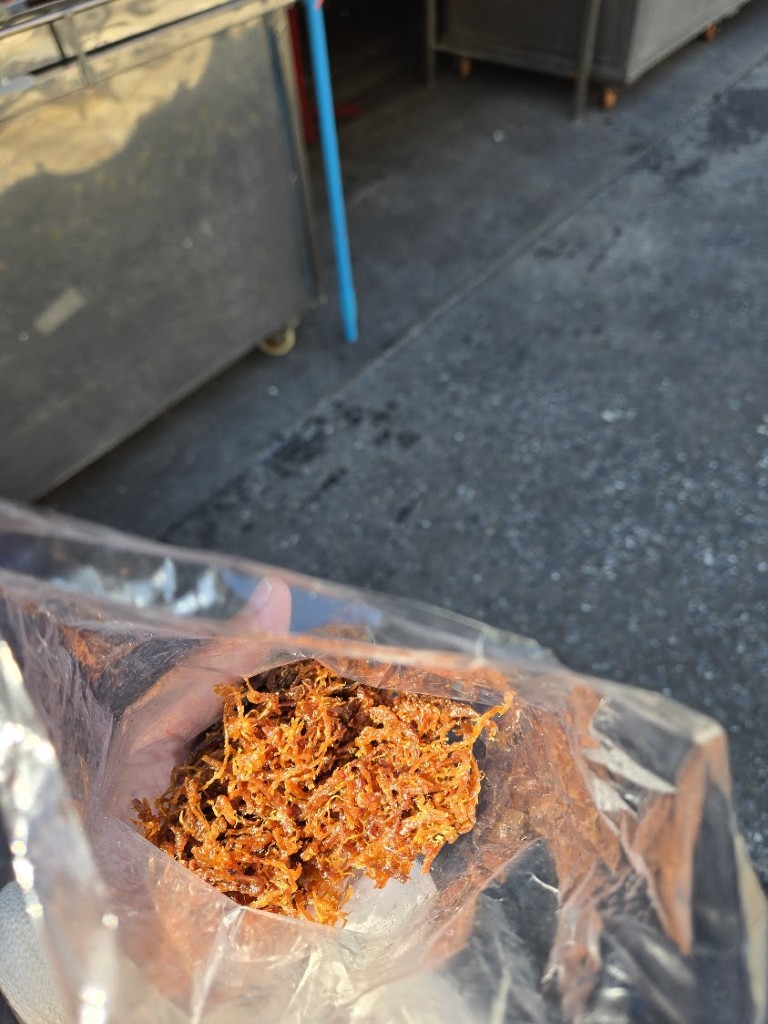
Oh look – deep fried sprats and chicken skin – here, take a bag of each!

If this post seems a little short on words and description it’s because I’m trying to convey the sheer overwhelming PACE of this tour.  At this point, we were still entirely on foot from our starting point.

It was becoming clear that while Chin definitely had some fixed stops she did every tour, there was also a GREAT deal of improvisation going on.  (“ADHD” would possibly not also be an inapt description, but in the best and most delicious possible way.)  We’d be walking down the street, or through a market, and she’d stop and go “Oh hey!  Look at this – this is delicious, you should try it!” And suddenly, we were.

We’ve been on food tours before (for example, in Prague) where there were a number of carefully curated stops, and each shop had been alerted to expect us and had a specific sample platter ready to go. And don’t get me wrong – those are great!  But this was NOT that.  While many of the merchants knew Chin, not all of them appeared to, and there’s no way the random careening from food to food was an entirely preplanned itinerary.

It was amazing. It also meant that as the day went on, we slowly accumulated a bag full of snacks we had no hope of eating in our one remaining day in Bangkok with access to a refrigerator.

Also – just to be clear.  All of the pictures (and eating) so far took place in under an hour.

At this point, we boarded the tuktuk and made our way to a heavily Vietnamese area north of the palace where it was time for lunch.  Well, I mean, we had to have a snack first to get ready.

Sweetened beef floss.  Delicious.  Everything was delicious.  But now it was time for lunch.

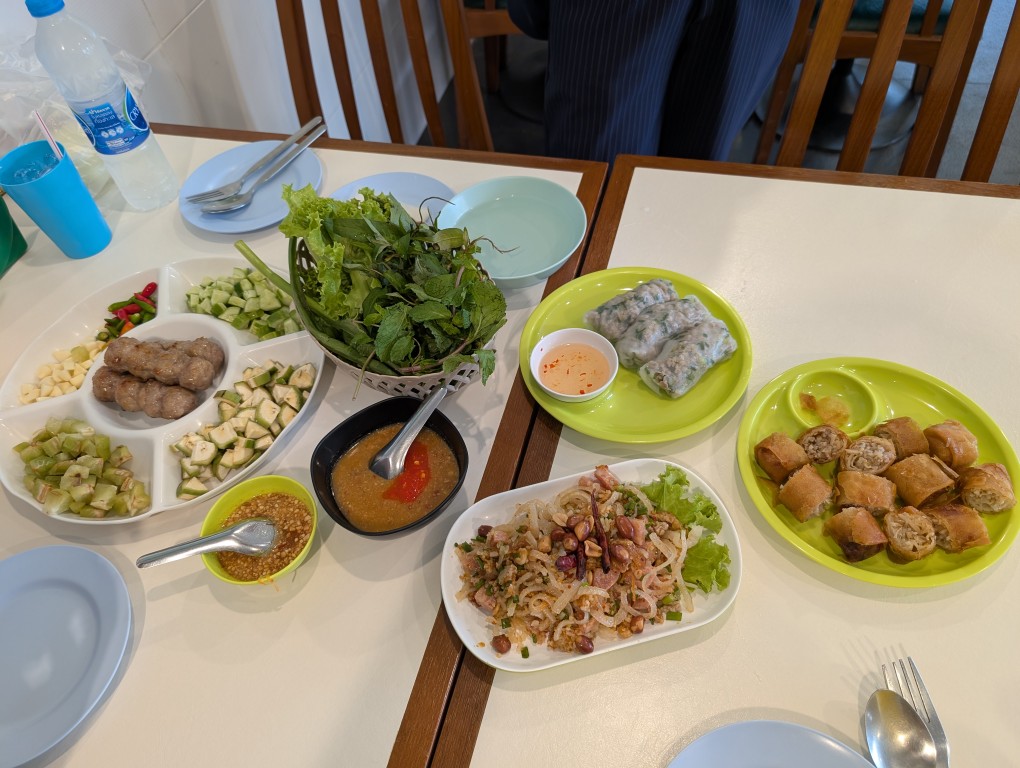
Which turned out to be a whole-ass Vietnamese FEAST.


At this point we could have been done with the tour, and it would already have been an amazing day.  But this is a day-long tour.  We were only half finished.  However, perhaps bowing to biological necessity, Chin took us to a nearby monastery complex for a bit of the “culture” part of the food and culture tour.


Interestingly, the murals in this particular temple were done in a much more Western style than was typical at many of the places we visited.  We also wandered through the lovely peaceful grounds of the adjacent residential complex, the relaxing calm broken only by the shrieks from the school playground across the street and the constant roar of construction equipment and motorcycle engines.

Leigh had asked if Chin knew of anyone making or selling silver jewelry, so at this point we made a stop at a charming little shop where she bought a few pairs of earrings. (Note from Leigh: I was not intending for this to become part of the food tour — I just thought she might provide a recommendation that we could follow up on later! At this point, though, we were happy to have the break from eating.)

But enough of this calm.  Back to the food!
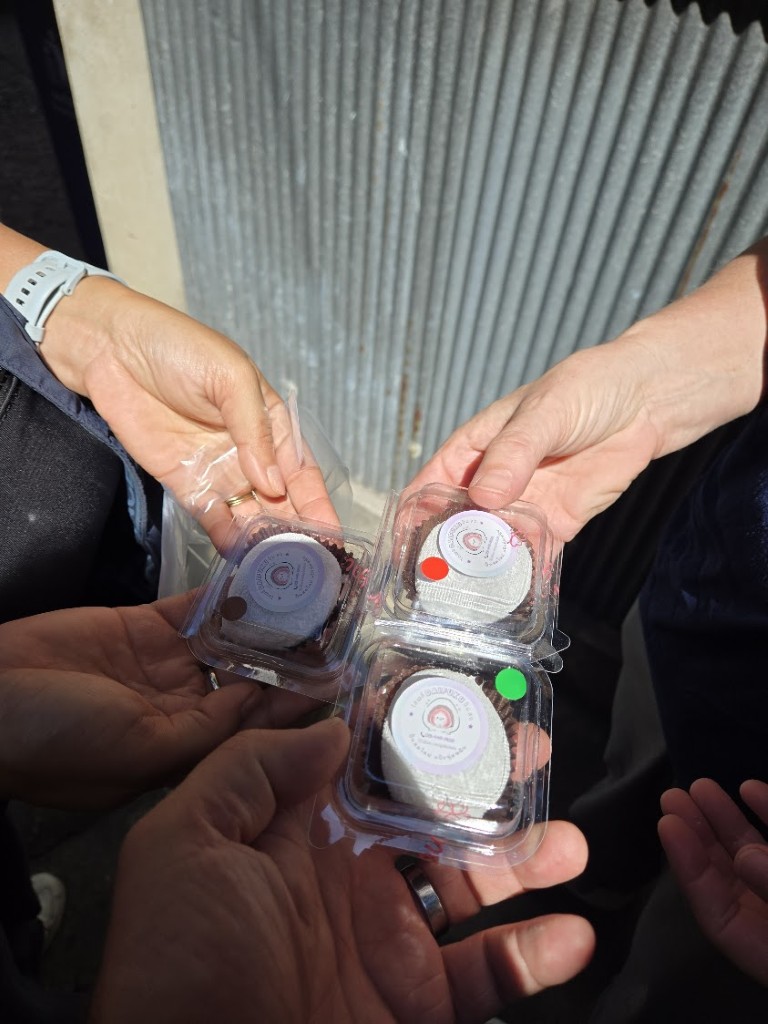
How about some daifuku?

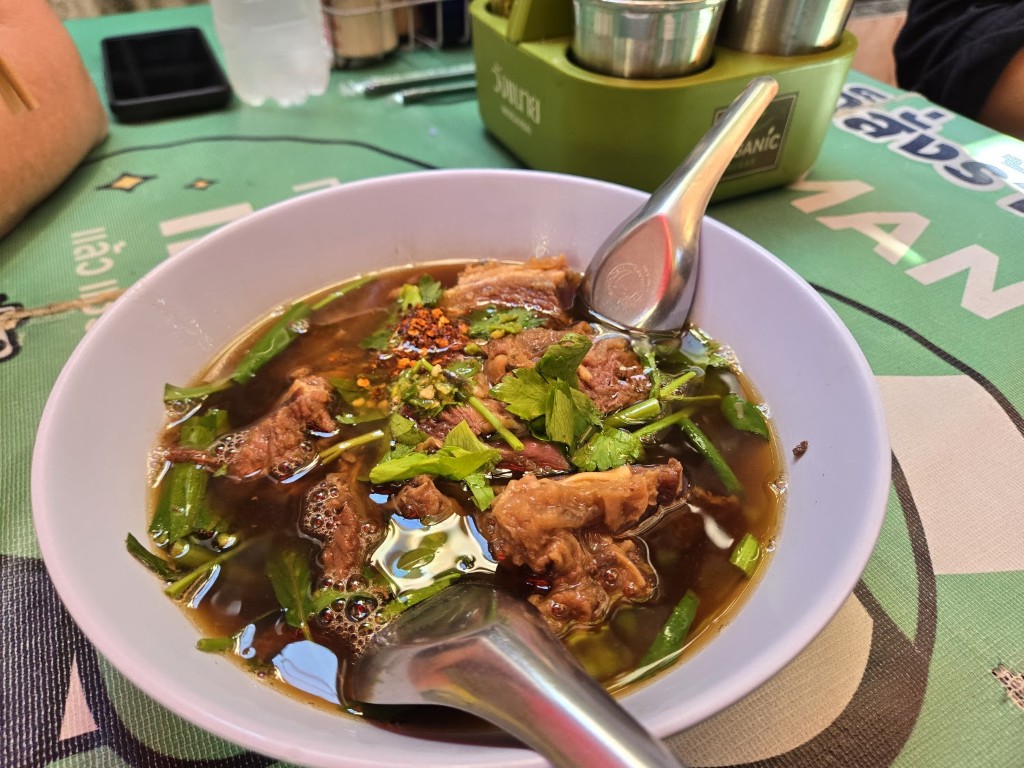
A nice bowl of offal soup?


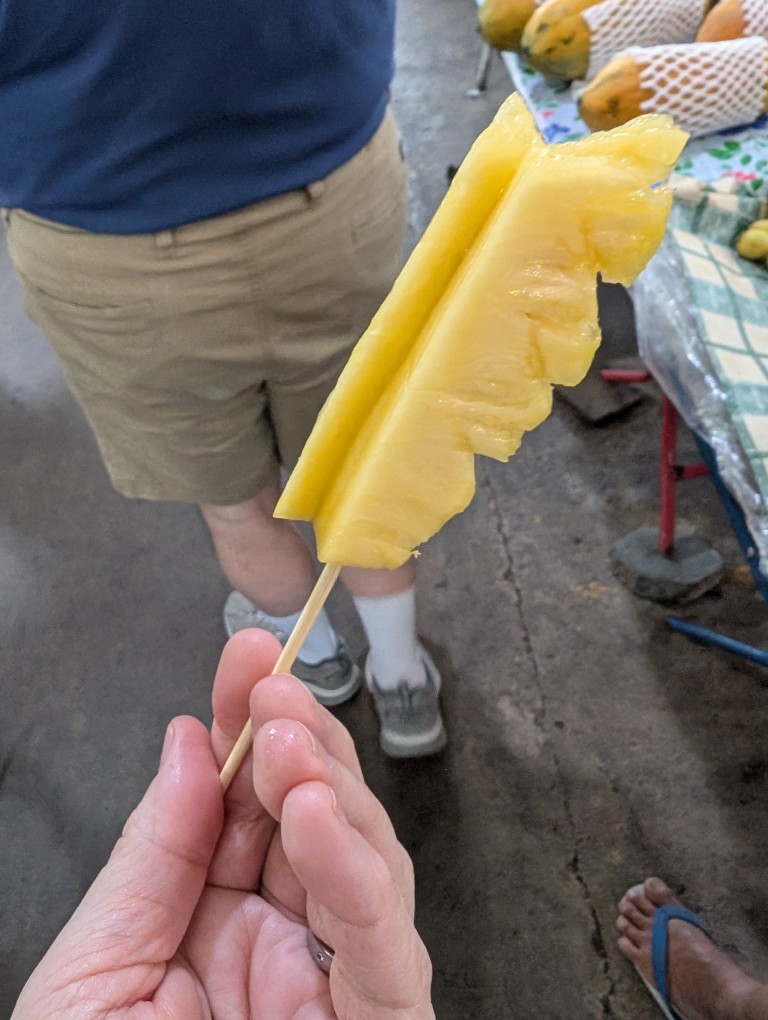
How about some pineapple on a stick? (And by “some”, I mean “what appeared to be an entire damn pineapple chopped up and thrust into our hands.)


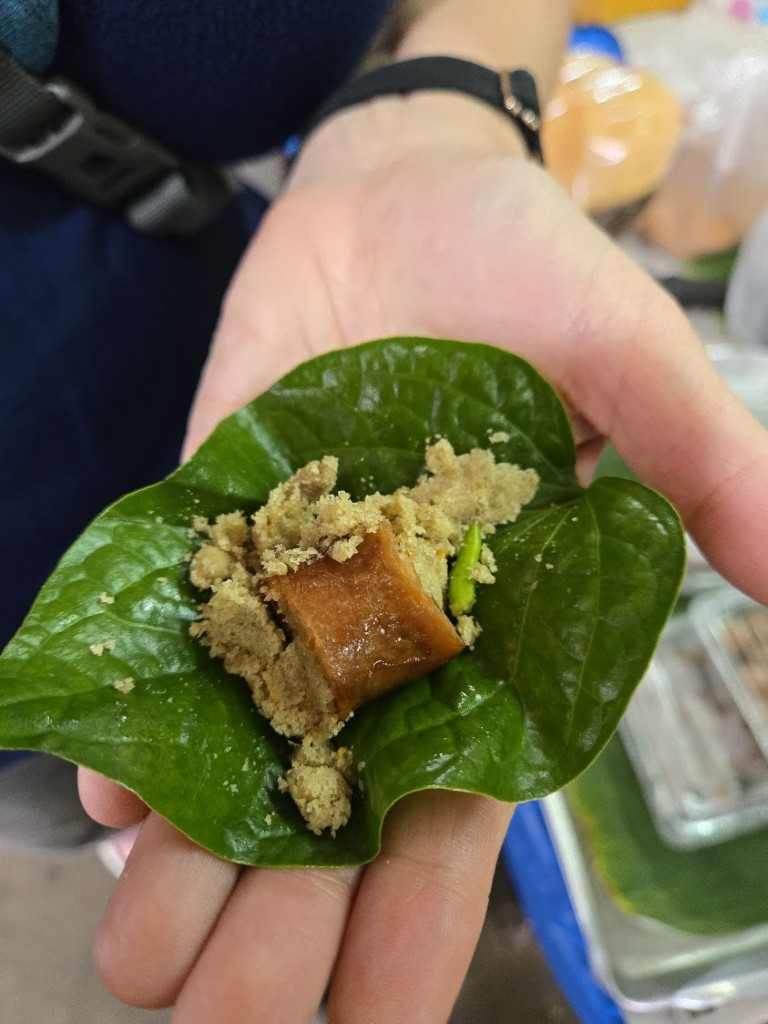
Some sort of sausage wrapped in a leaf with palm sugar? Why not?

At this point we were wandering around a market area, and we took a quick break to visit the Buddhist shrine inside the market. (After being handed a coconut cake for later, of course.)


We didn’t get any great pictures of the shrine itself, but this is the hallway underneath.

Stop!
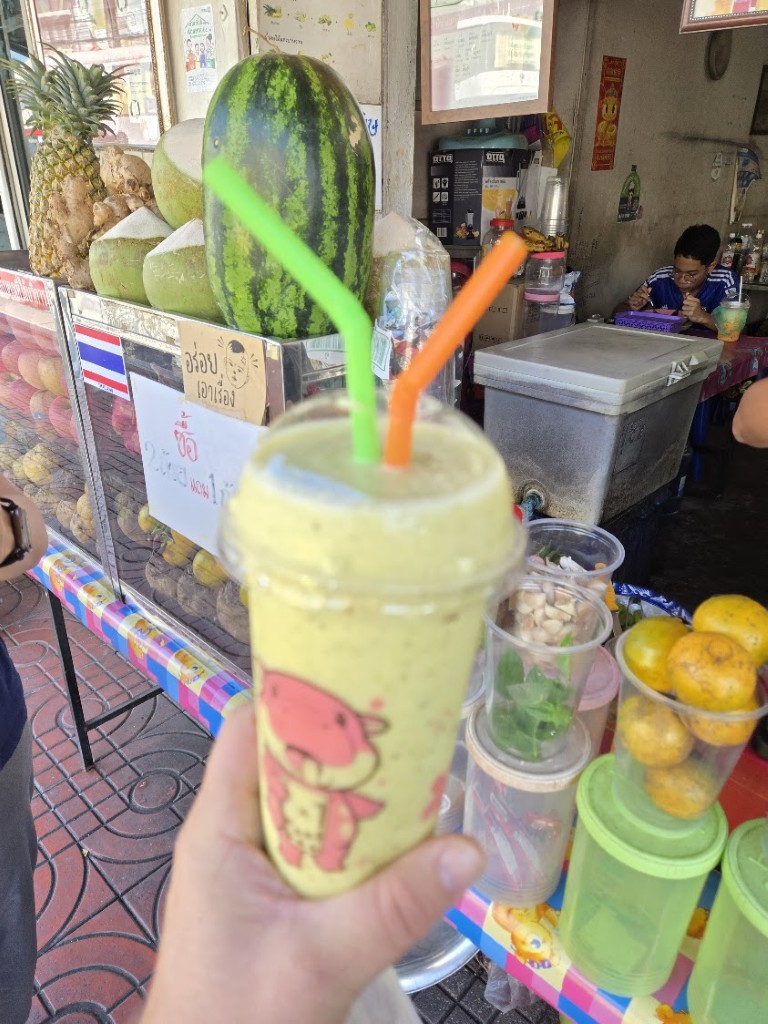
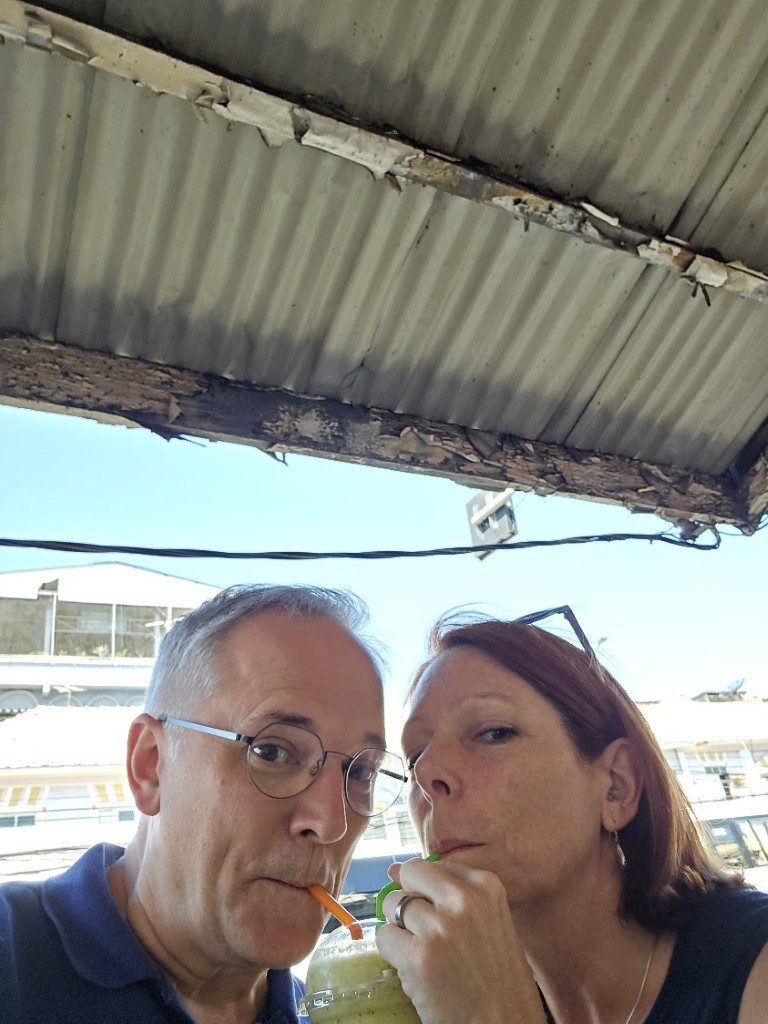
Smoothie time!

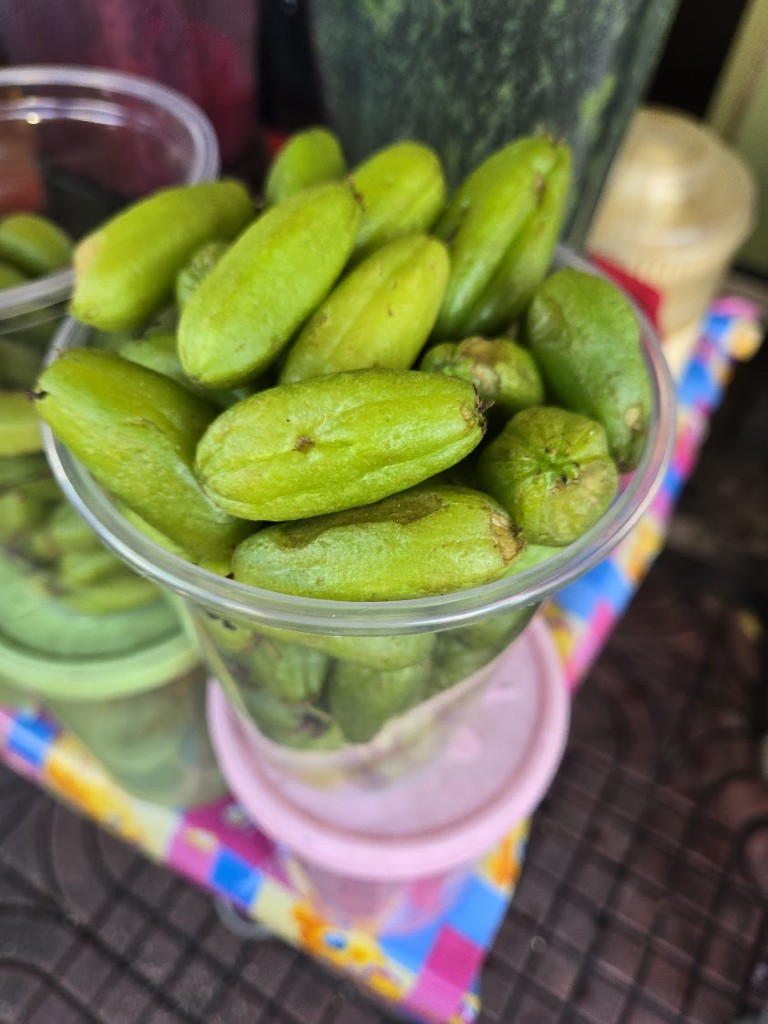
We were first handed a tiny green fruit to try.

This is a bilimibi fruit.  It can be eaten out of hand, and is sour and delicious by itself.  But, and hear me out, what if you blended it with fingerroot (sort of like ginger but different), passion fruit, pineapple, and roselle?

You get literally the best smoothie I have ever had in my life, that’s what.

Holy crap.  I will have DREAMS about this smoothie.

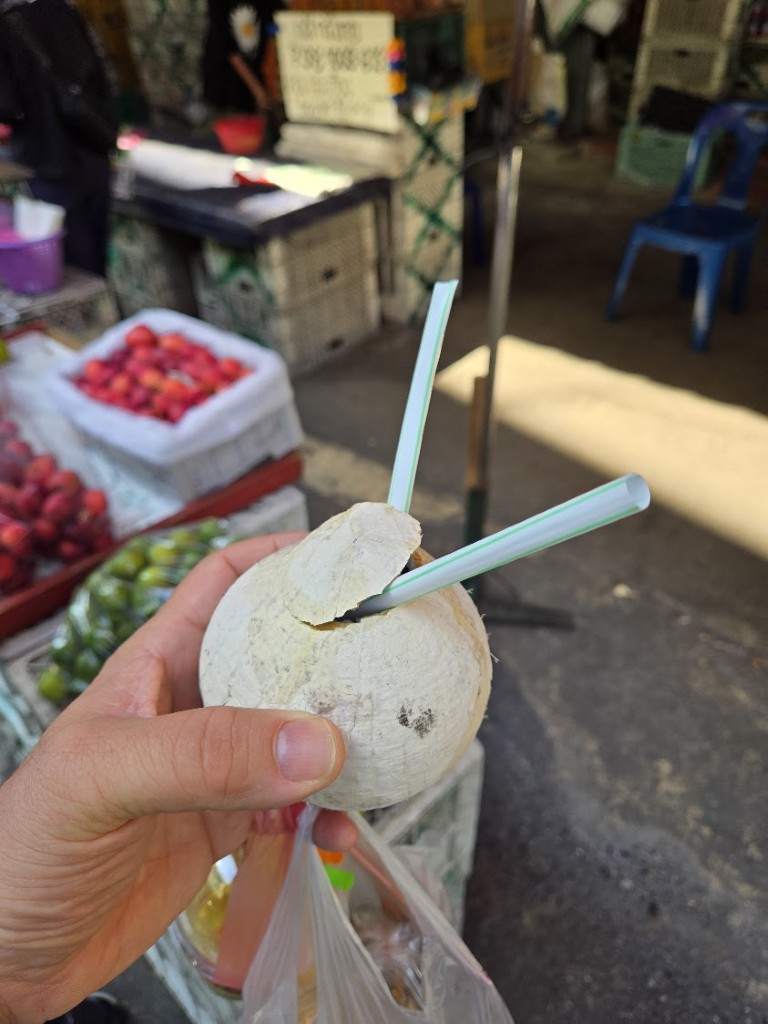
We continued to drink this as we were ushered around the corner to a fruit stand where we were issued not one, but TWO coconuts.  You know, so we could compare them.

Additionally, it was one old coconut and one young coconut, so we were prepared to perform any sort of coconut exorcism that might end up being required.

Back in the tuktuk, and off to the south side of town to visit a small shopping mall.  This served a number of purposes – it let Leigh look around a few more jewelry shops (although the private one earlier was definitely more interesting), it let us spend a little time in the AC, and it gave us another small break from stuffing ourselves.  We still wandered around and LOOKED at food, however, and the “oh look at this!” “oh look at this” “oh look at this!” was still on full display.

But soon enough, it was time to resume eating!

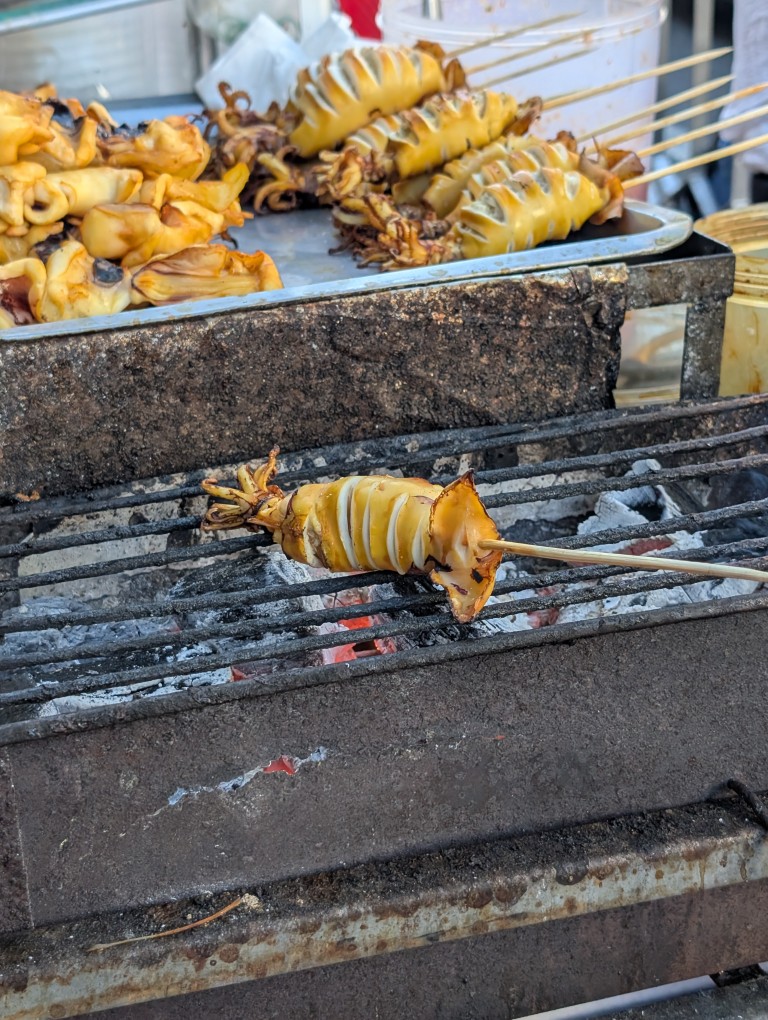
How about a squid on a stick?


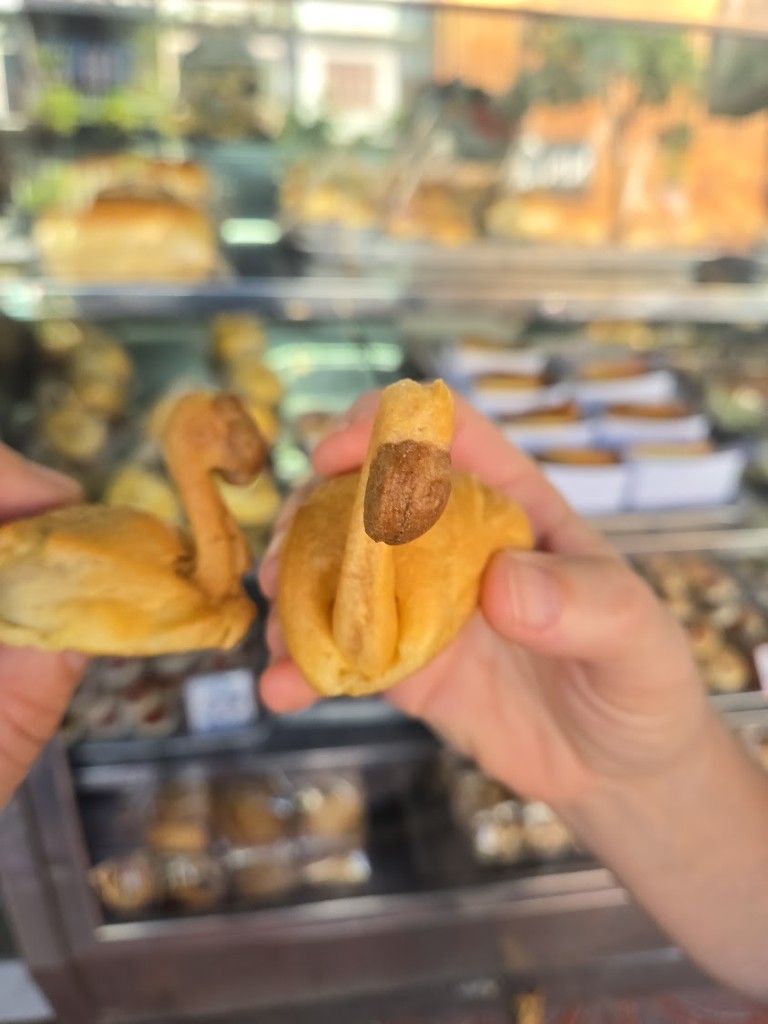
Choux pastry swan?

Banana roti?  (We somehow managed to have BOTH of us forget to take a picture of this one, but trust me, it was also delicious.  EVERYTHING was delicious.)

Flower market?


Wait – flower market?  You can’t eat that.

It was still fascinating, however – all of the floral offerings we had observed being presented at the various temples we had wandered through in the previous two days were clearly being prepared here or somewhere like it.


The day was getting late, but we still had a few more stops.  The tuktuk made its way to a Michelin recognized store famous for its mango sticky rice.  We were handed a portion of that for later, but also an entire mango.  “These are special mangos – they don’t normally sell them separately.”

So we ate a mango.  It was a lifetime top three mango, for sure.  Pity we also forgot to photograph it.  We were getting tired at this point.  One last stop in store, however.

We returned to our starting point in Chinatown, and made our way to…

…oh, look! Peking Duck! You should have some of this…

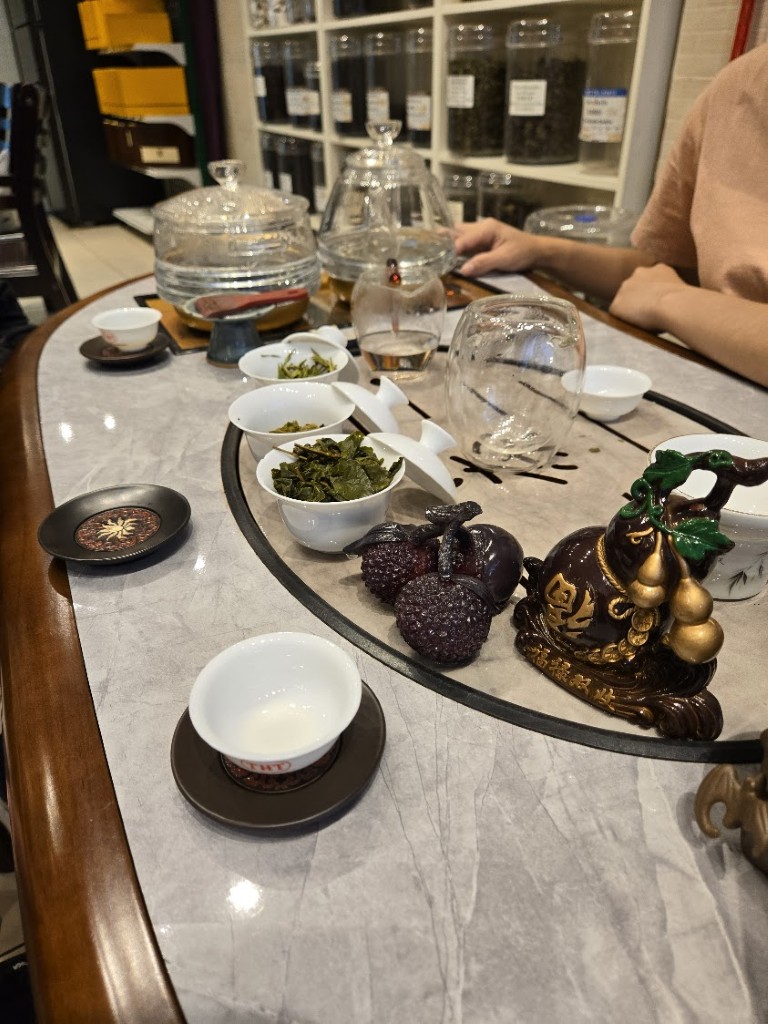
…made our way to a tea shop that we had passed earlier, but hadn’t been open at the time.  And we sat down to a fairly intense tea tasting, with a complicated, multi-step process of washing, pouring, rinsing, brewing, and pouring again, for each of the five or so teas we sampled.


And with that, the food tour came to its conclusion at 5 pm.  What an amazing day.

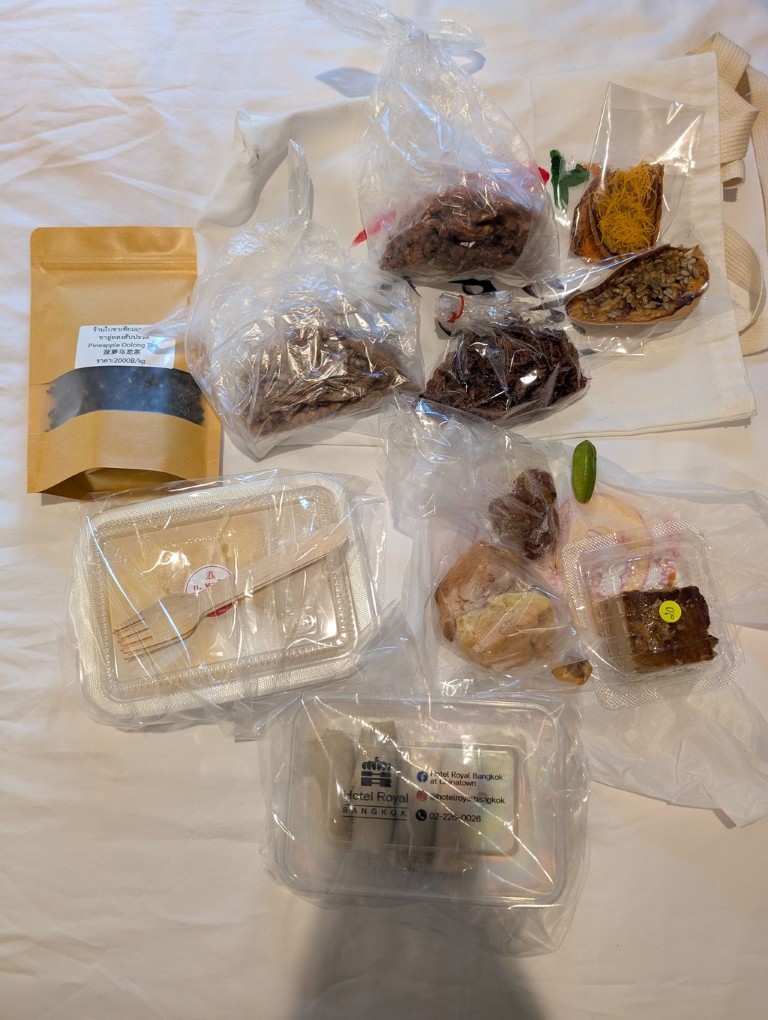
Oh, and here’s the haul of what we had in the bag by the end of it:

More or less clockwise from upper left, a bag of pineapple oolong loose leaf tea, some crunchy fried fish, chicken skin, beef floss, some crispy crepes (I know we picked those up at some point, but damned if I remember when, even though we’d clearly already eaten half of them [Note from Leigh: I’m pretty sure these were handed to us while we were at the flower market]), one of the little green bilimbi fruits, a coconut cake, some sausage, two pastry swans, a box of Peking duck wraps, and a portion of Michelin-recommended mango sticky rice.

Whew. That list would make the world’s weirdest rendition of “The Twelve Days of Christmas.”

What else to do after a day like that but go out for cocktails?

Holy hell, what a day.

Thailand, Day 2: Bangkok – Seein’ the Sights

In addition to eating absolutely everything we possibly could, we also did have every intention of seeing some actual, you know, sights in Bangkok.  Our plan for day two was to visit the big three historical sights in the city: the Grand Palace, and the temples of Wat Phra Chetuphon Wimon Mangkhalaram Rajwaramahawihan, (of course I cut and pasted that, what did you think?) or “Wat Pho” for short, and Wat Arun.

We’ll talk about each of those in turn, but first let’s talk about breakfast.

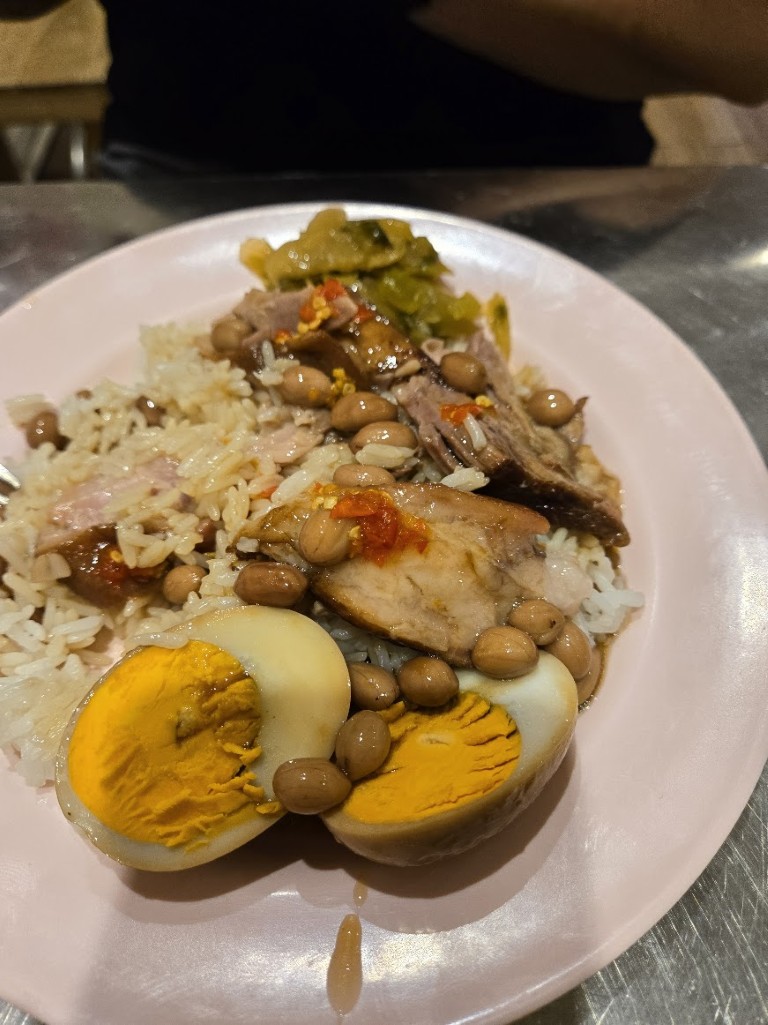
In our research for the trip, I had found some rhapsodic descriptions of a pork leg rice street food seller who was, in theory, located right outside our hotel.  But it turns out they weren’t.  So we went looking for them.  Pretty sure we didn’t find them, but who cares?  We found pork leg rice, and it was amazing.

Pork Leg Rice

Also, this was approximately 3 bucks Canadian.  I will stop commenting on this fact, probably, but just to be clear – food was insanely cheap throughout the trip, even at the high end.

Thus fortified, we headed for the Grand Palace.  En route, we were delighted to encounter our first scammer.  “Look honey!  A grifter!  Just like in the videos!”  Specifically, this was a nice woman in a polo shirt who looked like a tourist assistance person who came up to us while we were checking our map, and asked us where we were headed.

When we told her the Grand Palace, she told us that the queen mother had passed away (which was true) and that as a result, the palace would be opening late. (which was not)  She suggested that we take a tuk tuk over to the south side of the river and tour the temples there.  And wouldn’t you know it, at just that moment, a random tuk tuk just happened to pull up and ask if we wanted a ride?

We did not, having been warned about this exact scam by an incredibly Canadian Bangkok YouTuber named “Cal.” (Thanks Cal!  Your videos were awesome, and a great help in many ways.)

So we thanked her politely and moved on to the very much open Grand Palace.

A word about the queen mother, though – she passed away about a month before we arrived, but because the royal family occupy a quasi-divine mythology in Thailand, we were just at the start of a year of official mourning.  There was black and white bunting and photos of her EVERYWHERE.

Queen mother's photo

This included just about every temple we visited, which was definitely a contrast to the church-state separation we are accustomed to in the west.

The tour of the Grand Palace consists of two main areas – the temple of the Emerald Buddha, and the palace itself.  Most of the palace was indeed closed due to official mourning, but we were able to explore the temple.

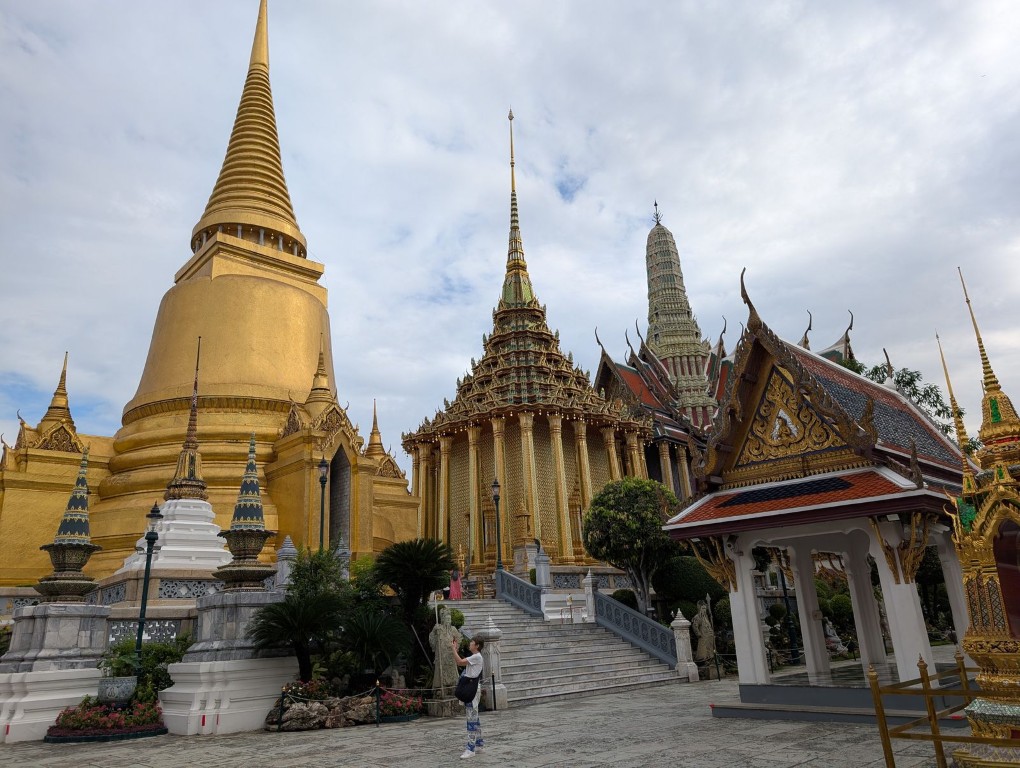
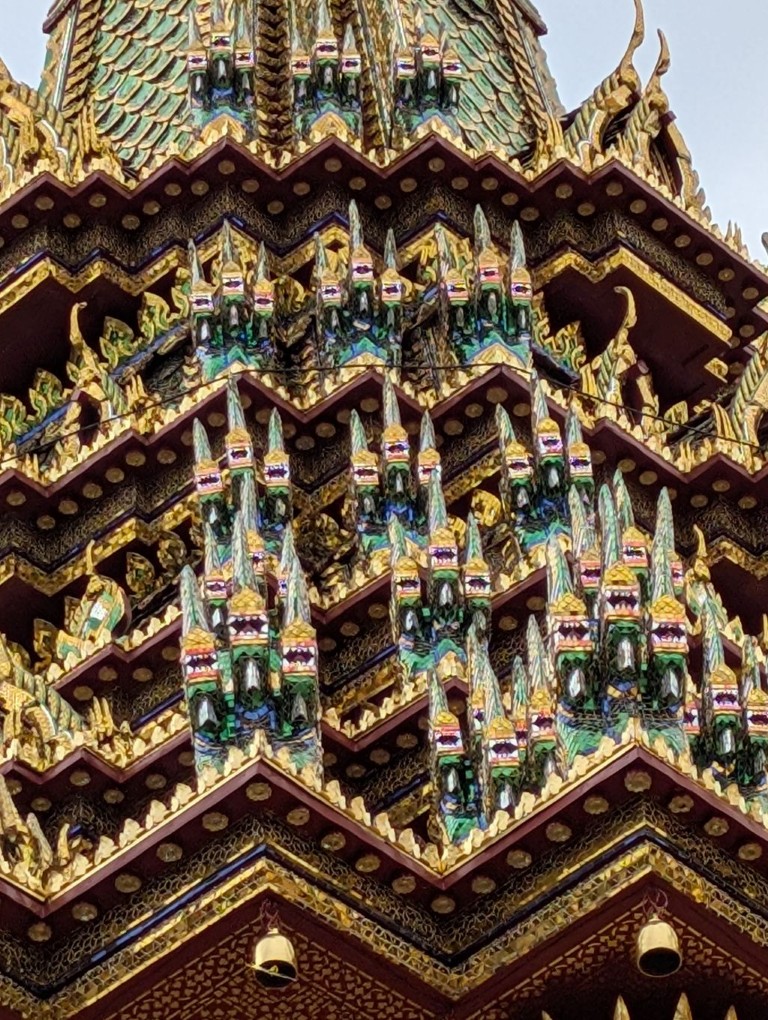
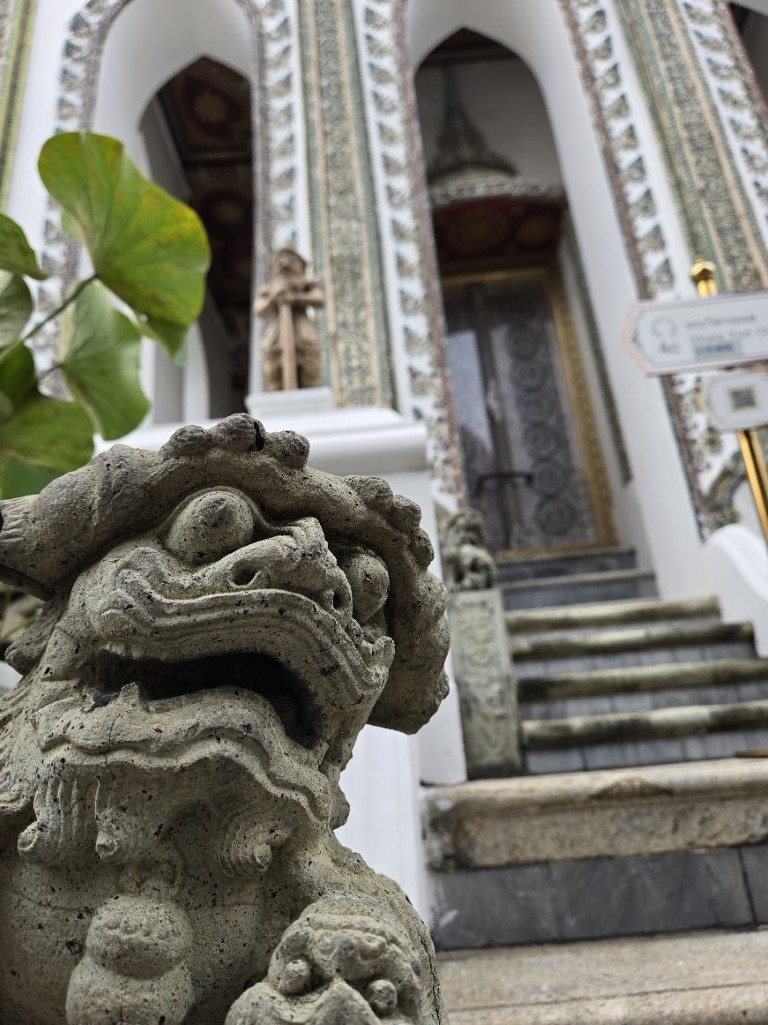
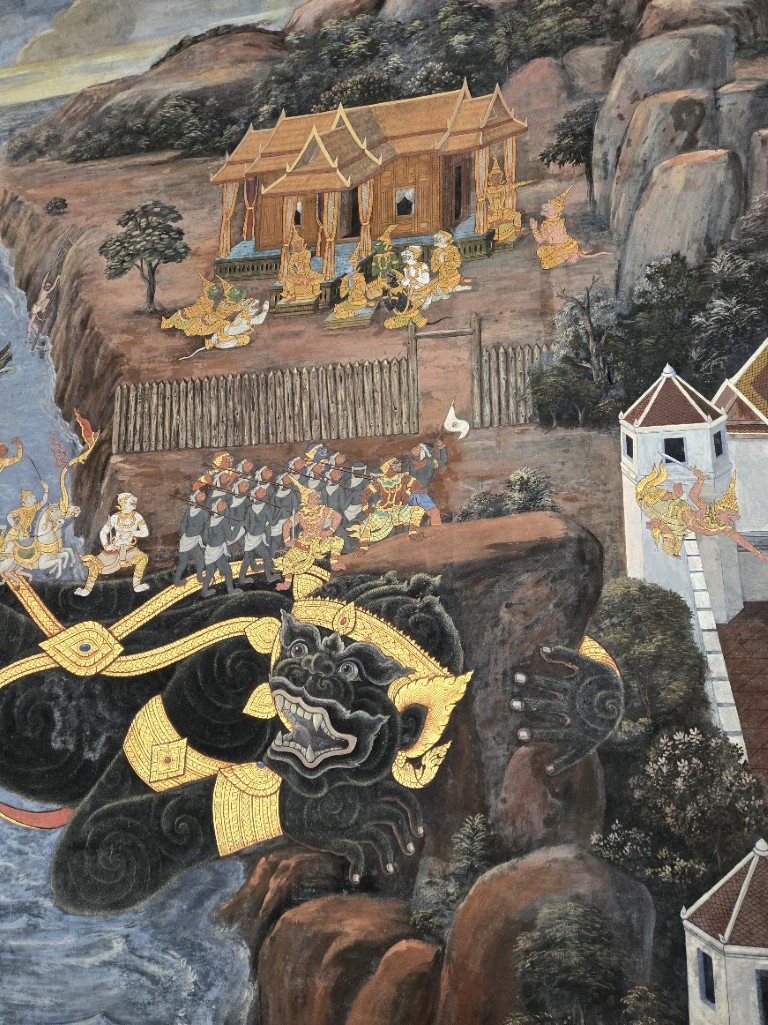
It’s hard to describe, even with pictures, the maximalist aesthetic on display here.  This was a common theme of the whole trip, particularly in the temple-rich environs of Chiang Mai, but unsurprisingly, the complex attached to the royal palace is at the top of this particular heap.  Just a few of our MANY photos:

The one thing we CAN’T show you is a photo of the Emerald Buddha itself, since this was one of the very few temples that didn’t allow photography.

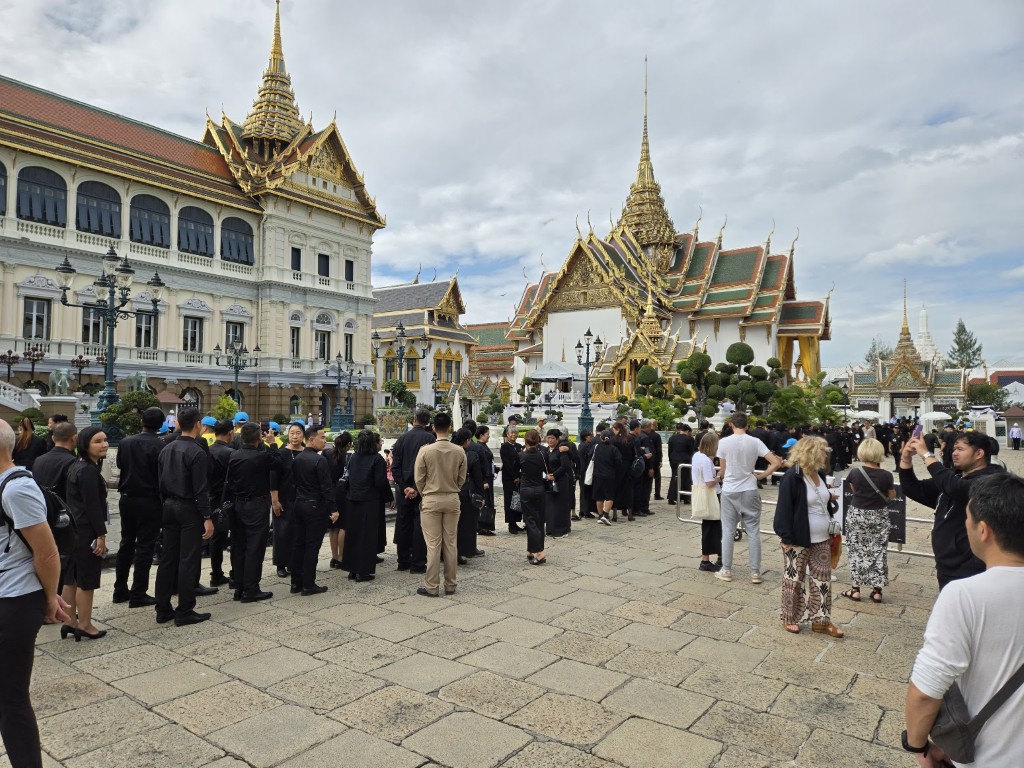
From the temple, we proceeded through to the Grand Palace, but we only got a look at the outside, because mourners.


Many, many mourners.  Mass mourners mobilizing for monarchal mother’s memorial.

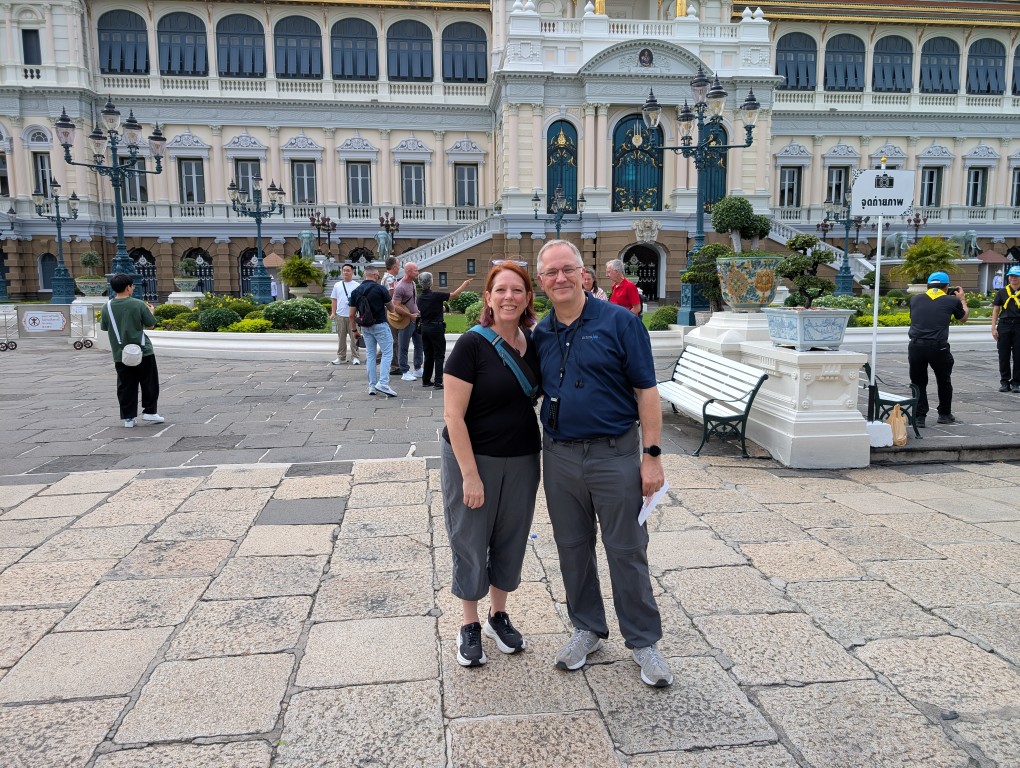
Ahem.  Sorry.  But the upshot was that the royal palace and the various museums associated with it were closed.  So after having our picture taken by an ACTUAL tourist support person (It FELT disrespectful, but it was their idea, and all the Thai mourners were also taking selfies) we moved on to our next stop.

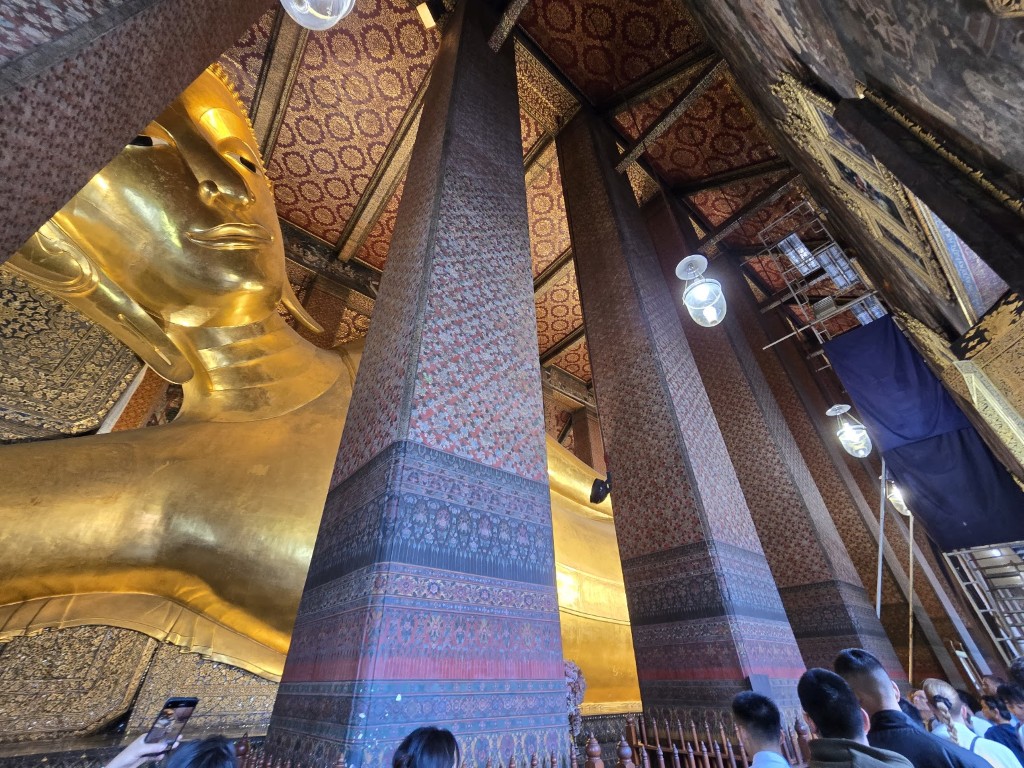
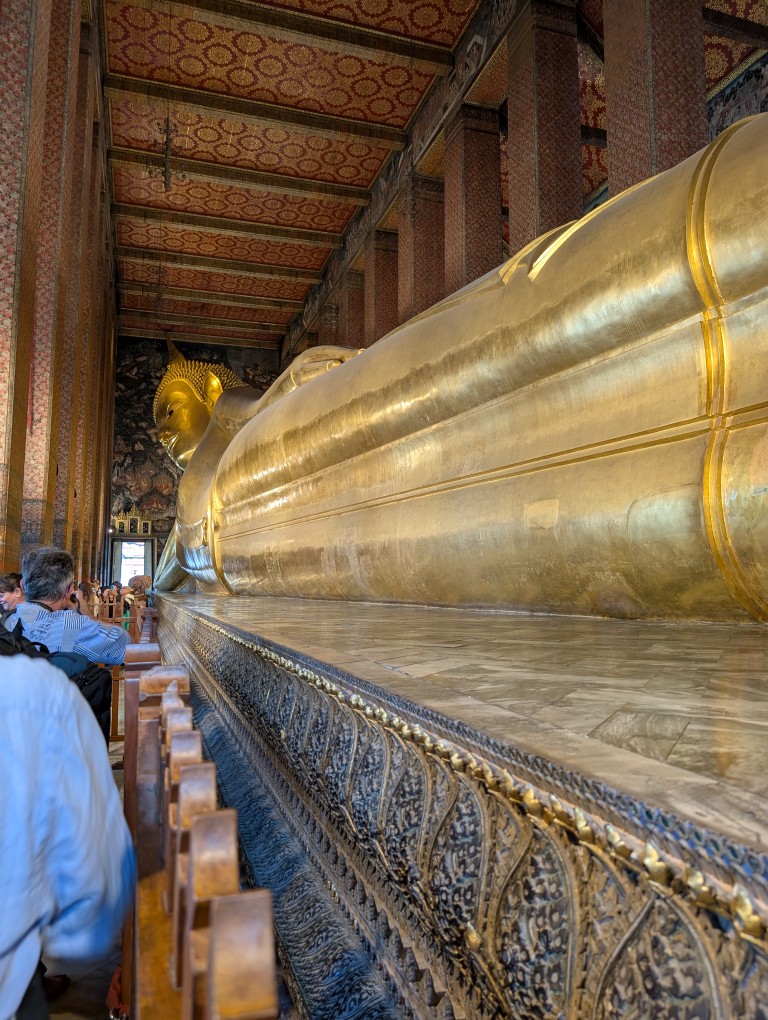
The next stop was Wat Pho, a large temple complex just south of the palace featuring a very, very large reclining Buddha.

At this point I turned to Leigh and whispered “I like big Buddhas and I cannot lie.”  Then I tripped over something and stubbed my toe, so I should probably be more respectful.

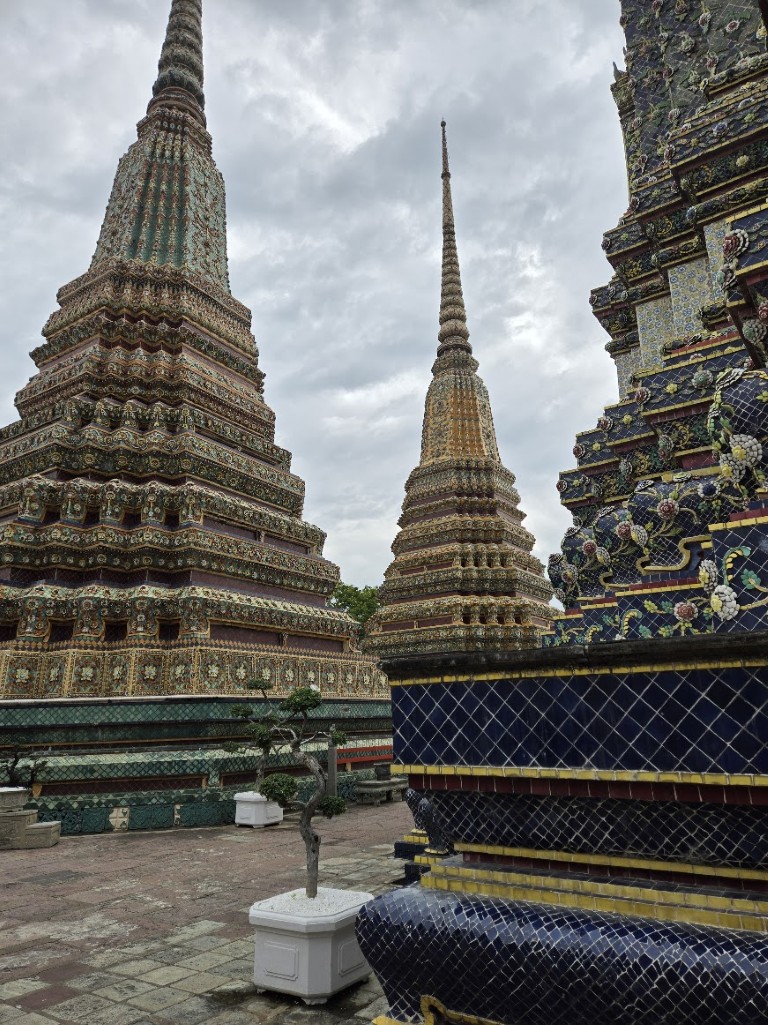
And to be clear, the building housing this enormous statue is just one small part of the larger temple complex.

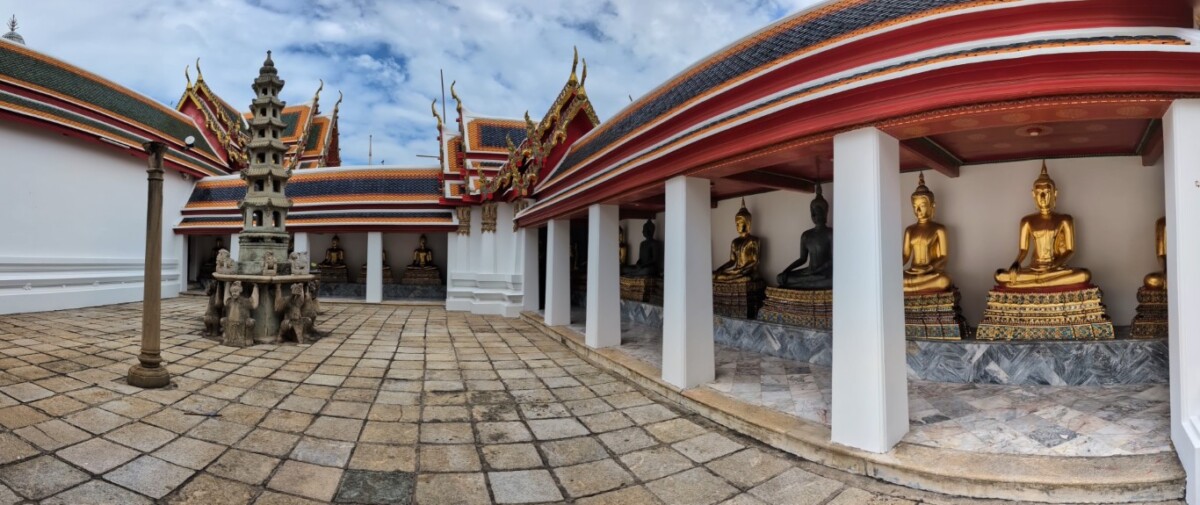
The second picture shows three of the four Chedi dedicated to the first four kings of the Rama dynasty, of which the current king is Rama the tenth.

At this point, we were absolutely overwhelmed, and also it was time for lunch.  Wanting to get away from the absolute tourist black hole that is the area around the palace and Wat Pho, we took a ferry up river a few stops to a smaller local market area called Wang Lang, which Google Maps helpfully describes as “A large open air market with many snacks.”

It certainly was. Sadly, we completely failed to take a PICTURE of our actual lunch (two different delicious curries). We did get a blurry photo of a pandan cake that we had for dessert, but I won’t trouble you with it here.

Because we then walked to the far more photogenic THIRD of the big three sights in downtown Bangkok, the temple of Wat Arun.  The walk wasn’t dangerous or anything, but it also wasn’t very INTERESTING.  It was along a light industrial street with a naval yard on one side, so not much to see.  Probably not on many tourist routes.

The temple itself, however?


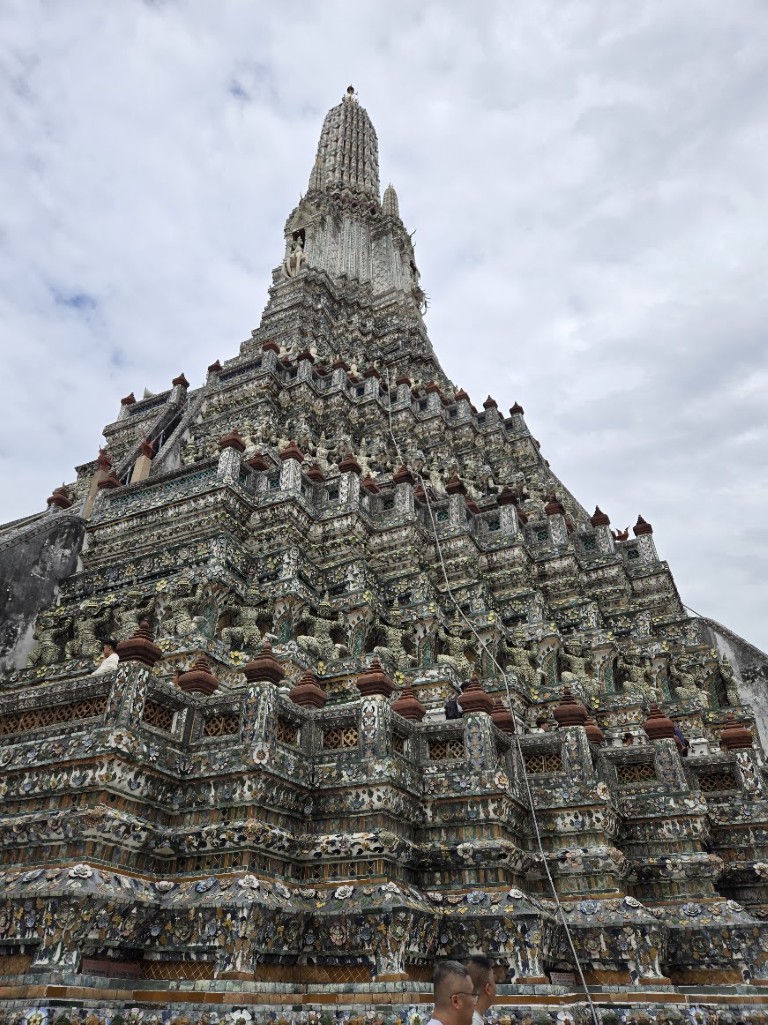
Definitely on the tourist routes.  Wat Arun, which literally means “Temple of Dawn”, is one of the iconic sites of Bangkok, and is prominently situated at a bend in the river so as to be visible for a long way  both up and downstream.

It’s absolutely stunning.

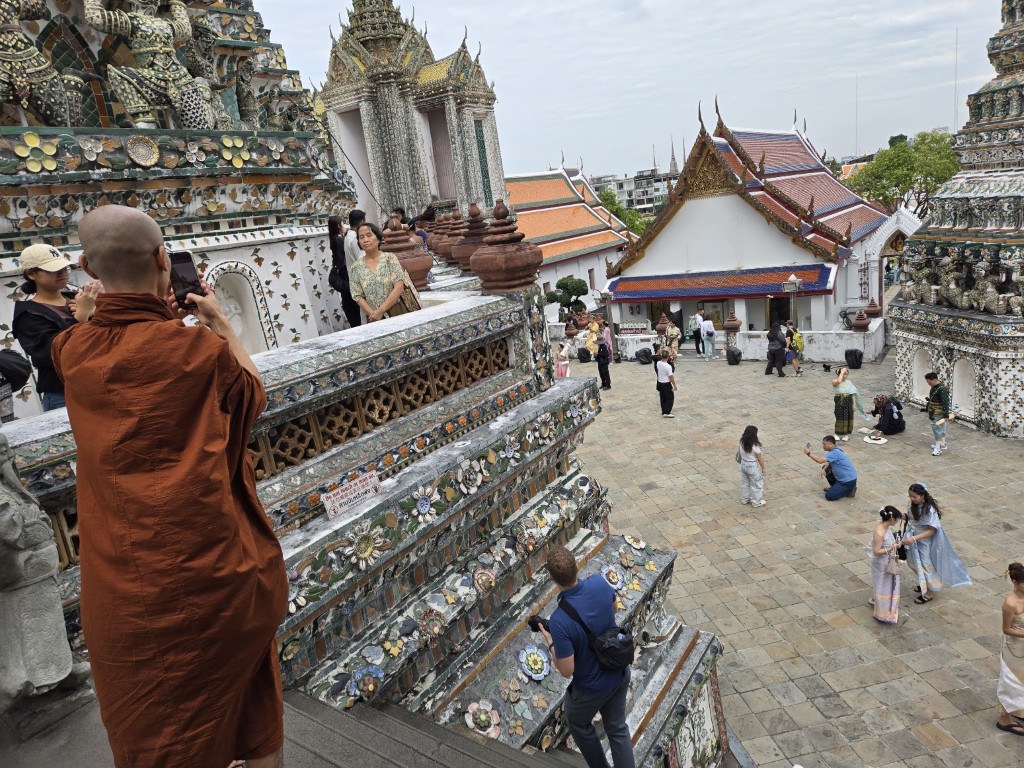
It is also absolutely infested with Instagrammers.

We were tired at this point, it was hot, and we had walked a long way.  So we basically just parked at a balcony and watched life’s rich pageant for a while.  Life’s rich pageant consisted of many, many people in rented Thai dress, frequently accompanied by rented Thai photographers, taking just that absolutely perfect shot for the ‘gram, artfully ignoring the absolute staggering wonder of Thai architecture that they were standing right next to.

I know, I know…
hand holding newspaper clipping with grandpa simpson titled 'old man yells at cloud'

It really was stupendous, though.

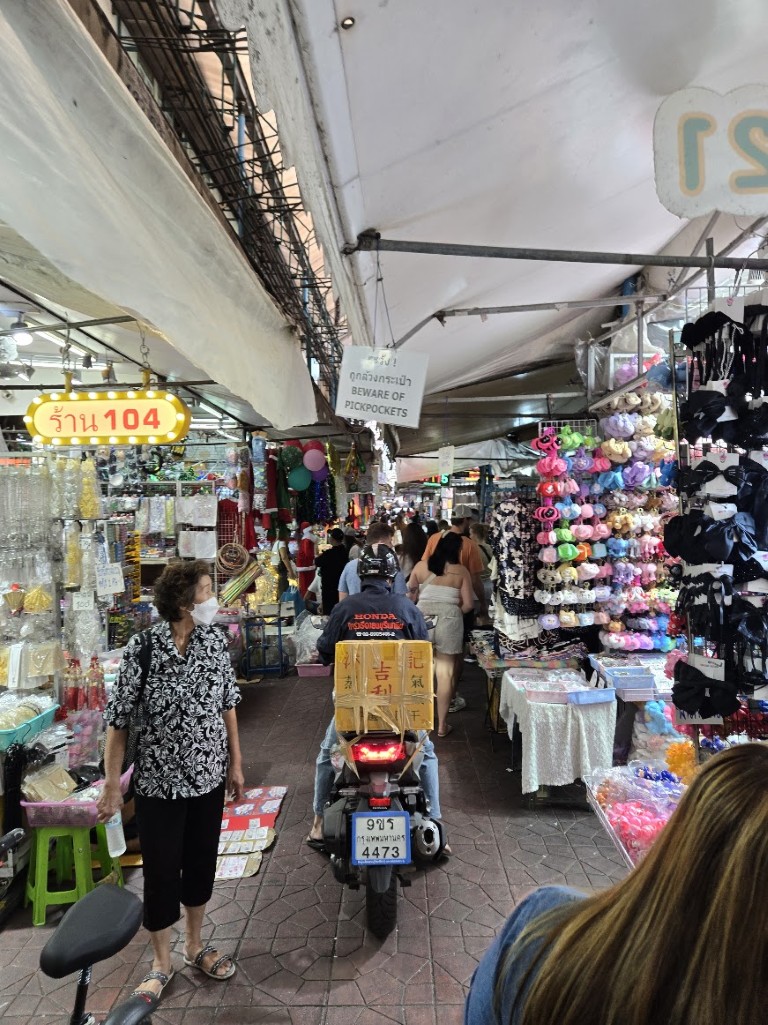
At any rate, after a nice long rest at this gorgeous temple, we made our way back across the river to explore a bit more of Chinatown.  We walked through a number of absolutely TINY market streets that you would assume were just too small and full of people to accommodate motorcycles.  But you would be wrong.

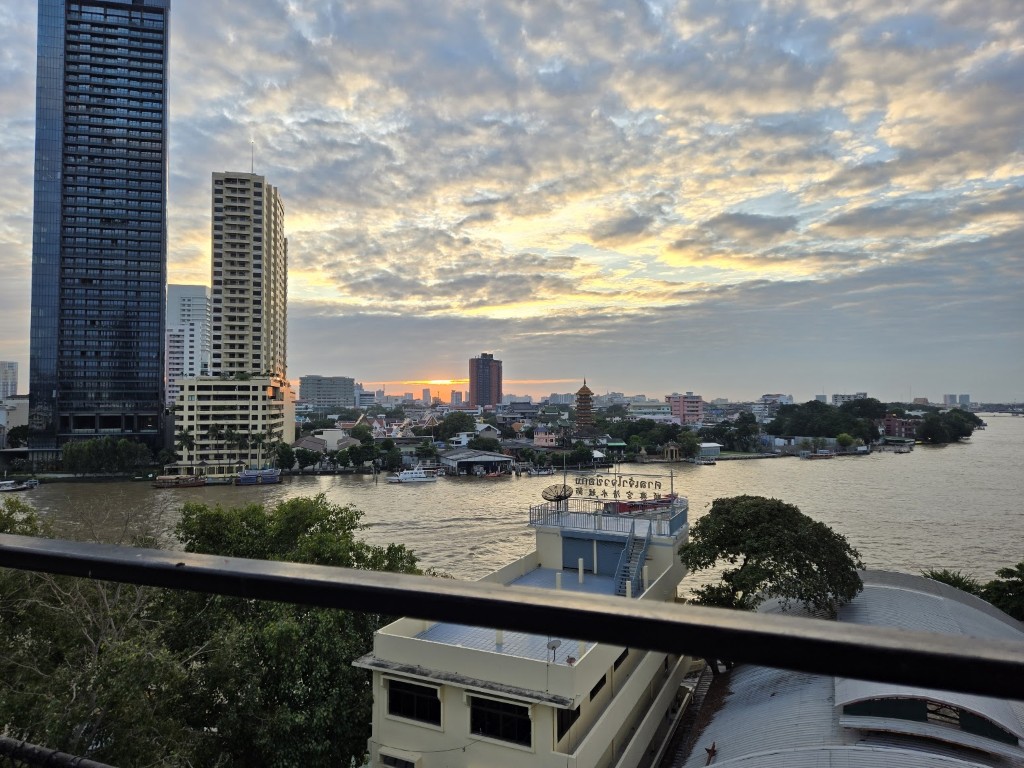
By this point we were getting tired and hungry. So we decamped to a rooftop bar for our first serving of Pad Thai of the trip, along with some pomelo salad and cocktails.  But also this view.

From here, we made our way back to Yaowarat road and really took in the absolute madness that is one of the great street food areas of the world at night.  Faced with an overwhelming number of options, we opted for some nice coconut ice cream, and called it a night.

But we really had no idea what an overwhelming variety of food could look like.  Not yet.

(Is that good foreshadowing?  It’s supposed to be foreshadowing.)

Thailand, Day 1: Bangkok – Malls and Monitors

On our first day in Bangkok, we woke up eager to get out, see the sites, and begin our quest to cram as much food into our faces over the next two weeks as possible.  We were staying in Chinatown, which had been described to us as absolutely the best place to stay to try as many different kinds of food as possible.

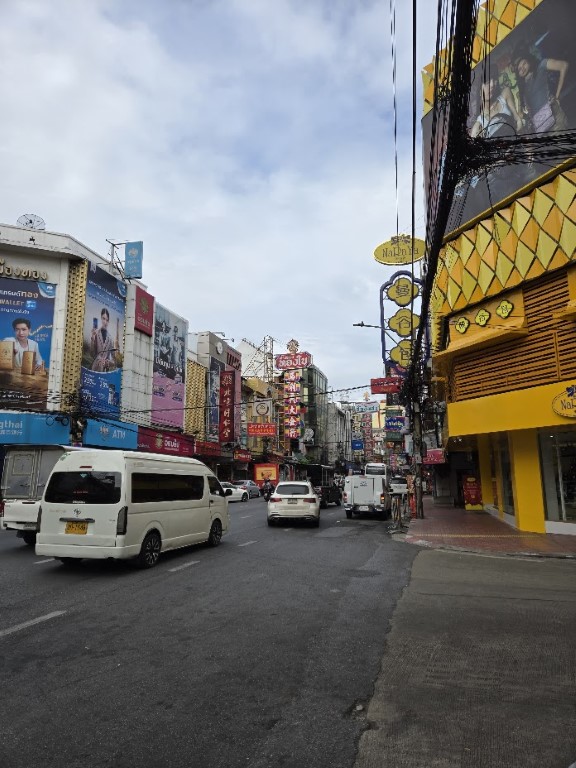
Yaowarat Road by day

This is Yaowarat Road, one of the most famous street food areas in the world.  It was two blocks from our hotel.  The better view is at night, but we’ll get to that.  But first – where to start?

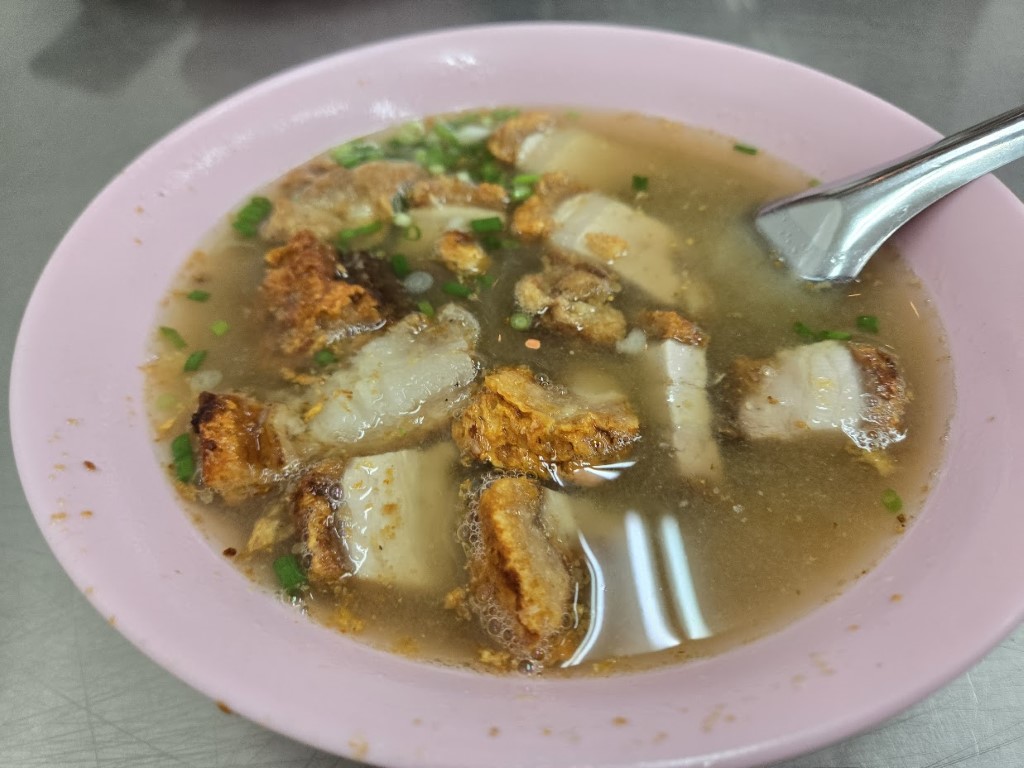
How about a restaurant famous for it’s rice roll noodles and crispy pork belly?  Sounds great!

Rice roll noodle soup

While it is certainly possible to get a traditional Western breakfast in Bangkok, we discovered that it seems just as common for locals to sit down and eat a portion of the same thing they might have for lunch or dinner.  And when THIS is on offer, why wouldn’t you?  This was spectacular, and we were worried that we might have peaked too early.  (Spoiler: we did not)

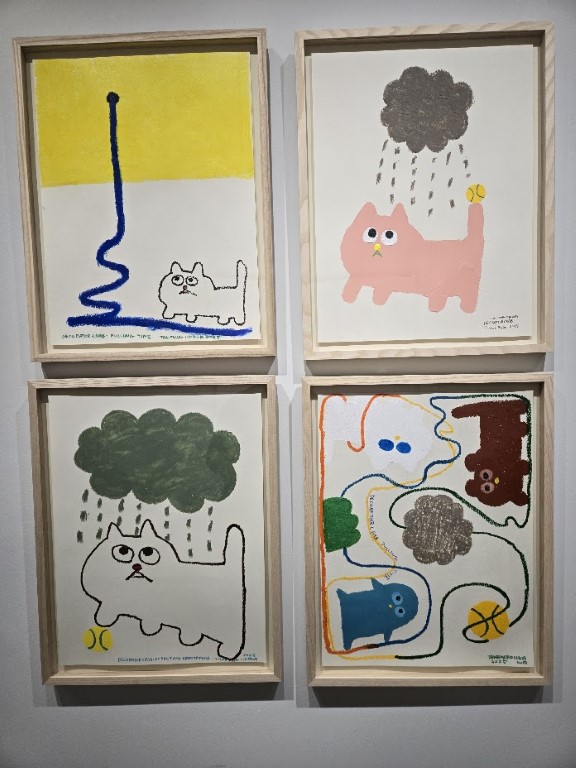
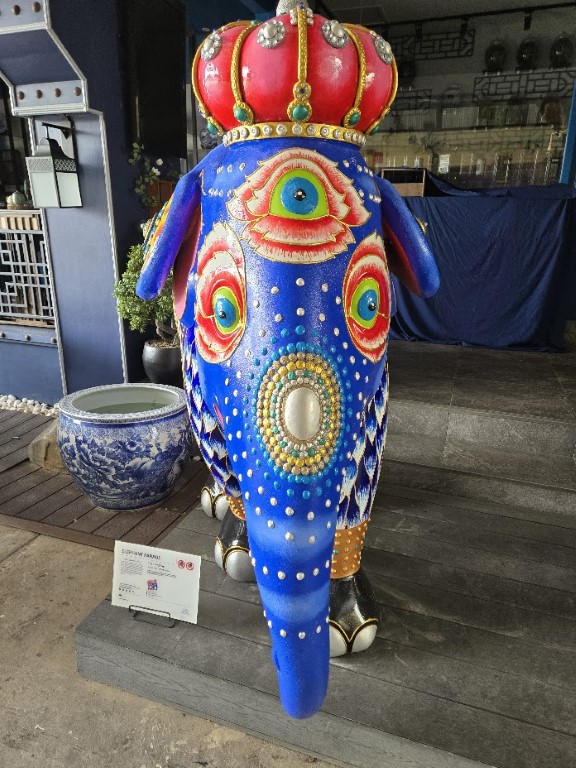
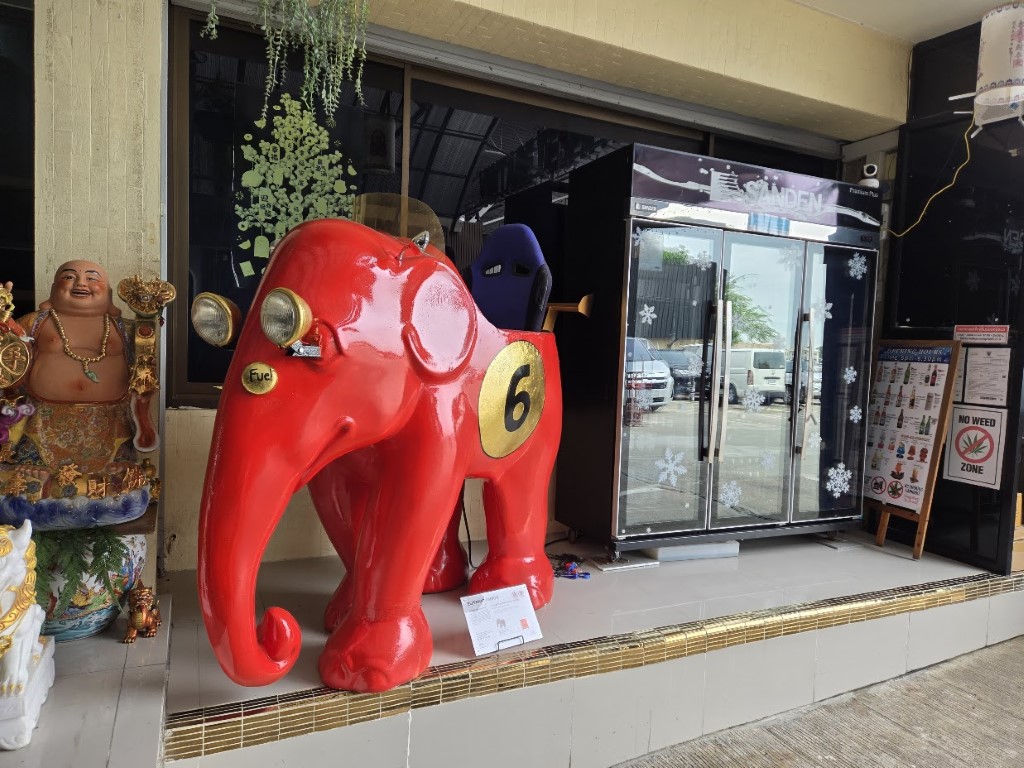
We spent another few hours bonking around Chinatown looking at cute art galleries and painted elephants:

We also consumed, according to my notes, a Hong Kong style coffee / tea hybrid drink, a glass of langan juice, and a chocolate Madeline.

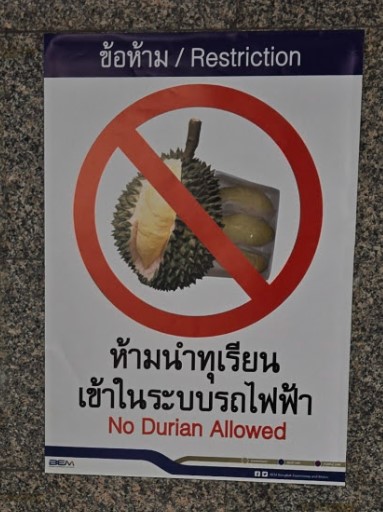
We didn’t have a FORMAL plan for the first day other than eat, wander around, eat, attempt to recover from jet lag, and maybe eat a bit, so we decided to hop on the subway (no durian allowed) and head over to a nearby park where we heard there were monitor lizards to be seen.

On arrival at the park, we were confronted with what turned out to be a bridge commemorating the deep, historical friendship between Thailand and… (checks notes) Belgium? Sure, why not – it didn’t NOT look like the bridges I saw in Belgium this summer. (Turns out there were a LOT of friendship monuments in this park for various random countries.)

Also lizards.

Monitor Lizard

After this we hopped on the elevated train to go look for a nearby (missing, as it turns out) geocache. But all this “doing things that are not eating” had helped us work up an appetite.  We had heard that shopping mall food courts could be surprisingly worthwhile in Bangkok, and since we were immediately adjacent to a large shopping mall, we decided to give it a shot.

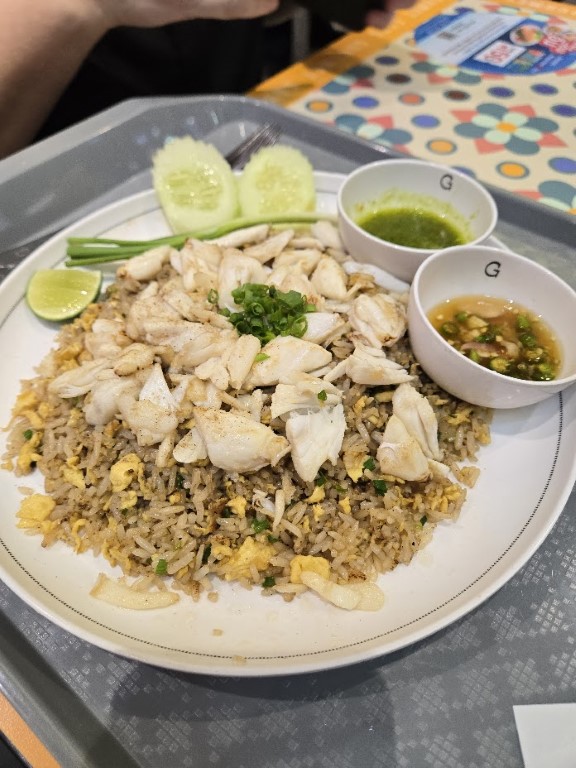
Friends, I have never seen so many “Michelin Recommended” symbols in one room. Here’s some crab fried rice from one of them.

Crab fried rice

For the rest of the day, we just sort of bopped around the city.  We went to the tallest building in Bangkok, thinking we’d check out the sky deck, but were given pause by how expensive tickets were.  We’d been eating world class food for pennies – it was a bit jarring to be asked for approximately forty dollars Canadian to ride an elevator.

So instead we just kept walking around.

We sat in a lovely Indian inspired temple watching people come in to make offerings after work, and then we sat in a coffee shop surrounded by lavishly presented Marvel memorabilia.

We wandered down to another cache hidden in front of a massage parlor, but the women hanging out in front were all happy to point it out to us, as soon as it became clear that’s what we were doing.

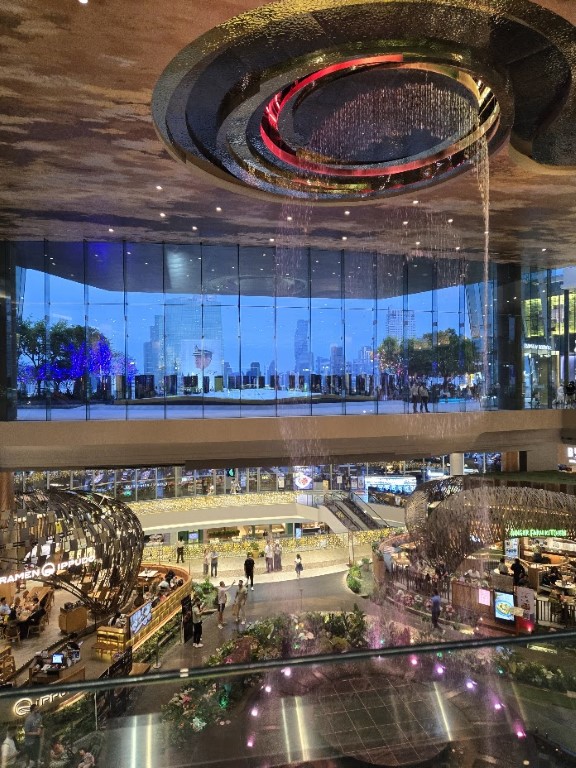
By dinner time, we were basically getting delirious with jet lag, so rather than cope with anything too complicated at that point, we decamped to another mall for papaya salad and mango sticky rice.  I say “another mall”, but Icon Siam is sort of next level, as it turns out.

After dinner we grabbed a ferry back across the river and walked back to our hotel, pausing only to first, marvel at whatever the hell THIS is:

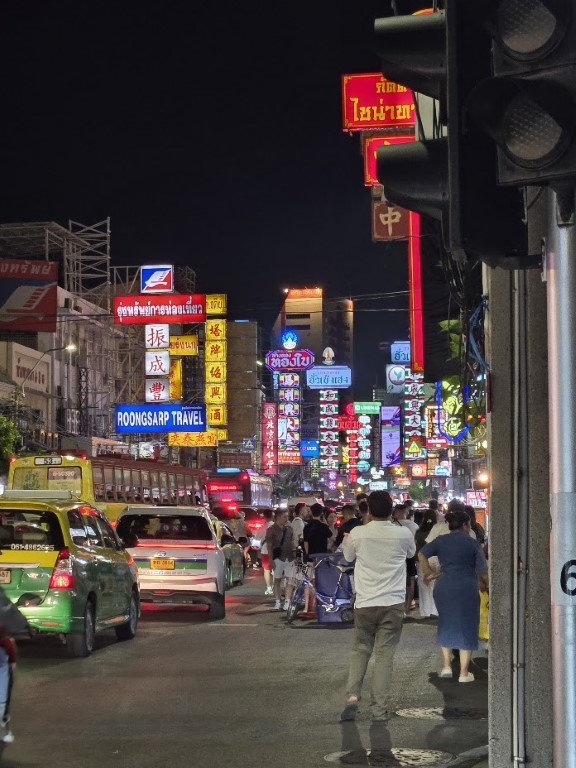
And second, snap another photo of Yarowat Road.  Looks a little different at night, doesn’t it?

Thailand was off to a good start.


Thailand, Day 0: Planning and Preparation

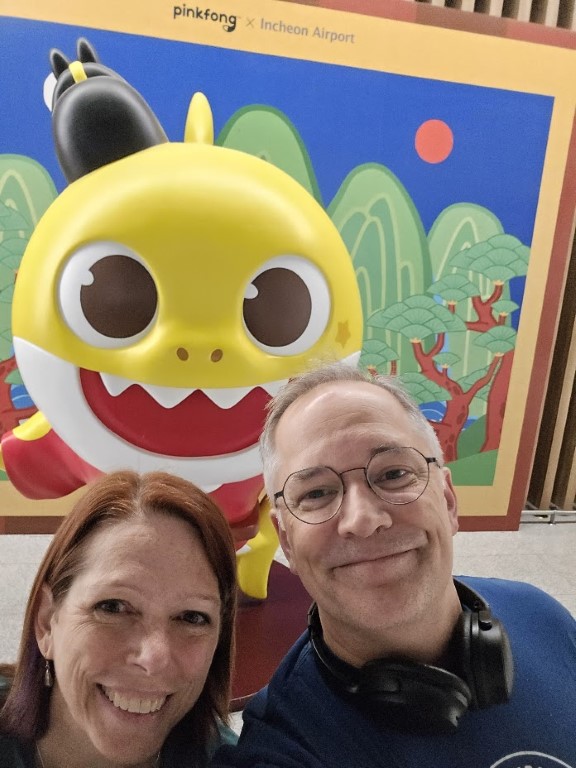
Both of the people who have read all of this blog may have noticed a pattern with the travel portions – they virtually all revolve around a professional conference; usually Leigh’s, but occasionally Dan’s.  We’ve taken some AMAZING vacations, but the choice of destination is generally dictated by where ICMPC, or IPAC, or ACTOR, or SPECTRE is having their conference that year.  (The tote bag for the last one was amazing.)But the problem with that approach is that you don’t have any say in the destination, so if there’s somewhere in particular you want to go, you only have two options: keep waiting until one of your organizations decides to go there, or else look up who is planning a conference in your desired city, and then go become a pediatrician, or a forensic accountant, or a Lutheran, or whatever.And since we didn’t want to have to pick a synod, we appeared to be out of luck.Turns out, however, there’s a loophole.  You’re allowed to just… go somewhere?  Like, you can buy tickets on an airline, and then reserve a room at your destination, and they just let you do it.  You don’t even need a cheap tote bag full of vendor tchotch or shark laser upgrades.Who knew, right?We were very excited to discover this fact, and decided that for our first trick, we wanted to go to Thailand.  We wanted to see wildlife, and experience culture, and sit on a beach and… Nah, let’s be honest – we wanted to eat ourselves stupid. And then maybe look at some culture once dinner had settled.We chose late November as our preferred travel time, since it is largely past the end of the monsoon season but before the start of the Christmas travel season. Like with Japan, we spent so much time PLANNING the trip, that by the time our departure rolled around, preparing for this trip had basically become a part time job of its own.But the fateful day arrived, and we were off to (checks notes) Seoul!Wait, what?  Yeah, it turns out that although you CAN take a direct flight from Vancouver to Bangkok, no one in their right mind would want to, so we flew KAL.  Here’s a picture of us with a terrifying mascot in the Incheon airport.

Incheon mascot

And then just a short 5 hours later, we landed in Bangkok, caught a ride share to our hotel, and collapsed.  Actual Thailand will commence in the next entry.

International Meals – Mauritania

Mauritania is a west African country bordered to the south by Senegal and to the north by…

(checks notes)

You know what, never mind.

It is presently in a period of democrac-ish, which is good, but still has an uncomfortable amount of slavery, which is very, very bad..

Let’s just get to the food, shall we?

We struggled to find a dish that wasn’t more identified with either Morocco or Senegal, and we eventually settled on Leksour, which is a lamb stew served over millet flour pancakes.

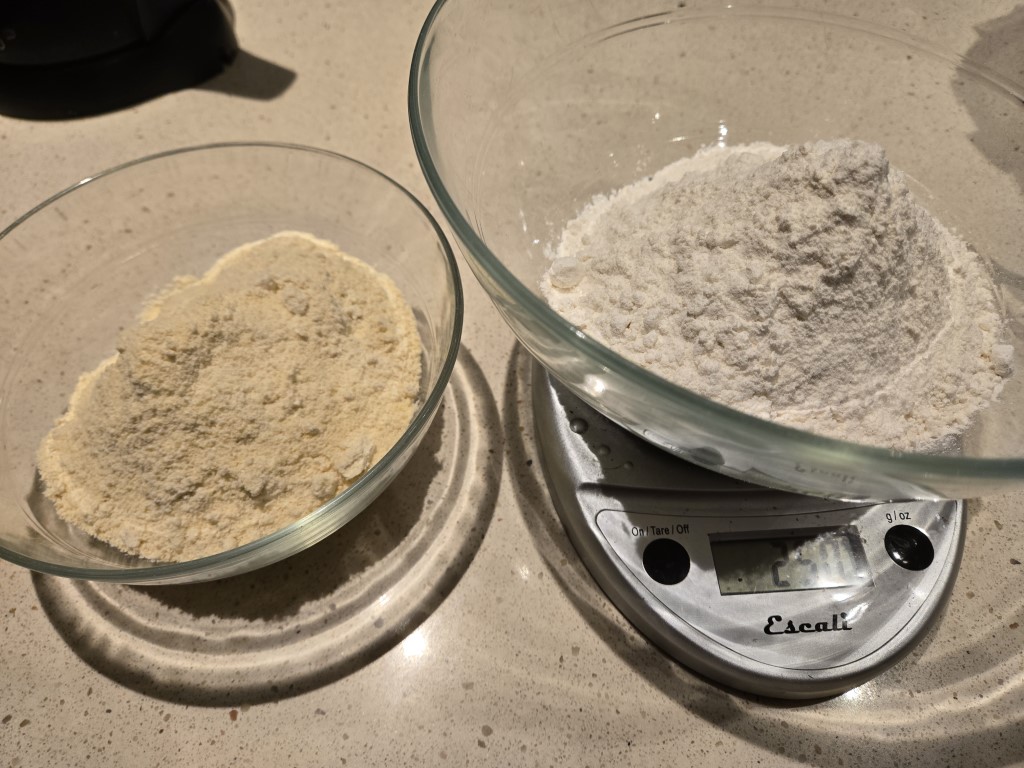
Rather than buy millet flour, I used our spice grinder to make it from some millet we had left over from a previous recipe.  (I’m NOT going to back and try to identify which one, because then I’ll have to admit how long that millet has been in the cupboard.)

Millet and wheat flours

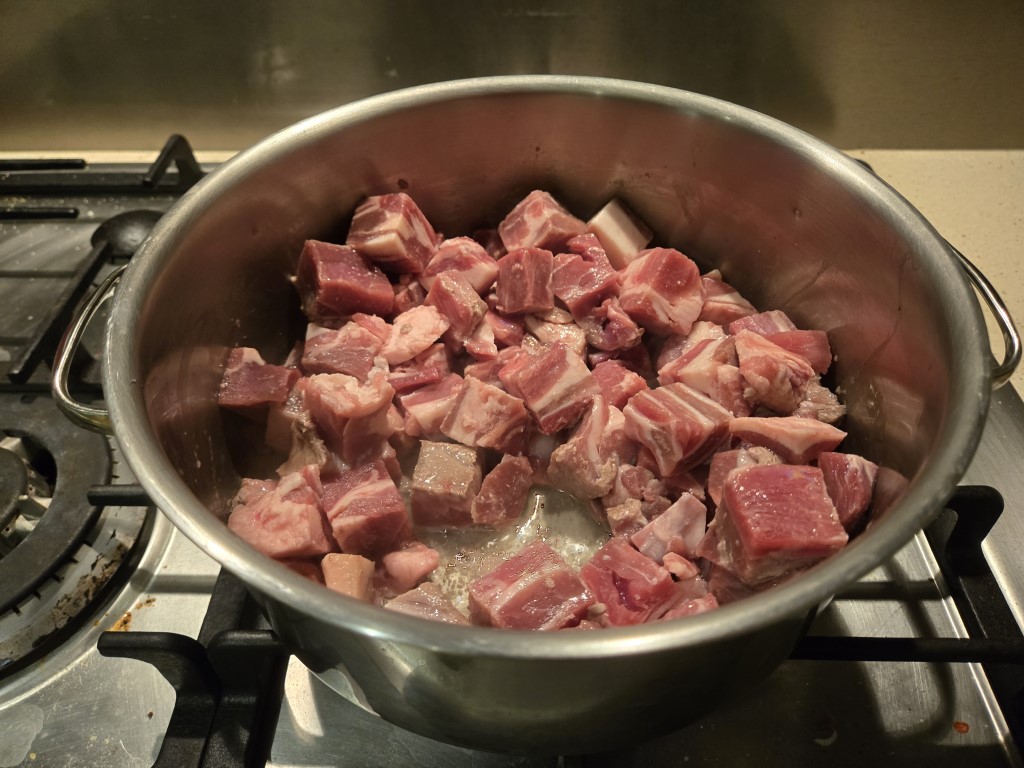
The flours are mixed together with water and a bit of salt, and that batter rests for a bit as you get to work on the stew.  Which, to be fair, is pretty straightforward.  Brown some stewing lamb.

Lamb chunks

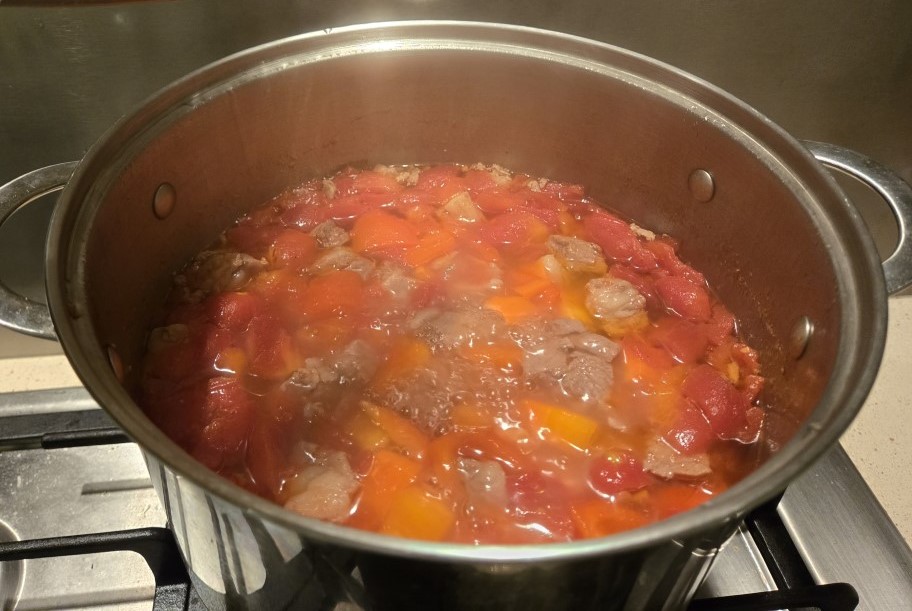
Chop up some vegetables and toss them in with salt, pepper and a bay leaf.

Lamb stew cooking

Then stew for an hour.

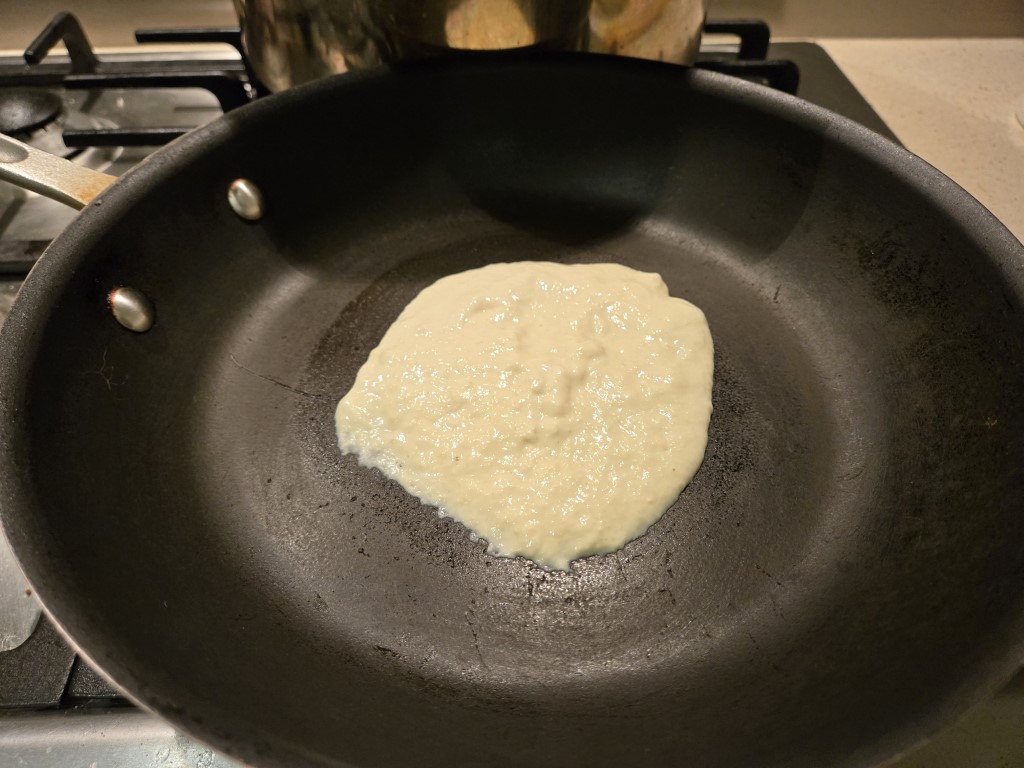
The pancakes were interesting – the dough was substantially stiffer than normal pancake batter, but given that the ratios for flour to water I found online were all over the map, I’m not sure if it was supposed to be or not.  None of them seemed to either burn, or be too undercooked, at any rate.  I think they may have been a little under, but it’s hard to say – there’s also a variety of colors of the millet itself out there to choose from.

Millet pancake cooking

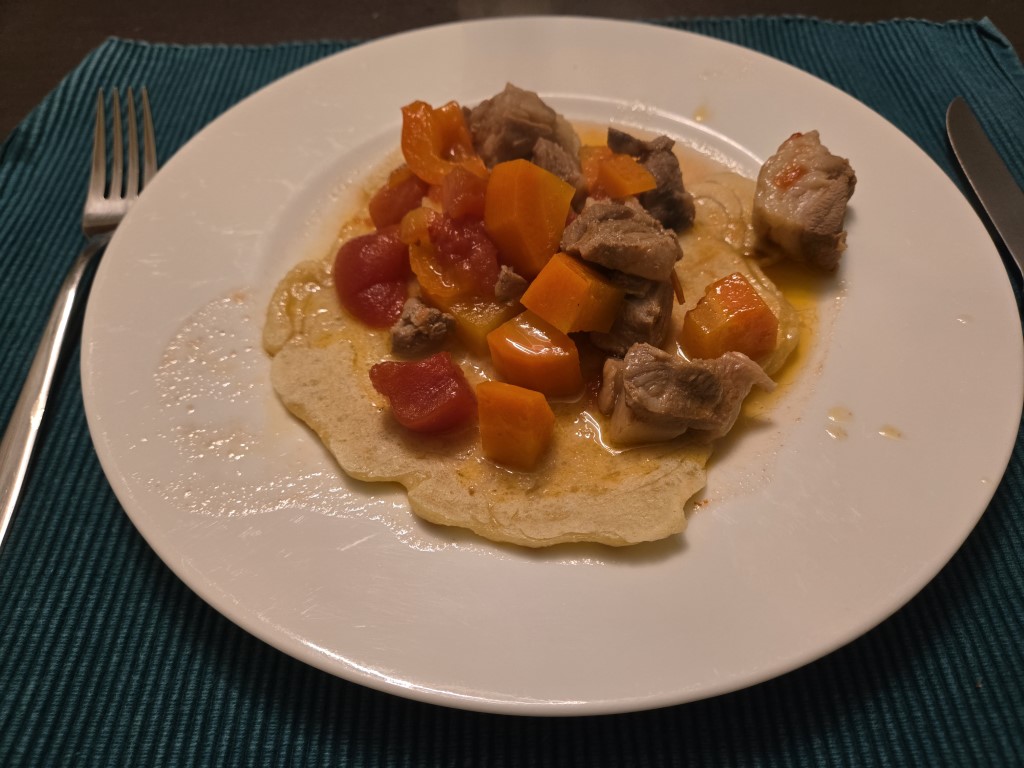
And once the pancakes are ready, you just put the stew on the pancakes and eat it.

Mauritanian stew

And it was fine.  There’s nothing wrong with a basic lamb stew, and the flatbread was good to soak up the juices.  But it was also… pretty basic.  The research for African countries is frequently difficult, as we’ve discussed earlier, and I’m sure there’s more interesting things that could be done with this if we had a better sense of what the normal range was.

But as it was, we had a nice Thursday night dinner and leftovers for several days.

Next up, we’re off to a country whose name could easily be mistaken for Mauritania, but isn’t.

Recipe:
Leksour (Mauritanian-style Pancakes with Sauce)


International Meals – The Marshall Islands

After doing the Maldives a few meals ago, we’re back out in the ocean for a country with an even higher ratio of water to land – the Marshall Islands. This time it’s not the Indian Ocean – we’re going to be a bit more Pacific than that.

Sorry.  However, if I’m going to say anything much about the history of the Marshall Islands, that’s the last bit of levity we’re getting for a while.  You see, the most famous of these Islands is Bikini Atoll, where the good ‘ol USA decided to set off the first hydrogen bomb.  And then the second one.

In time, the US would detonate 67 nuclear weapons in the Marshall Islands at Bikini and Enewetak atolls. The health impacts of the tests are still felt today, and likely will continue to be a serious issue right up until the likely destruction of the entire country due to climate change.

Woof.

OK, let’s talk about some food now, please?

The Marshall Islands have at various times been inhabited and / or governed by aboriginal populations from Australia and elsewhere, Germany, Japan, and the United States.  They’ve been independent since 1979, although they still depend on the US for things like (checks notes) bank insurance?  Huh.

At any rate, that’s a lot of influences.  As one might expect, fish is quite common, and as we’ve seen in other oceanic countries, pumpkin also comes up a lot.  Although rice isn’t native to the islands, a glutinous rice ball is a very common side dish, and finally the arguable national dish is a macadamia nut pie, despite the fact that macadamia nuts AREN’T originally native to these atolls.

We’ll get to the pie, but let’s make our main dishes first.  While most authentic would likely be to wrap the fish in banana leaves and grill it, I found a recipe for baked fish with a coconut milk sauce that sounded amazing (spoiler: it was), so we decided to go with that one.

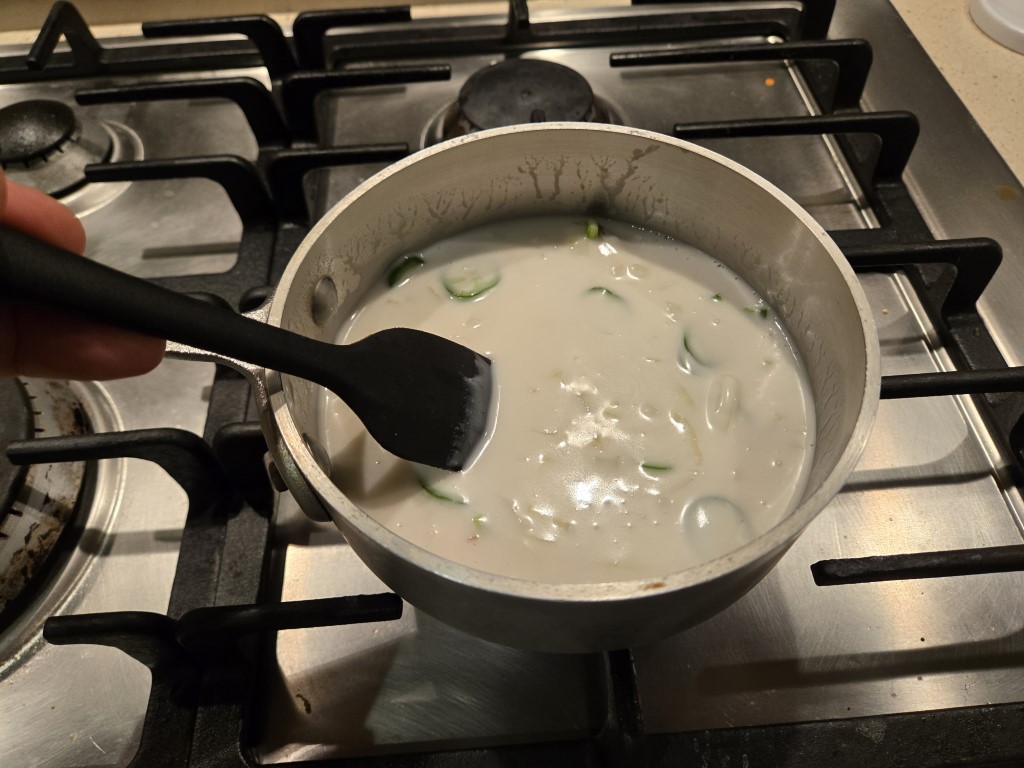
First you make a sauce with coconut cream, onion, chilis, lemon juice, and a little corn starch for thickener.

Coconut sauce

Next, you shake the fish in a container with a coating made of flour, salt, and white pepper. Barramundi would probably be the most common fish, but the store had black cod on sale, so black cod it was. Plus, black cod is delicious.

Fish ready to be dusted
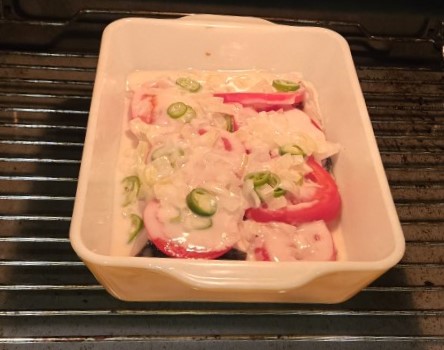
The fish gets lightly browned in oil, and then baked in the sauce with a layer of tomato slices on top.  I definitely think we’ve probably wandered a bit from traditional Marshallese food here, but here it is.

Fish baking

While the fish bakes, we had a go at two more dishes, a pumpkin rice porridge, and chuck chuck.

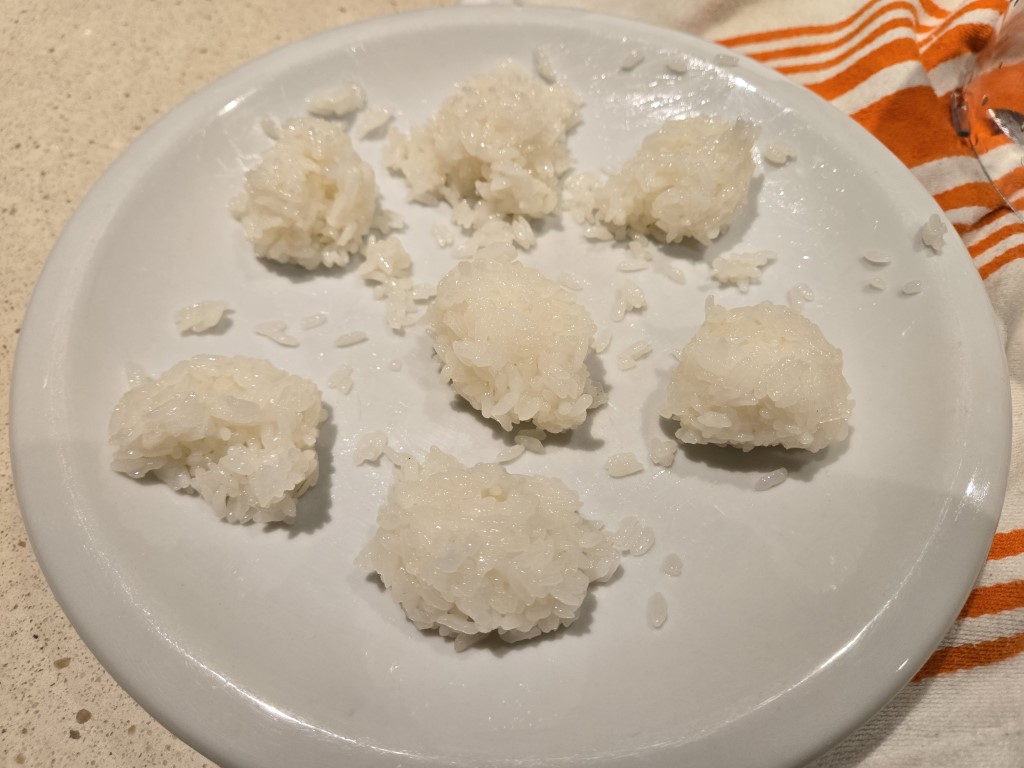
Chuck chuck is simplicity itself: make some sticky rice, roll it into balls with a little sugar and salt, roll said balls in coconut.  One problem – our sticky rice, for once, turned out not at all sticky, so we ended up with rice piles, rather than balls.

Rice "balls"

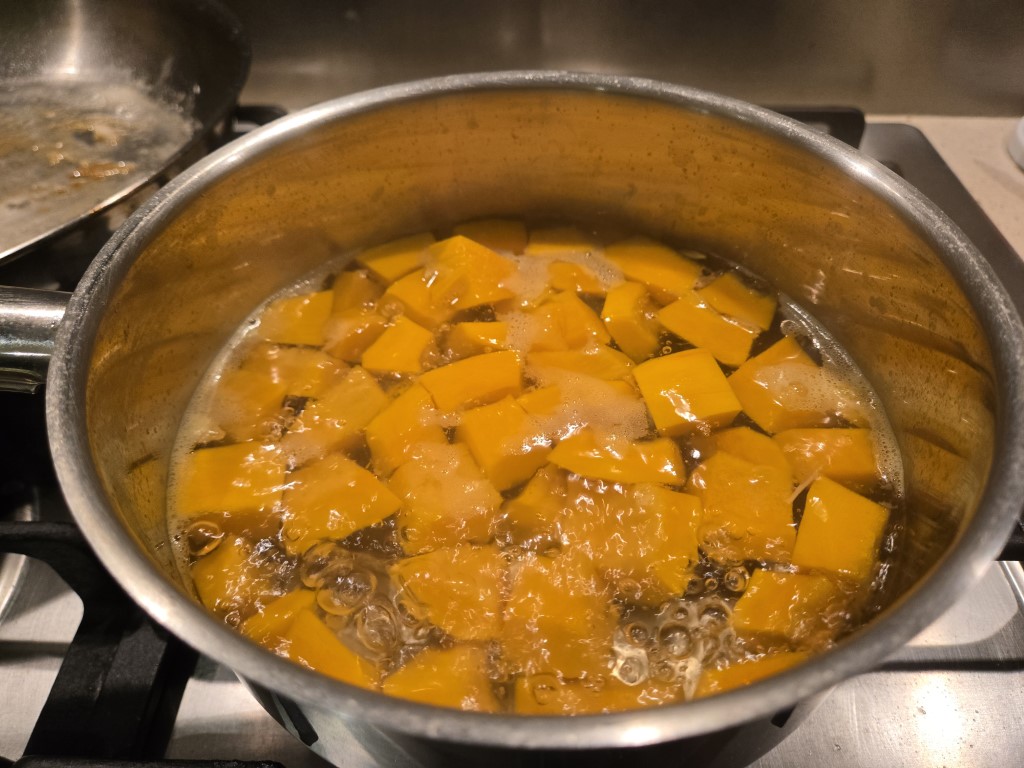
The pumpkin rice dish had recipes that were more vibes than anything else – “Boil the pumpkin until tender, add rice, cook until done, add coconut milk, and cook until absorbed.”  But since all the sources agreed that a) these were, in fact, the steps in the process and b) sweating the details was likely not critical, we went with it.

Pumpkin:
Pumpkin cooking

Pumpkin + rice:
[photo missing]

Pumpkin + rice + coconut milk:

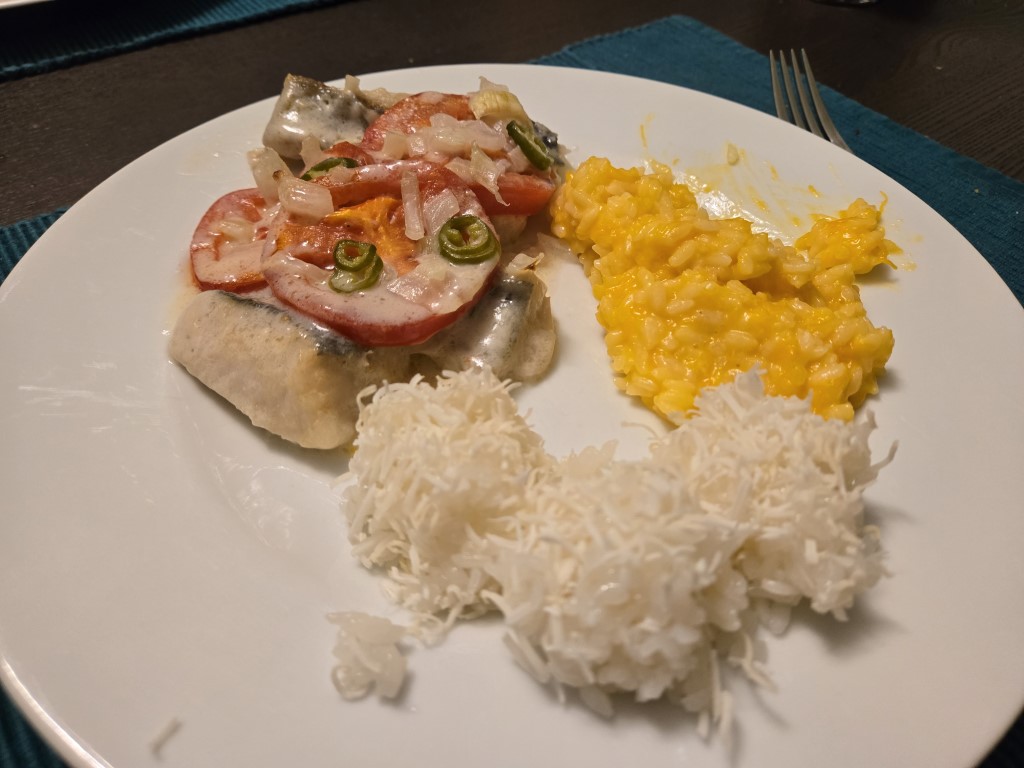
Well, we didn’t take a photo specifically of that step either, so here’s the whole meal on a plate.

Isn’t that yellow color pretty?  It’s entirely from the pumpkin.

For all the various hiccups, this meal goes hard. The rice, er, piles may not have ended up as finger food, but the sweet and salty flavor with the coconut was excellent.  May have to try this one again as a weeknight side.

The pumpkin rice porridge was hearty and delicious.

And finally the fish.  My heavens, the fish.  The ingredients weren’t all that complicated, but as mentioned earlier – black cod is delicious, and the sauce fused the chilis, coconut, and lemon juice together brilliantly.  The tomatoes, in particular, were so tasty when infused with the sauce, that I frankly do not care if they are remotely authentic.

And now, let’s make a macadamia nut pie.  At least, once we recover from the sticker shock.

Macadamia Nuts

I will point out that these two small bags of nuts constituted half the cost of the entire meal.  And black cod ain’t cheap, either.

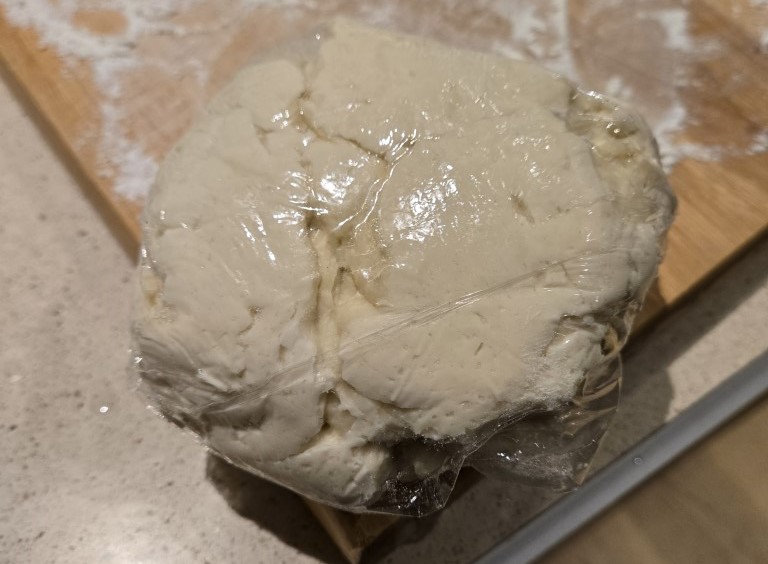
But it’s the national dish, so let’s do this.  First off – scratch pie crust. Pulse dry stuff in blender, then add wet until it coheres. Wrap in plastic, rest in fridge.

Dough resting

We’ve watched lots of Bake Off – how hard can this be?

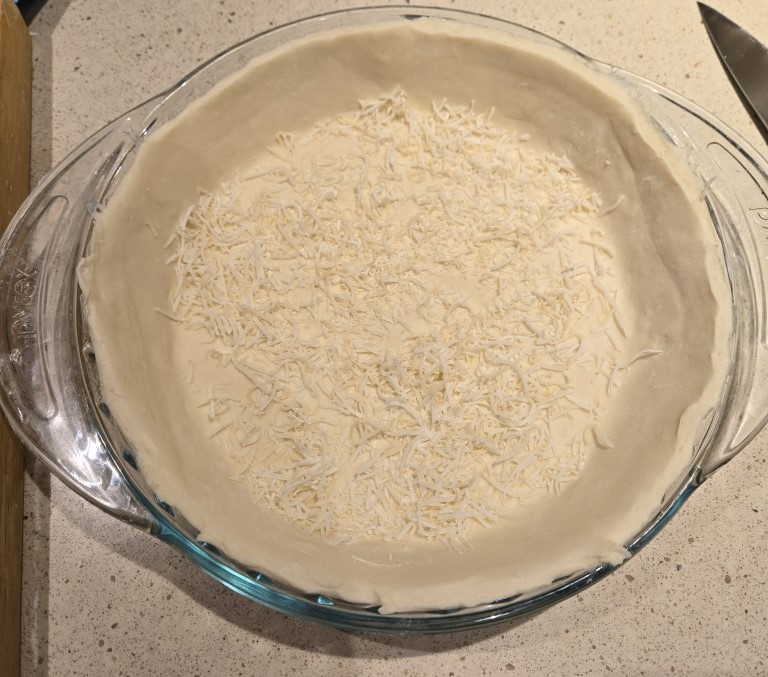
Oh wait. We’ve watched lots of Bake Off – we know EXACTLY how hard this can be.  But the dough rolled out nicely, and rather than a blind bake the recipe we found called for dusting the bottom of the crust with coconut.

Pie crust
The filling is a sugared coating for the nuts, similar to a pecan pie.  It consists of either corn syrup or honey, (the former is likely more common, but for obvious reasons we went with the latter) butter, coconut milk, light brown sugar (which is apparently “golden” sugar here in Canada), and eggs.

You just mix those ingredients together, fold in the nuts, pour that into the shell, and bake.

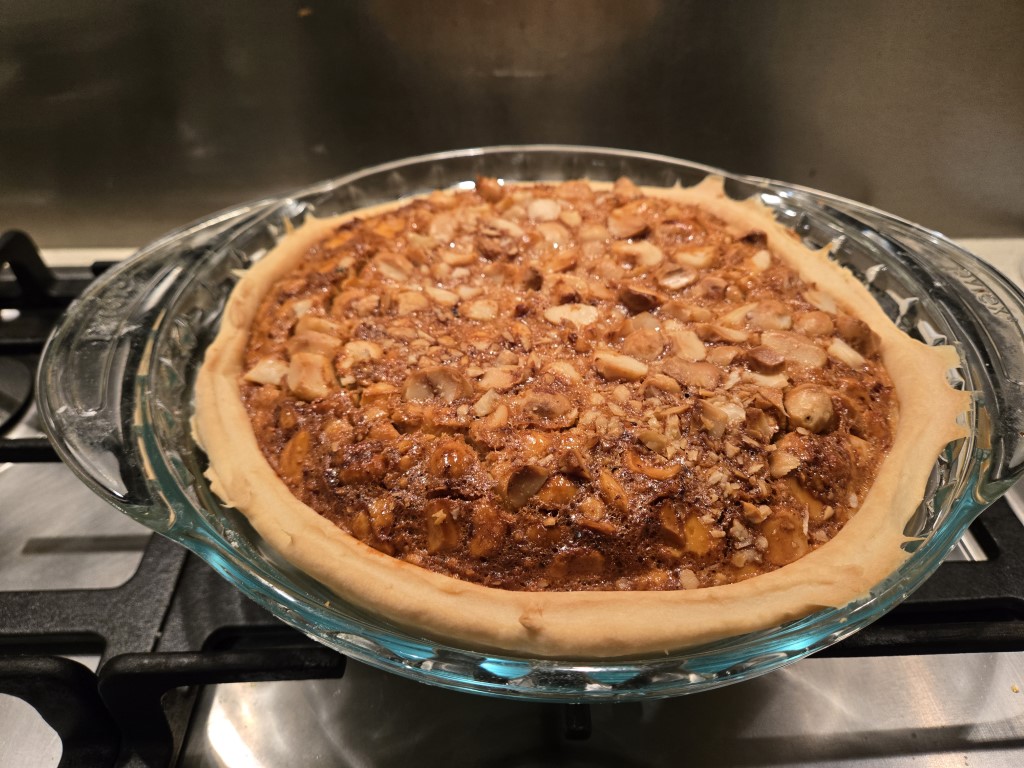
Then 30 seconds later, you realize you left out one bag of your absurdly expensive nuts, yank the thing out of the oven, and toss those in to keep baking.

Honestly, I don’t think that was the issue – rather, I suspect blind baking WOULD have helped the crust be a little less doughy at the end.  Still, you can’t see that in the picture, can you?

Macadamia pie
There was one more minor hiccup before serving – you’re supposed to make a coconut whipped cream to go on top, but I didn’t realize you have to whip the cream BEFORE you add the coconut milk, or it won’t set up.  Lesson learned.

A quick nip over to the grocery store, and it turned out they HAD coconut whipped cream on the shelf, pre made an ready for topping.

Which we did.  And it was good. As was the pie itself.  I mean – macadamia nuts in sugar and honey – how can you go wrong?

The Marshall Islands may have a depressing past and future, but their present seems to be delicious.

Next up – Mauritania!

Recipes:
Coconut Fish
Chuk Chuk
Pumpkin Rice Porridge
Macadamia Nut Pie

International Meals – Malta

Hooray Malta!

Maltesers - Wikipedia

(Checks notes)

OK, I am informed that Maltesers have nothing to do with Malta.  Dammit.

OK, what DOES have to do with Malta?

Well, lets see – the island has at various times been ruled by Phoenicia, Carthage, Greece, Rome, Arabs, Normans, Aragonese, Knights Hospitalier, France, and Britain.  It became independent in 1964, and is so small and densely populated that the entire country is essentially considered one big urban region. Its capital city, Valletta, is the smallest capital in the EU by both population and area.

Also, it’s real pretty:
Valletta - Wikipedia

Like last week, I’ll point you to an Overly Sarcastic video for more information.

But let’s talk food.  The most commonly named option for the national dish of Malta is Stuffat tal-Fenek, a rabbit stew made with red wine.  Well that sounds tasty – lets get us a rabbit.  That’ll be photogenic, right?  Sure would have been, if I had remembered to take a picture BEFORE dismembering it.

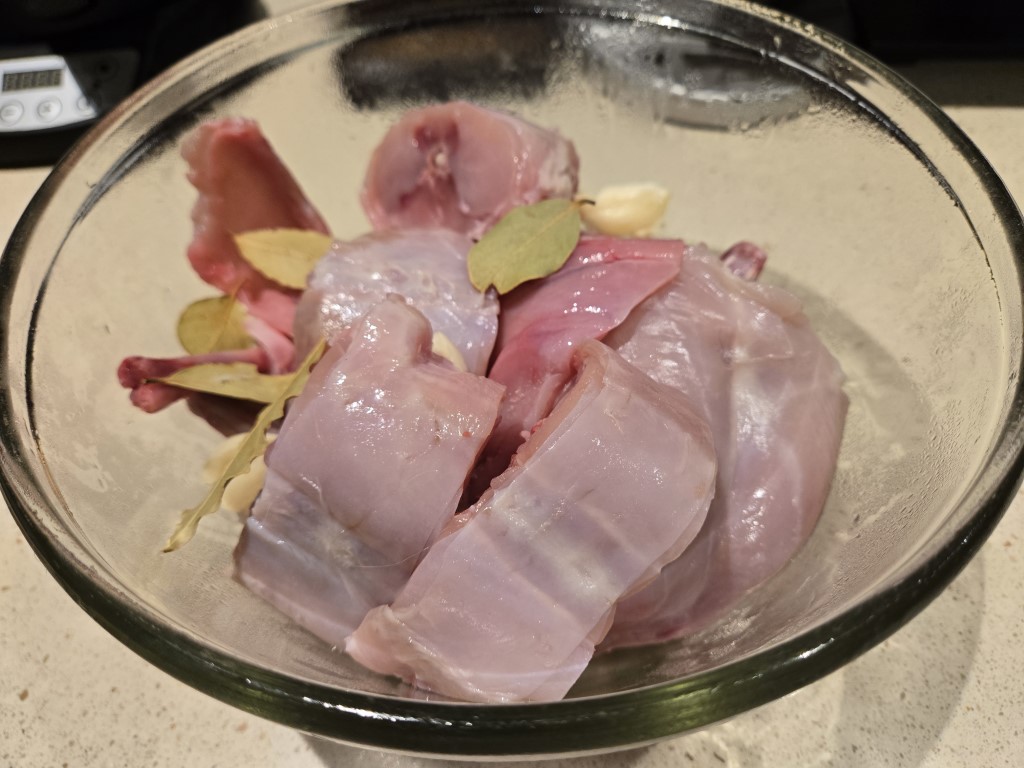
Jointed rabbit

A bowl of rabbit parts with some bay leaves and garlic is less impressive, but trust me, it was a whole rabbit before I got started.  Thanks to Jamie Oliver for the instructional video on the deconstruction. This got marinated for most of the day in “cheap and cheerful” red wine.

But before we get on to dinner, there’s another rabbit bit to talk about:

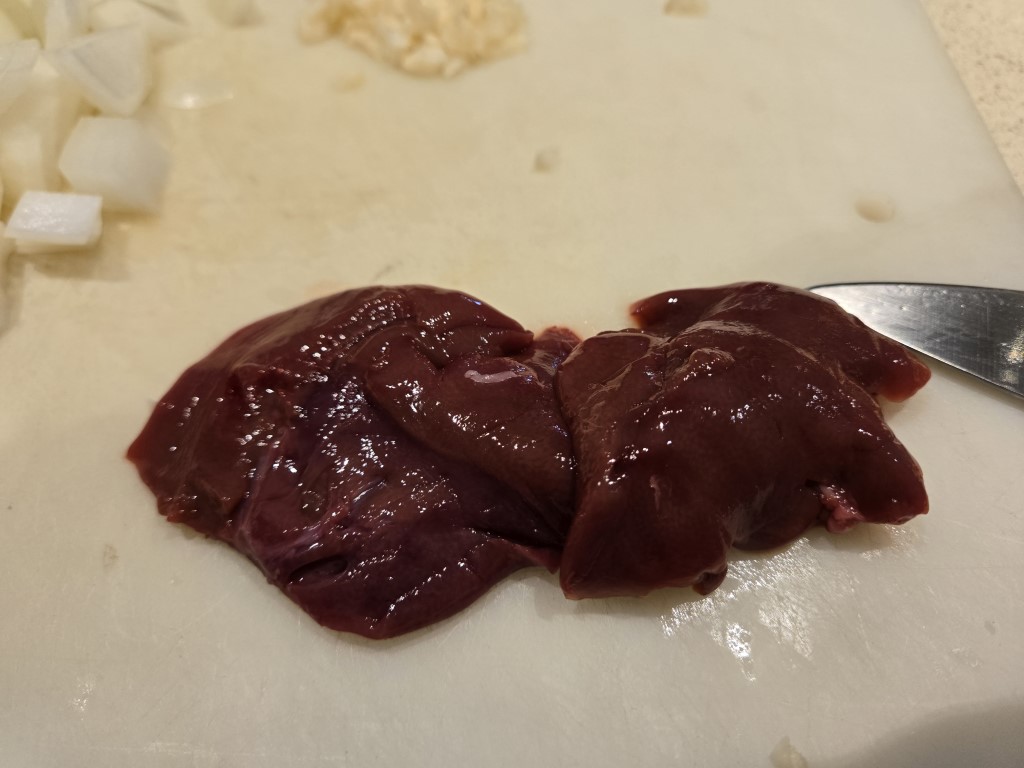
Rabbit Liver

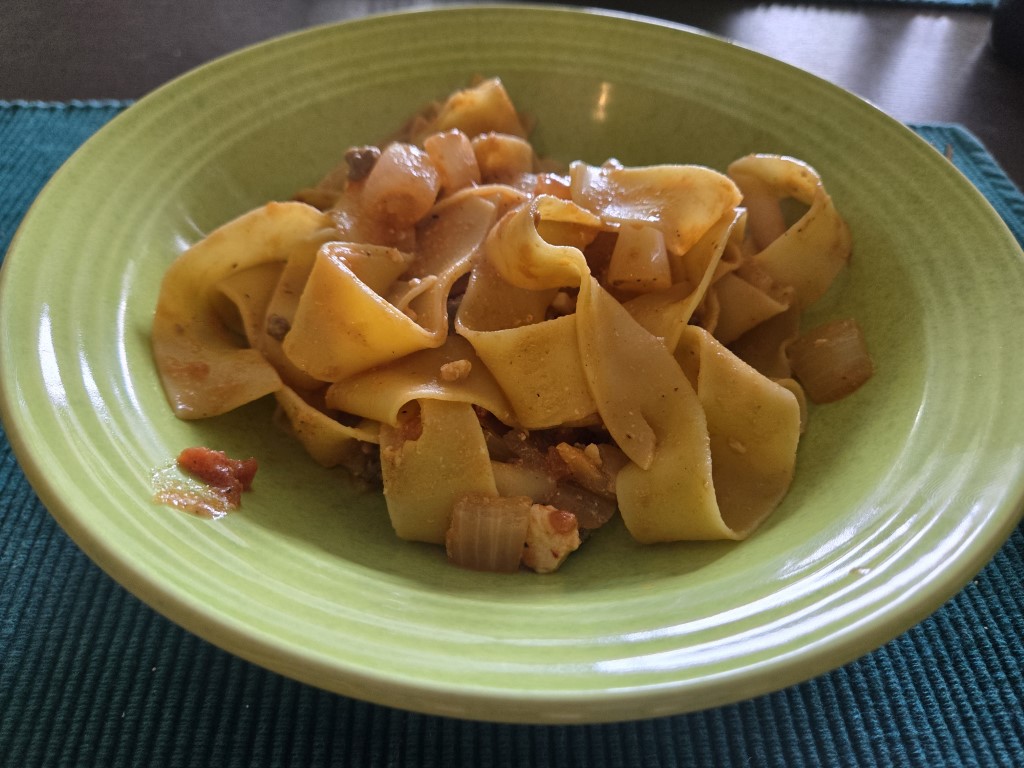
This is the rabbit liver, and it’s considered a delicacy in many quarters.  A traditional thing to do with it is to scoop it out of the stew and use it to make a pasta sauce which is served over noodles as a first course.  That sounded like a LOT to do all at once, so instead I made a pasta sauce with it that we had for lunch.

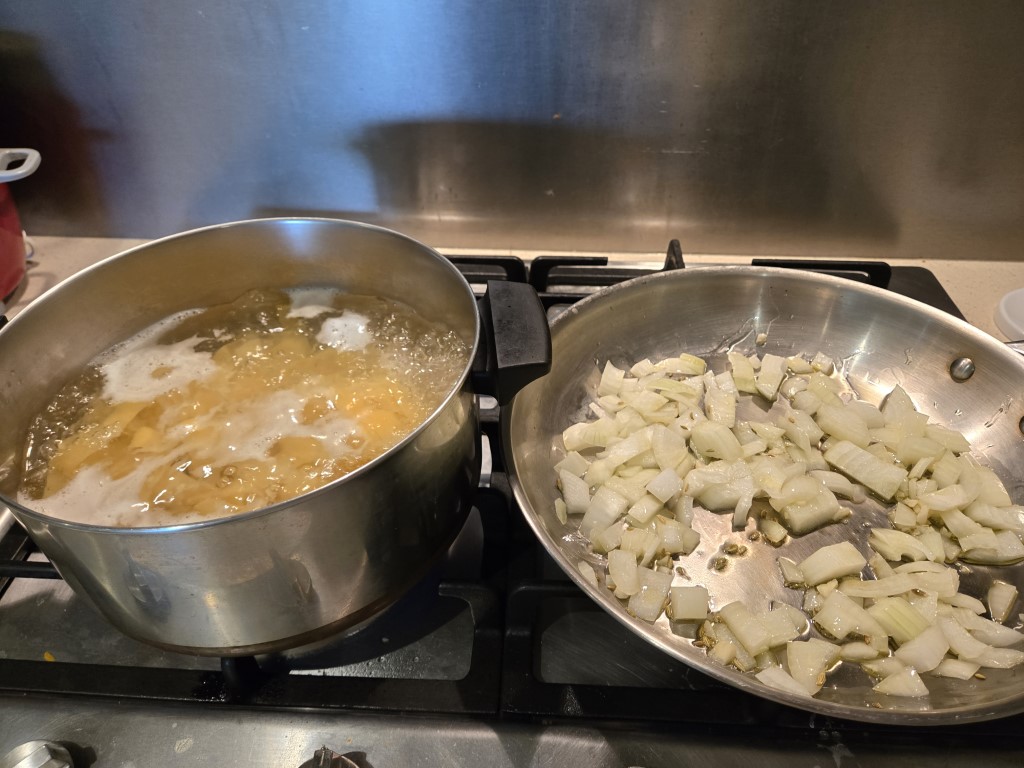
First you sweat some onions while the pasta is boiling:

Onions and pasta

Then you brown the livers, and use this as the base of a tomato pasta sauce.  This sauce calls for a number of ingredients for which we had to make substitutions.  For example, it calls for a “Maltese Cheeslet.”

I am informed that I am no longer allowed to use that as a pet name for Leigh.

So failing that, I just got some feta cheese.

It also calls for a fancy sounding ingredient called “Cucina d’Oro Cooking Sauce.” I can find LOTS of hyperbolic language describing this product online (largely from the manufacturer) but very little about what it is actually intended to DO in a dish. It appears to be powdered buttermilk in a matrix of palm oil and starch.

I just used heavy cream.

There’s also some chili powder and fennel seed in here.  It’s actually quite a delicious sauce when you get done making it.

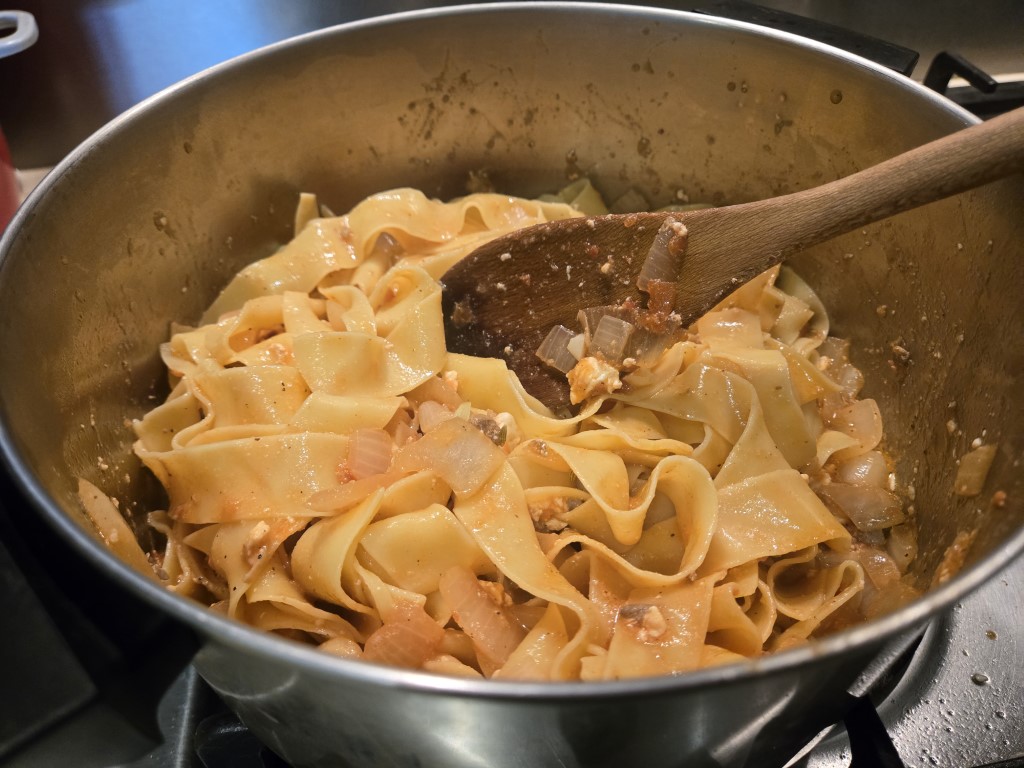
Rabbit liver pasta sauce.

And that was lunch.

Rabbit Liver Pasta

Moving on to dinner, the first step is to take the rabbit out of the marinade and sear it on all sides.

Rabbit seearing

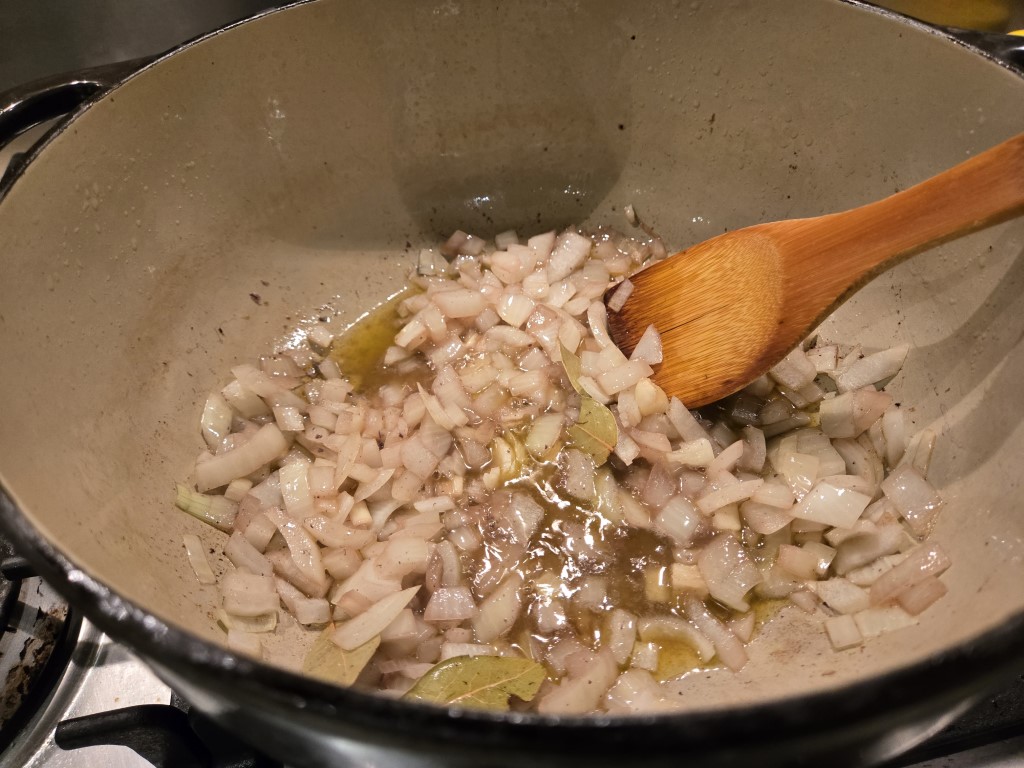
That accomplished you then, (what else?) sweat an onion with some garlic and bay leaves.

Onions sweating

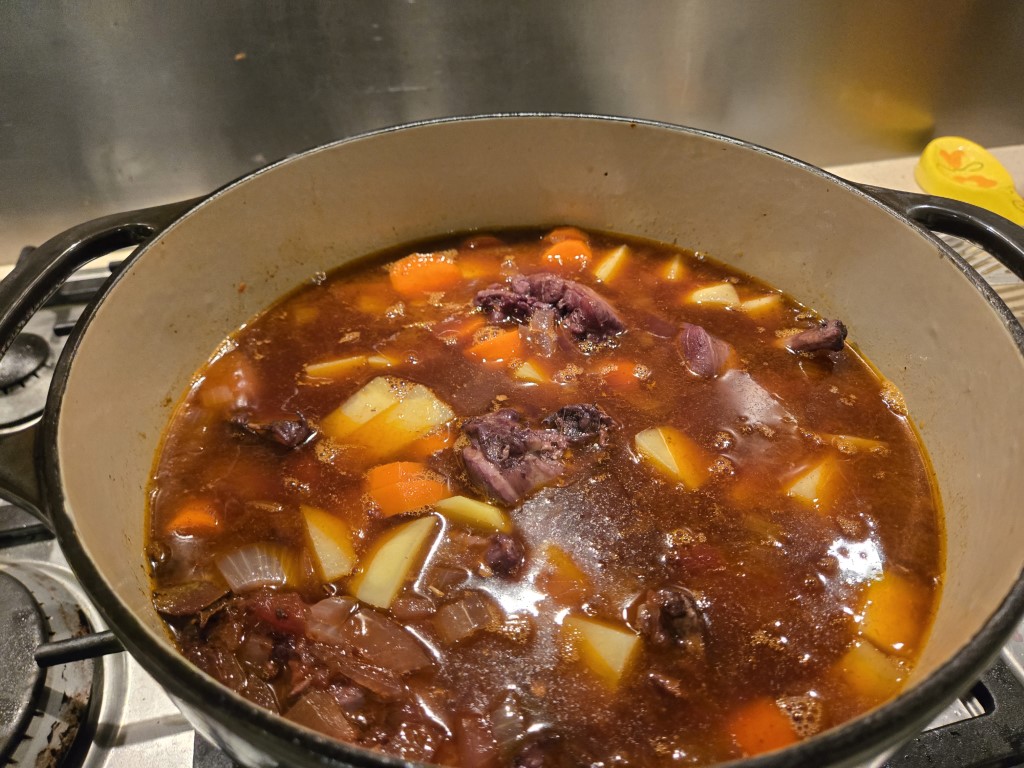
This being a stew, the cooking process from this point forward is “put stuff in the pot, cook it for a while, put more stuff in the pot.”  That included the marinade (which, recall, is basically just red wine), carrots, potatoes, tomatoes, more bay leaves, and salt and pepper.  Then it just… stews for a while.

Rabbit stew

Despite the fact that this stew CONTAINS potatoes, the suggested side dish for the recipe we found was… potatoes.

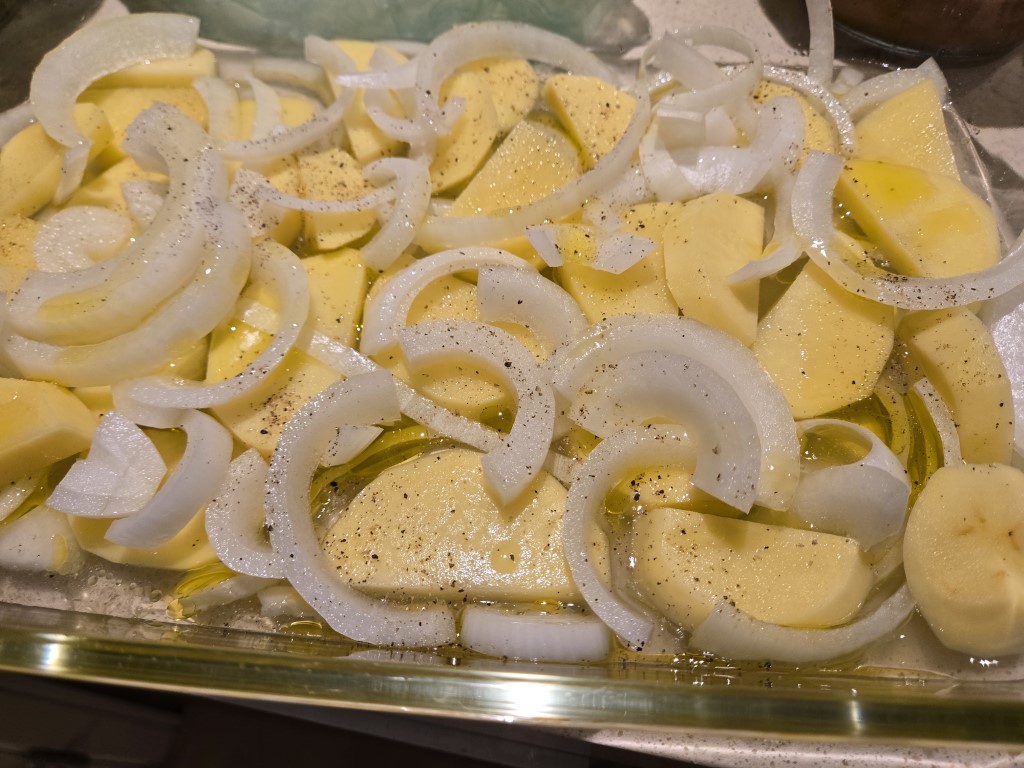
So – slice the potatoes medium thick, layer with onions and olive oil, and cover with foil. (Foil not pictured)

Potatoes ready for cooking.
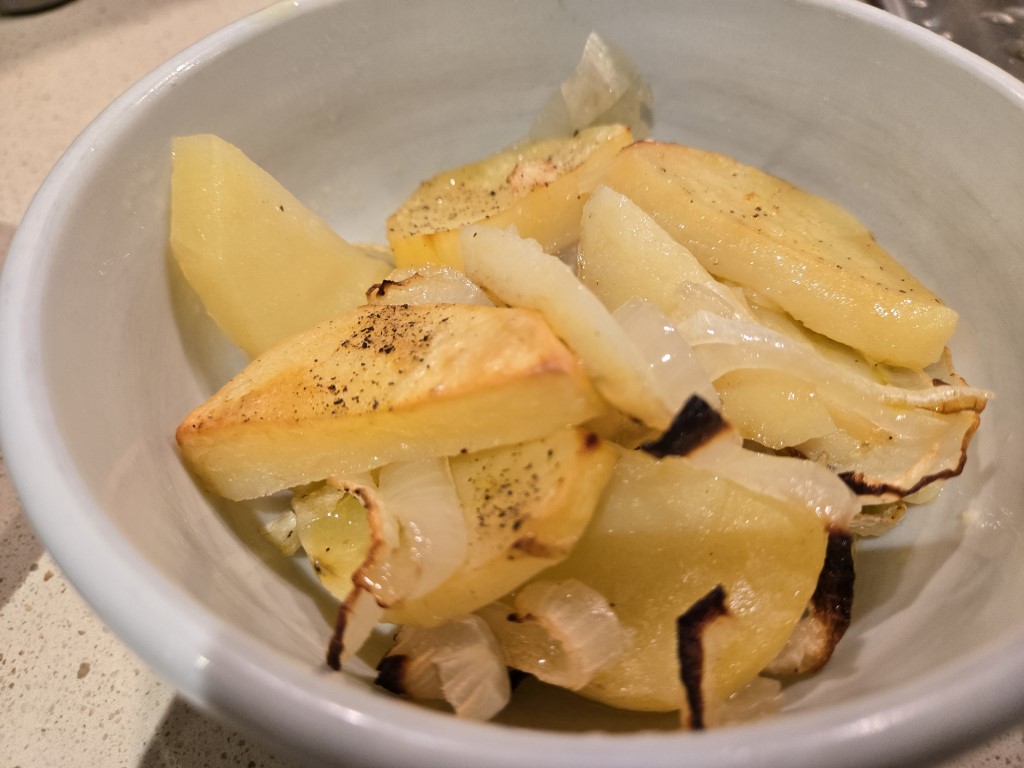
The idea is that you steam them for about 45 minutes in the foil to get them nice and soft, then take the foil off and let them crisp up on top.  The former happened, and they did crisp up some but we were hungry and the stew was done, so we popped them out when they looked like this.

Maltese potatoes

They were pretty good, but for leftovers I’m going to add some cheese.

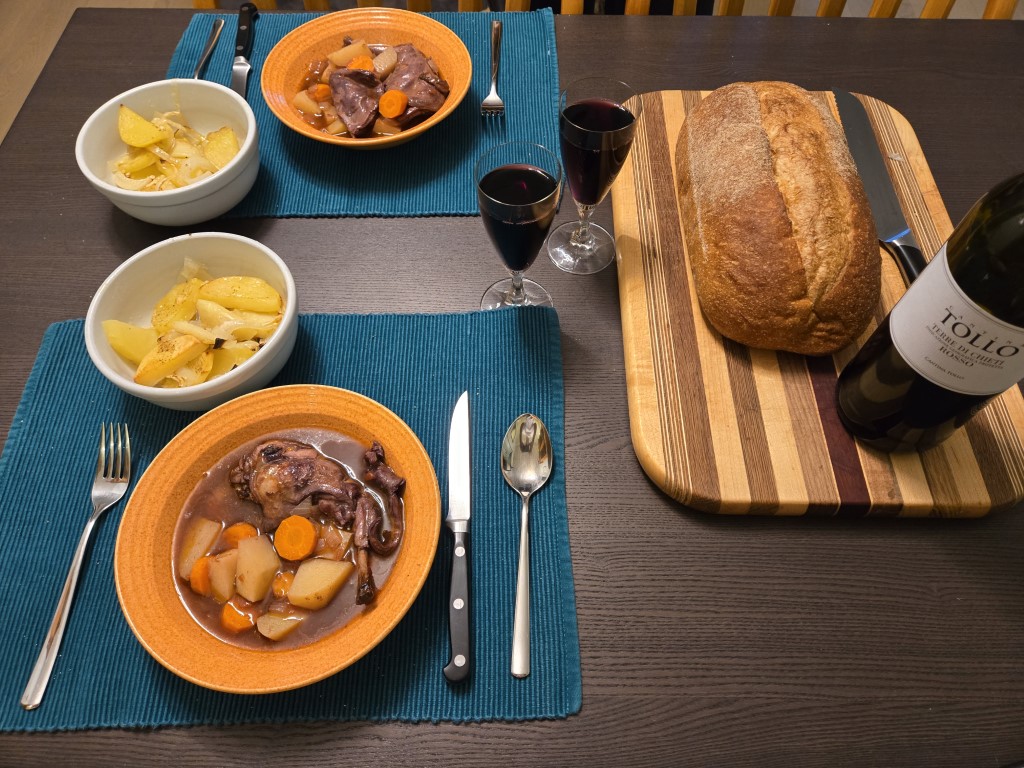
And here’s the final spread:

Maltese meal
Not bad, right?  The rabbit was nicely cooked without being tough, and the stew was quite flavourful.  That flavour being basically “red wine,” but we LIKE red wine.  The potatoes on the side had quite a different texture than the potatoes in the stew, so they didn’t feel redundant.

And it was good!  The rabbit was a bit pricey, but we got a TON of leftovers out of this meal, so no worries there.
Next up – The Marshall Islands.

Recipes:
Stuffat tal-Fenek (Maltese Rabbit Stew)
Patata fil-fom (Maltese style potaotes)
Rabbit Liver Pappardelle

International Meals – Mali

I feel a little bad about this one.

There’s a dish that’s mentioned on a lot of sites as the national dish of Mali, which is a stew called Tiguadege Na.  I found a recipe with a reasonably promising looking source.

But – I feel like we just didn’t quite DO enough.

Also, it’s remarkably similar to the dishes we made for Chad, the Gambia, and the Central African Republic, so I wonder if we should have tried harder to find something a bit more unique?  There’s lots of reasons why the African countries are frequently challenging, and also somewhat problematic, which I talk about a bit on the CAR page.

So anyway, Mali.  Fascinating country with a lot of really interesting history.  Timbuktu is in Mali.  You can learn more about that in this video. 

All that said, here’s the dish.

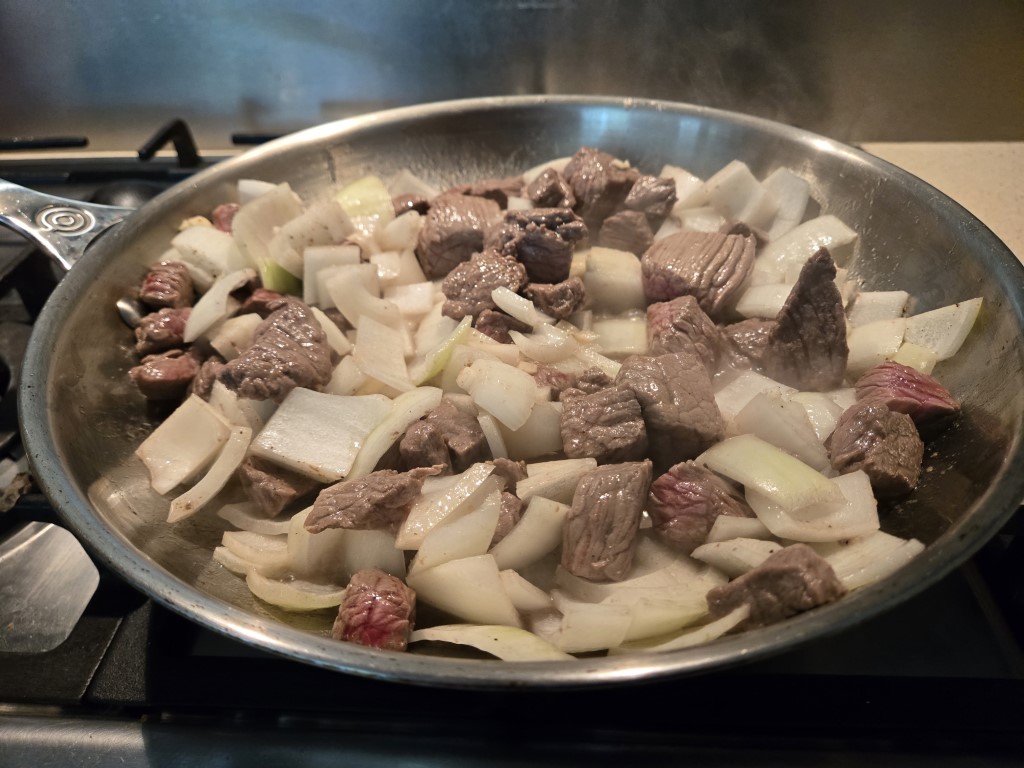
Brown some meat, then add onions and garlic until they’ve softened.  Our local Save On Foods had some wildly varying sizes of stew meat on offer, but since we were going to braise it forever, it didn’t really matter.

Meat and aromatics

Add tomatoes, broth, peanut butter, and Herbes de Province. I’m assuming the latter is due to the fact that France was the colonial aggressor in this part of Africa.

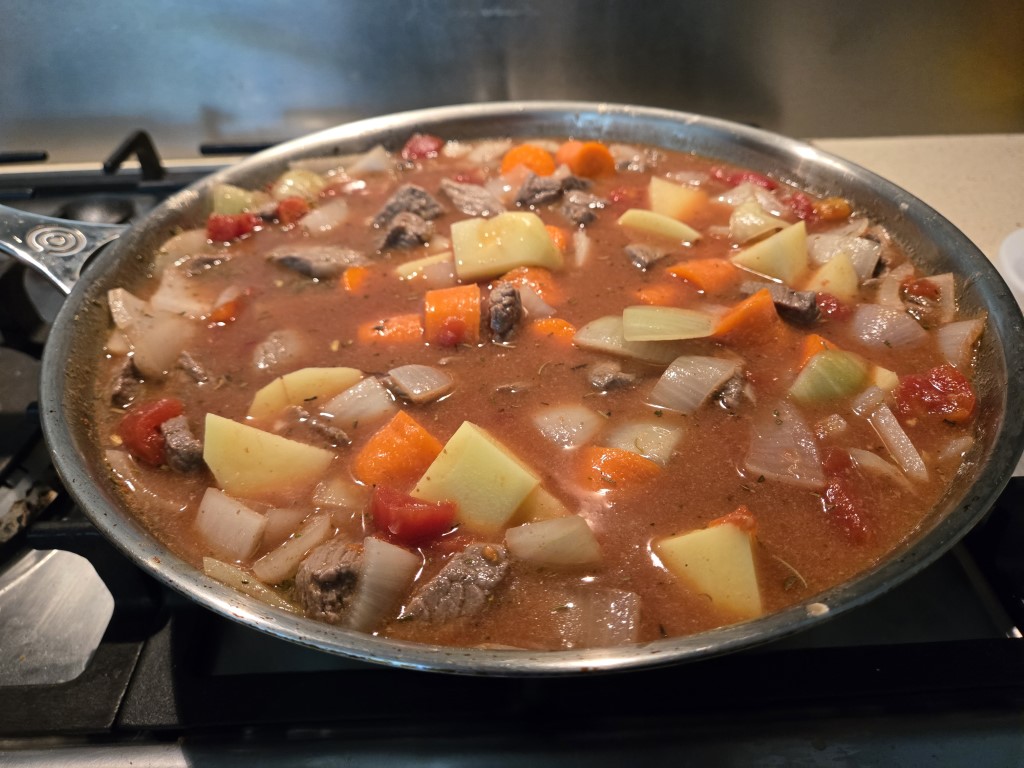
Finally, toss in carrots and potatoes and stew forever.

Stew in progress

It ended up being tasty, but much more watery than in the recipe photos.  If you try this one, I might consider doubling the peanut butter at least.

Peanut Stew

And that’s Mali.  They can’t all be huge production numbers, I suppose.  Next up, Malta!

Recipe:
Tiguadege Na

International Meals – Maldives

It’s been a few months since we did one of these meals.  Can’t imagine why.

Oh wait – see the preceding 24 entries on this blog for the reason why.

But we’re back, and it’s time to get back on our nonsense.  Heretofore unfamiliar specialty ingredient?

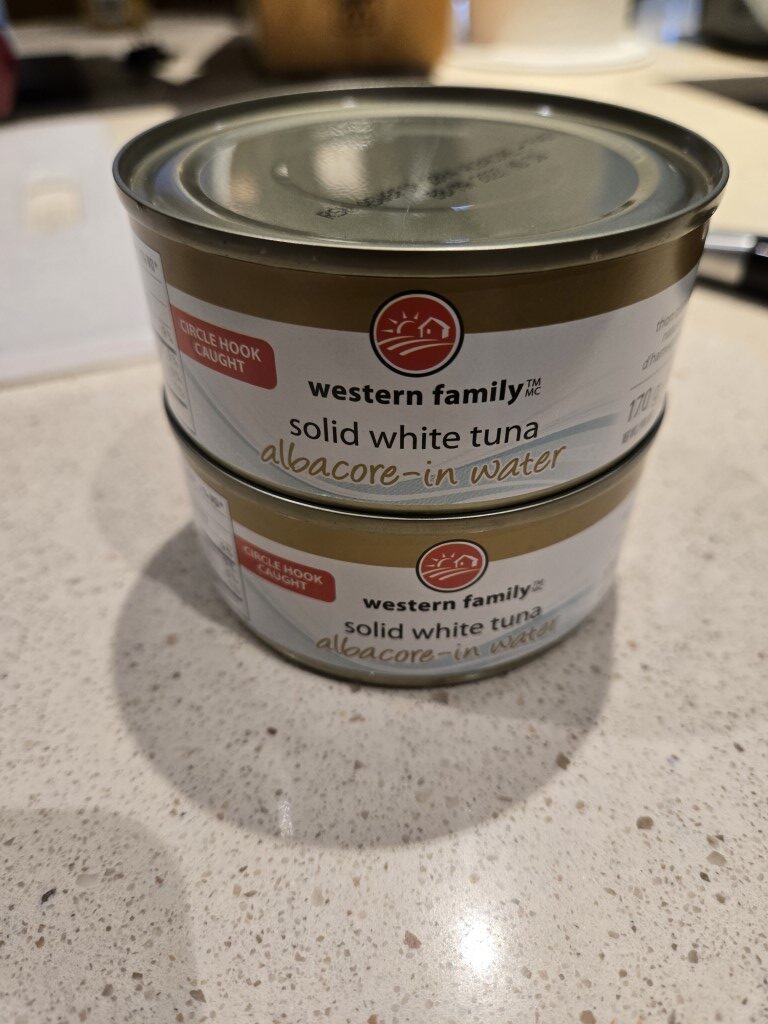
Canned tuna
Chec… oh no wait, that’s tuna.  OK, as I said – unknown specialty ingredient?

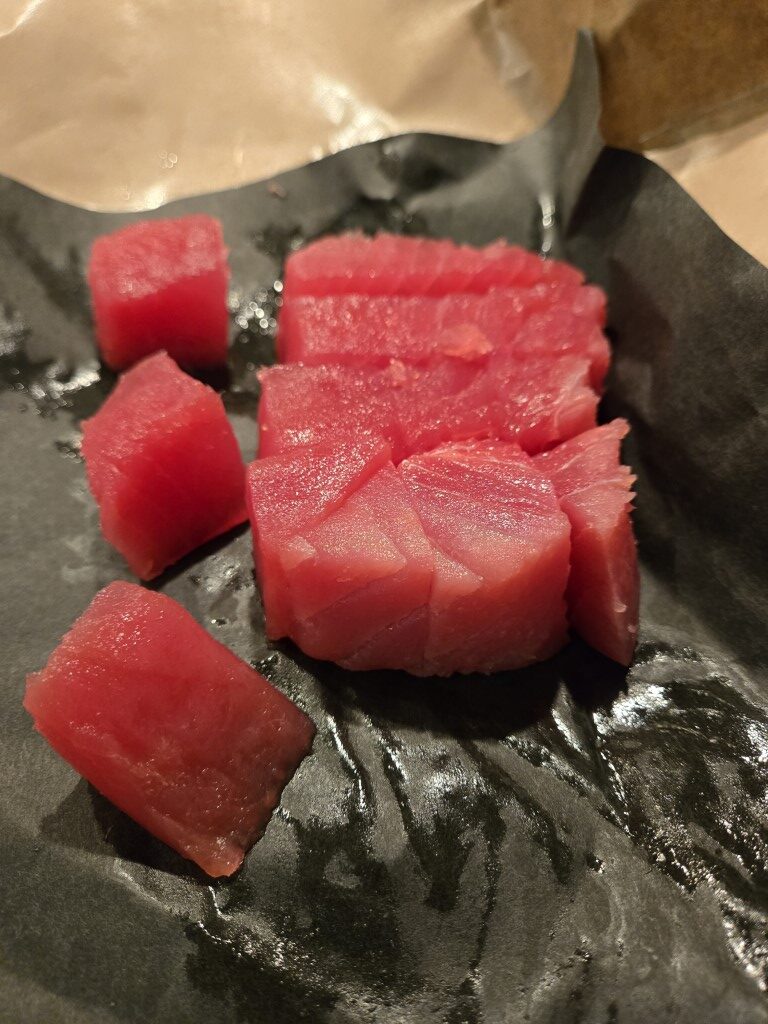
Fresh tuna
Chec… no, hang on, also tuna. One more try.

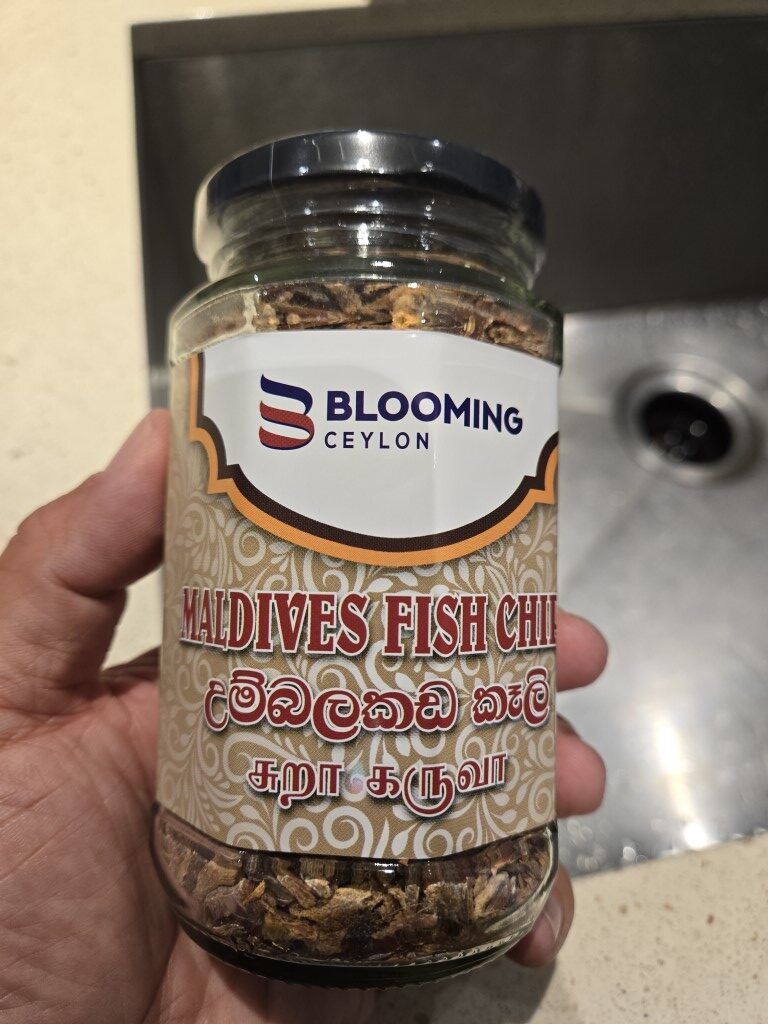
Dried tuna flakes

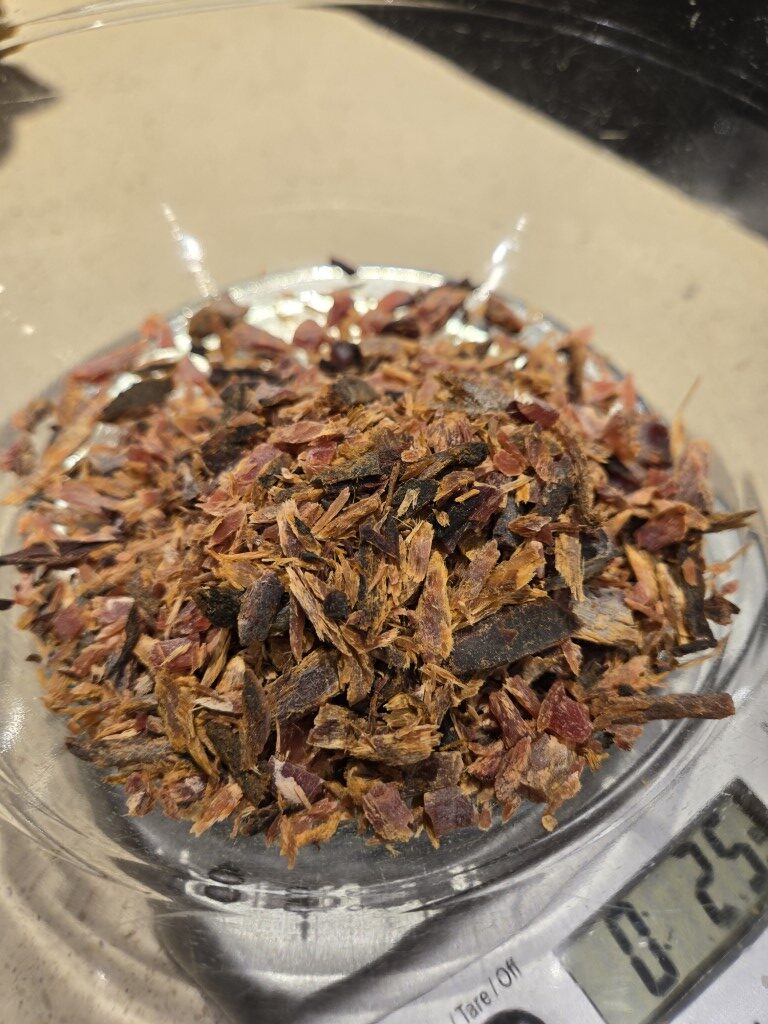
OK, this is ALSO tuna, but it is, nonetheless, a heretofore unfamiliar specialty ingredient.  Specifically, it’s dried tuna flakes.

Dried tuna

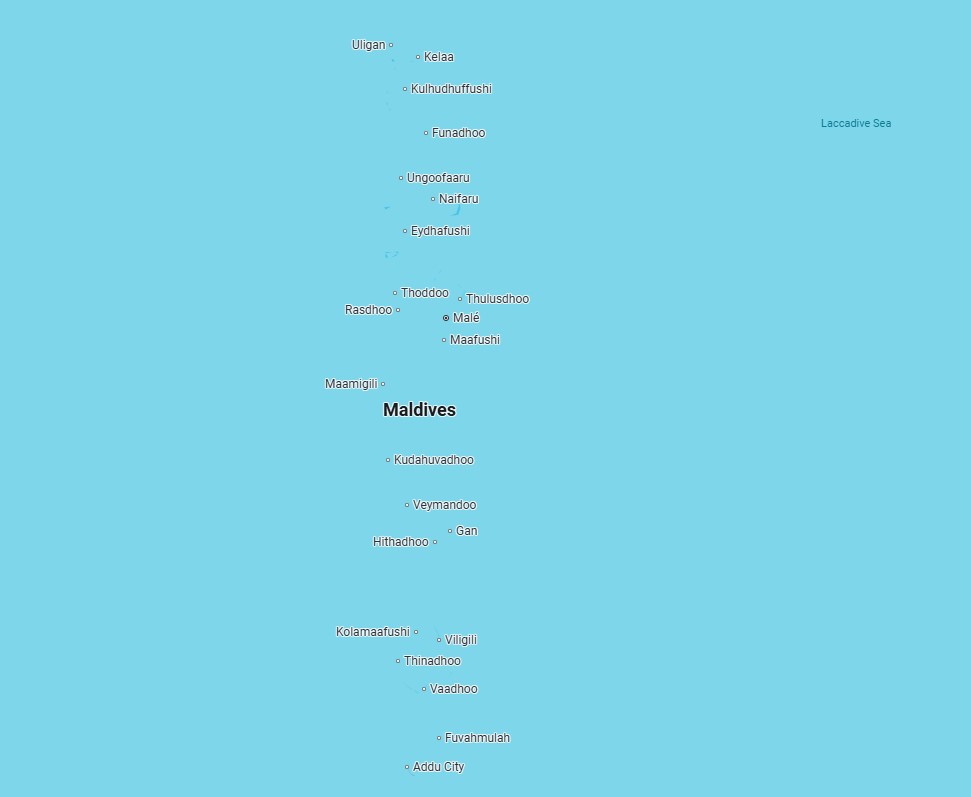
I’m sensing a theme here – where IS this country?

Maldives from Google maps.

Ah.  That explains all the tuna.

The Maldives have a population of half a million people, concentrated on a surface area the size of Fresno, making it the second most densely populated country in Asia. (after Singapore.) On the other hand, that surface area is spread out over a region the size of Maine, making it one of the most spatially dispersed countries in the world.  So that’s neat.

Also, they apparently eat a lot of tuna, because the two plausible dishes I could find as the most iconic are (checks notes) a tuna soup, and a cold tuna salad.

Good thing we LIKE tuna, then, innit?

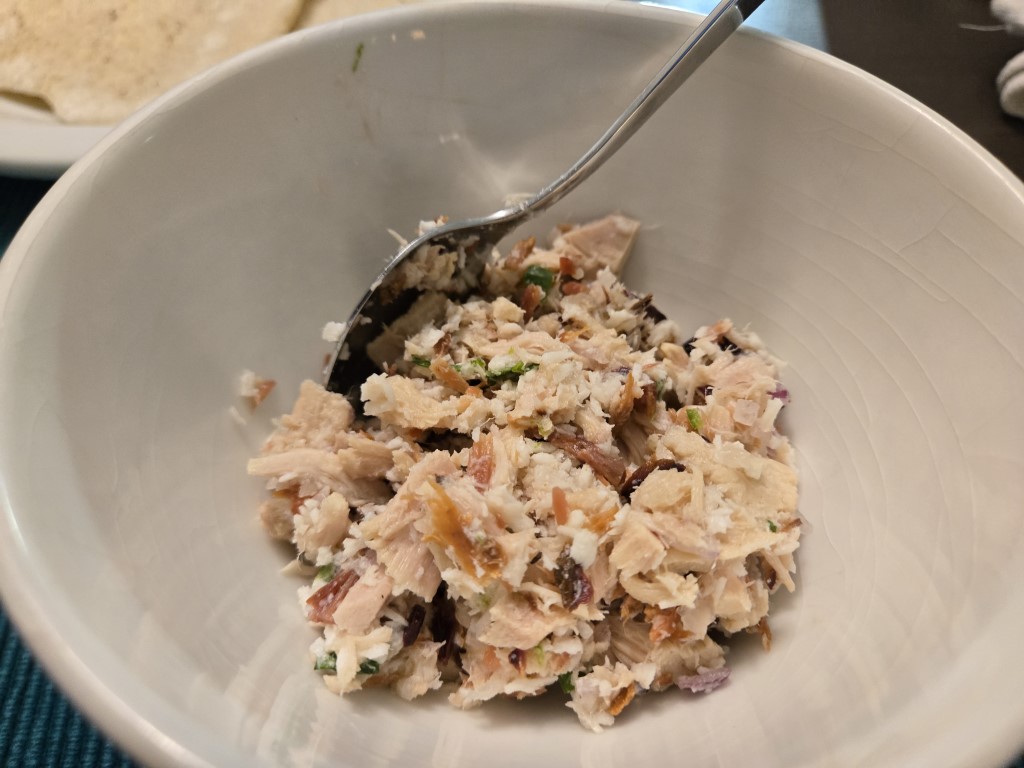
OK, let’s make the salad, which is called Mas Huni. It is frequently eaten as a breakfast dish. You can find a bunch of different versions of it online, but some of them are so simple it didn’t feel like we’d be putting in sufficient effort. This one at least meant I had to get in the car to go get the dried tuna flakes.  (While I was at it, I also got some South Asian spices I’d been meaning to pick up, and then I went across the street and got donuts.)

And even for this, maximally complicated version, the process is “put everything in a bowl and mix it up.”  Everything in this case being canned tuna, tuna flakes, coconut, grated onion, green chilis, coconut milk, and some cilantro.

Mas Huni

Bam. Done.  What next?

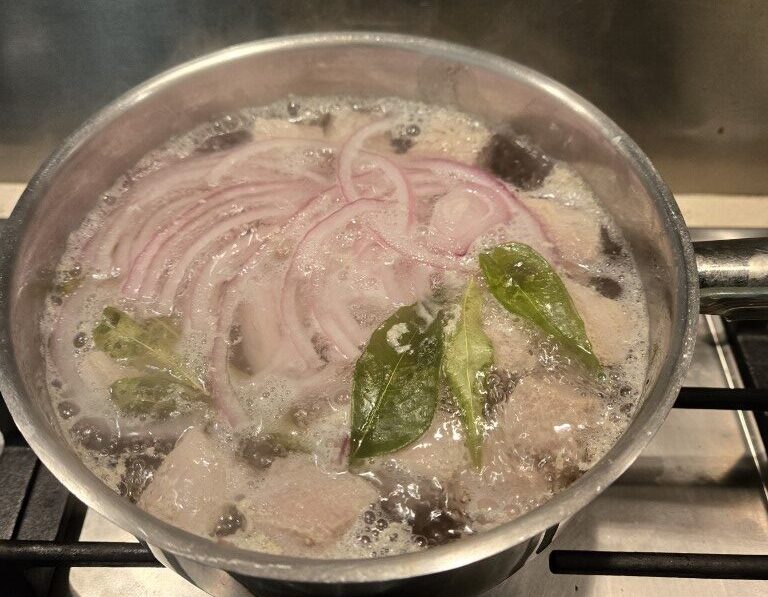
The tuna soup is called Garudhiya, and there’s basically no difference in the recipes I found online.  First you poach the tuna for a bit, then you toss in some onions and curry leaves and poach it some more.

Garudhiya cooking

Salt to taste.  Is that all?

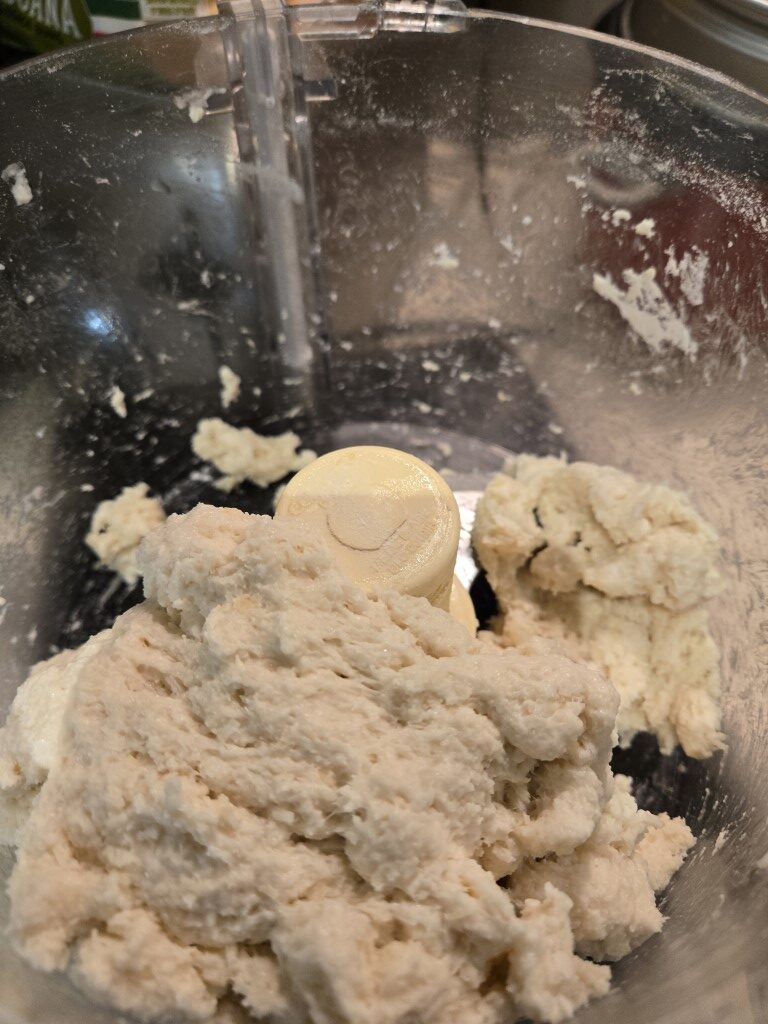
Well, we did one more thing, and it was the most time-consuming, but only because it’s a flatbread, so you have to cook them one at a time.  To make these Huni Roshi, you make a simple dough of flour, water, coconut milk, and shredded coconut, and then you just cook them in a pan.

Huni roshi dough

Like any batch cooking item (looking at you, pancakes) the first couple didn’t turn out so great, but they got better as we went along.  And that was it.  Here’s the full spread.

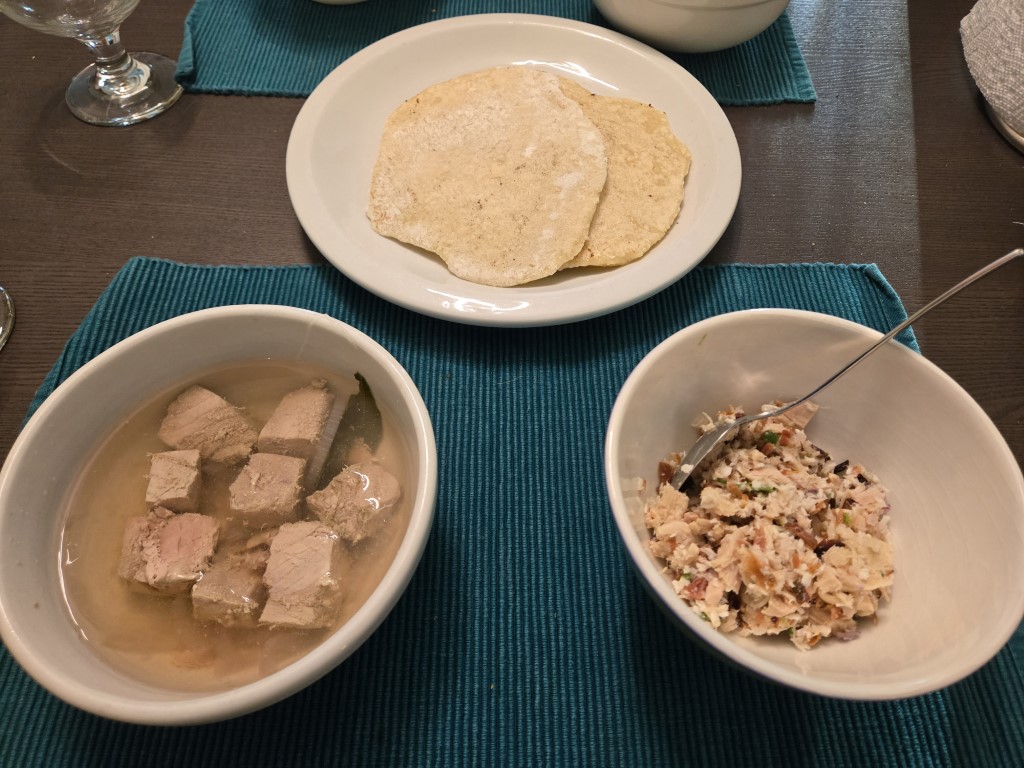
Maldives meal
Tuna, tuna, and bread for eating tuna.  And you know what?  It was pretty good.  The tuna soup was subtle, but that meant the tuna and curry leaves got to speak for themselves.  And the Mas Huni was extremely flavorful – the lime juice, coconut, and chilis really perked up the tuna to make something really tasty.  The leftovers got polished off for lunch on the next two days, which says something.

And that’s the Maldives!  They were tuna-riffic.

Next up, Mali!

Recipes:
Mas Huni and Huni Roshi
Garudhiya